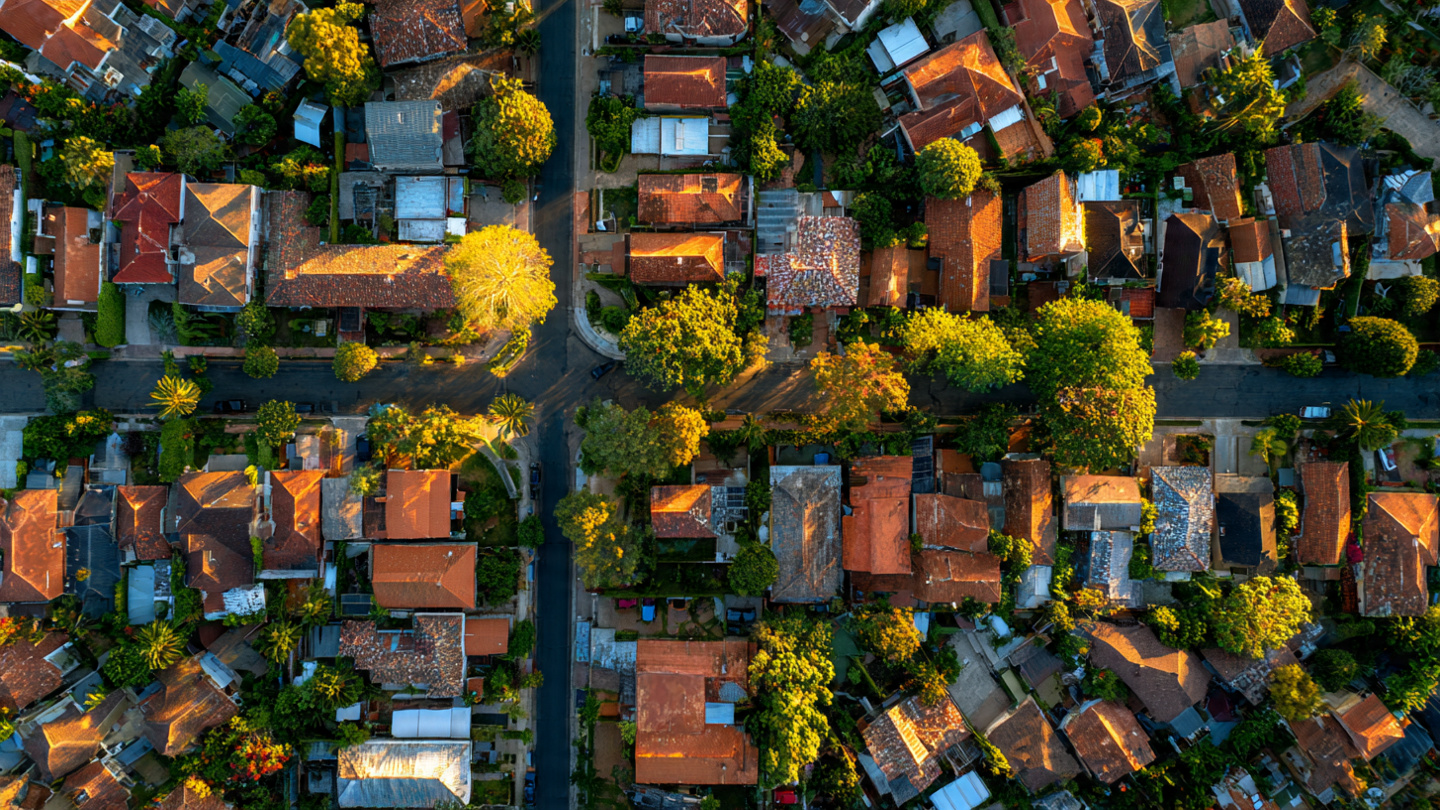
Linda Bennett has lived in her Santa Ana, California home since 1993. Last year she opened an envelope from State Farm and found a $28,290 ultimatum: replace your roof or lose coverage. No inspector had visited the property, nobody climbed on the roof, and nobody knocked on the door. As Bennett told reporters, "My initial thought was it's a mistake. They've got the wrong house because there's nothing wrong with my roof." State Farm later confirmed it may use "a mix of tools, including aerial images from manned fixed-wing aircraft or satellites" when reviewing properties.
Bennett's experience is not unusual anymore, and that is precisely the point. It is the system working exactly as designed.
What the Machines See
CAPE Analytics, which claims a majority of US property and casualty carriers as clients, converts high-resolution aerial imagery into structured underwriting data in two seconds. Their computer vision models detect roof condition, roof complexity, yard debris, pool condition, trampolines, and "liability concerns," producing a Roof Condition Rating that functions as an automated thumbs-up or thumbs-down before a human underwriter reviews the file. Nearmap embedded its AI-enhanced roof condition scores directly into Zurich North America's underwriting platform in October 2025, giving underwriters instant access to deferred-maintenance indicators that the company says "even on-site physical inspections could not deliver."
That last claim deserves a pause. A bold one. Zurich is saying a satellite photograph analyzed by a neural network catches things a human standing on the roof would miss. Whether that is aspirational marketing or verified capability, the fact that a major insurer says it publicly tells you where the industry's confidence sits.
The Numbers Behind the Nonrenewal Letter
In May 2026, The Wall Street Journal analyzed claims data from the five largest home insurers and found that more than 44% of resolved claims resulted in zero payout, up from 36% a decade earlier. State Farm, Allstate, Liberty Mutual, USAA, and Farmers are all getting stricter on what they pay, and the aerial imagery pipeline is one of the mechanisms enabling that shift.
Verisk's 2026 Roof Report puts hard numbers on the scale of the problem. Roof replacement costs have climbed 33% over the period studied, and roofing materials rose 1.48% nationally in 2025 while labor costs climbed just 0.79%, a gap that compounds dramatically in states like Nevada, where material costs surged 10.37% in a single year while New Hampshire saw a 15.80% decline, creating a patchwork of cost pressure that makes national averages nearly meaningless for any individual homeowner trying to budget a replacement. In the Northeast, 18% of roofs are 31 years old or older. In the South, severe weather and rapid housing growth drive faster turnover, with 28% of roofs less than five years old, but that just means more claims in the pipeline.
Ryan D'Amario, Verisk's senior vice president of property product management, put it bluntly: "When more than a third of the housing stock falls into this category, roof condition becomes a core underwriting signal."
Translation: one data layer from aerial AI now determines pricing for tens of millions of homes. Just one.
When the Wrong House Gets the Letter
Alaina Callahan lives outside Houston. In March 2025, her insurer told her she needed a new roof or face nonrenewal. Her roof was five years old and in good condition. She asked to see the aerial photos and never received them. As she told NPR: "I had no recourse as a homeowner. None whatsoever."
Since 2023, at least a dozen homeowners have asked the Texas Department of Insurance to investigate aerial-photo-based decisions. In one documented case, an insurer acted on imagery of the wrong property entirely. Five insurers operating in Texas confirmed to NPR that they use third-party aerial photos, and some acknowledged using AI to analyze the images. When pressed for details on accuracy and homeowner appeal rights, two responded with general statements that confirmed the practice while revealing nothing about safeguards or error rates. The other three said nothing.
Doug Heller, director of insurance at the Consumer Federation of America, is direct about what is missing: "Using images that were gathered without consumer awareness, or let alone consent, is really problematic."
Regulators Are Paying Attention, Slowly
Twelve states launched the NAIC AI Systems Evaluation Tool pilot in March 2026, the first structured attempt by state insurance regulators to understand how carriers deploy AI in underwriting and claims. California, Colorado, Connecticut, Florida, and eight others are participating through September 2026, with a nationwide rollout targeted for November. The tool is a questionnaire, not an enforcement mechanism.
A Troutman Pepper Locke analysis of state regulatory guidance found a consistent theme: aerial imagery should be "one input among several, not the sole basis for cancellations, nonrenewals, declinations or significant rating changes." Regulators flagged concerns about images obscured by trees, misaligned to the wrong parcel, or simply outdated. Some are drawing a distinction between structural risk and cosmetic issues, arguing that moss on shingles is not the same as a failing roof deck.
None of these regulatory moves prohibit the practice. Not one. They ask, politely, that insurers not rely on it blindly. The distance between that aspiration and what is happening on the ground remains wide.
What This Means If You Are Building a Home
Roof material selection has become an insurance variable, not just a construction one. When the first aerial photo of your finished home hits an AI scoring pipeline, the computer vision model will evaluate the roofing material, the installation quality visible from above, the gutter condition, the defensible space around the structure, and a half-dozen other factors that collectively determine the Roof Condition Rating your buyer inherits.
Class 4 impact-resistant shingles, rated under UL 2218 as the highest tier, offer a concrete path to lower premiums. State Farm provides discounts as high as 33% in certain states. Most carriers offer between 10% and 25% off for verified Class 4 installations. The upfront cost premium is real but finite: Class 4 shingles typically run 10% to 20% more than standard architectural shingles.
| Scenario | Class 4 Upcharge | Annual Insurance Savings | Break-Even |
|---|---|---|---|
| $15,000 roof, 15% premium | $2,250 | $343 (at 15% discount on $2,285 avg.) | ~6.6 years |
| $15,000 roof, 15% premium (TX/CO/OK) | $2,250 | $571 (at 25% discount) | ~3.9 years |
| $15,000 roof, 15% premium (high-risk zone) | $2,250 | $754 (at 33% discount) | ~3.0 years |
In hail-prone states, Class 4 break-even drops under four years when you factor in the insurance discount alone. Add the extended lifespan (30 to 35 years versus 20 to 30 for standard shingles) and the wind resistance upgrade (130 mph versus 110 mph), and the total-cost-of-ownership math favors the premium material decisively in any region that sees regular severe weather. A 2026 This Old House survey found 47% of homeowners still install standard asphalt shingles, which means a majority of new roofs are going up with materials that will cost their owners more in insurance over the life of the home than the upgrade would have cost at installation.
One critical detail that falls through the cracks constantly: documentation. Several roofing industry sources report that homeowners who install Class 4 shingles frequently fail to submit proof of the impact rating to their insurer, and the discount is never applied. The insurer does not assume; they require UL 2218 certification from the contractor and sometimes a report from a certified roofing inspector. If your builder specs Class 4, make sure the paperwork follows the shingles.
The Strongest Argument for the Machines
Ann Frohman, a former Nebraska insurance commissioner, offers the case for AI-driven underwriting with uncomfortable honesty. "Policies were being used as a home-maintenance program, paying to replace roofs for even minor damage," she told the WSJ. Frohman is not a distant observer; she herself received nothing on a $6,500 storm-damage claim last year after agreeing to a higher deductible. "It pains me," she said. "But that's the way it's supposed to work."
The argument is structurally sound, if you accept the premise that accuracy is a binary rather than a spectrum. Aerial AI sees every property consistently, does not rush through inspections before lunch, and does not miss the cracked flashing that a ground-level adjuster cannot see from sixty feet below. A system that scores 100 million roofs with identical criteria is, in principle, more equitable than one where renewal depends on which inspector drew your neighborhood that quarter, what mood they were in, and whether they climbed the ladder or eyeballed it from the driveway.
That "if" carries enormous weight. When the technology scores the wrong house, uses outdated imagery, or cannot distinguish a ten-year-old algae stain from structural rot, the consistent application of an error becomes systemic. A human inspector gets one property wrong. An AI model gets every property with similar pixel patterns wrong, at scale, silently, and with the institutional confidence that comes from having run the same algorithm on a hundred million parcels without anyone checking the output against ground truth for the specific property in question.
If You Are Buying a Home
Request a CLUE report (Comprehensive Loss Underwriting Exchange) before closing, which shows the property's claims history baked into every AI scoring model. Ask your insurance agent whether the carrier uses aerial imagery for underwriting, and if so, whether you can review the images and the resulting score before the policy binds.
If the home has a roof older than 15 years, budget for the insurance cost of that roof age, not just the replacement cost. In states where insurers can nonrenew based on aerial assessments, an old roof is not merely a maintenance item but a coverage risk that could trigger nonrenewal at the next policy anniversary. The premium you are quoted at purchase may not survive the first renewal cycle if the aerial imagery pipeline flags the roof between your signing date and your anniversary.
Limitations of This Analysis
Insurance discount percentages vary by carrier, state, and policy type, and no single figure applies universally. CAPE Analytics claims that a majority of US P&C carriers use their product, but they do not publish a client list, and we could not independently verify the claim. The 44% nonpayment figure from The Wall Street Journal includes claims voluntarily withdrawn by consumers and claims falling below the deductible, not strictly insurer denials. The NAIC pilot is still running through September 2026 with no results available yet. Our break-even calculation assumes constant premium savings over the roof's life; in practice, insurance markets reprice annually, and the discount percentage offered for Class 4 shingles may change as adoption rates shift. Regional material and labor cost data comes from Verisk's 2026 Roof Report and reflects 2025 figures.