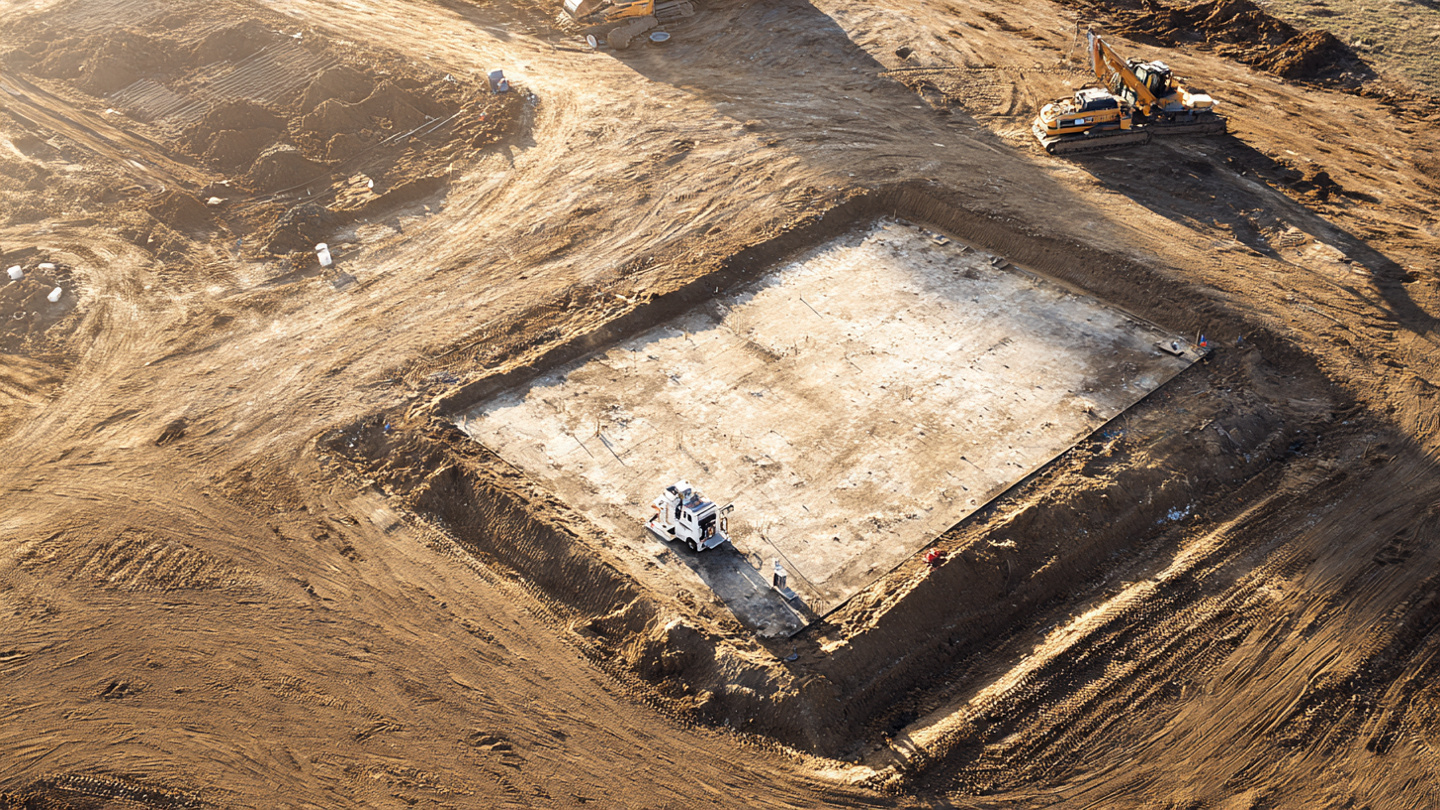
Six holes. That is what stands between your foundation and a warranty claim.
A geotechnical tech drives out with a nuclear density gauge, punches it into the dirt at six spots across the pad, reads the numbers, and leaves. Total time on site: 45 minutes. Each measurement covers about 0.79 square feet. Six spots: 4.74 square feet total.
Your pad is 2,000 square feet.
That leaves 1,995 square feet of dirt nobody checked.
What a Soft Spot Costs
Foundation settlement. Diagonal cracks from window corners. Doors that stick. Floor slopes you feel in your socks. Sometimes it shows up in two years. Sometimes eight, well after the builder's warranty expired but well within the life of your mortgage.
Angi's 2026 cost data puts foundation repair at $750 to $25,000, with structural pier installation running $1,000 to $3,000 per pier. A typical residential fix needs 8 to 12 piers. You can do that math yourself.
And the soft spot that causes this might be four feet wide. A pocket of organic fill the grading crew missed. A seam where two fill materials meet. A spot where water pooled overnight. None of these show on the surface. All of them can drop a section of your slab half an inch over five years.
Density vs. Stiffness: A Measurement Problem
Nuclear gauges measure density, how tightly the particles pack together. Useful. But density doesn't predict how soil actually responds to load. What you want is stiffness.
A pad can hit 95% compaction density and still have localized soft zones. Moisture variation does this. Thin lenses of organic material do this. Non-uniform fill with different grain sizes does this. Density says "the particles are close together." Stiffness says "this ground will hold your house."
Intelligent compaction (IC) systems measure stiffness. They mount accelerometers on vibratory rollers and analyze the drum's vibration response in real time. Well-compacted soil produces a crisp, predictable pattern. Soft zones shift it. GPS tags each reading to coordinates. You get a continuous stiffness map of the entire pad.
FHWA's IC technology program has documented this across hundreds of DOT projects. Their finding that matters here: IC correlates well with Lightweight Deflectometer readings but does not correlate well with nuclear density data. Different instruments measuring different things.
The Expected Value Calculation
I ran the numbers to see whether continuous monitoring makes financial sense.
| Variable | Value | Source |
|---|---|---|
| Homes with settlement (10yr) | 5–8% | Industry warranty data |
| Homes needing structural repair | 1–3% | Subset of above |
| Average structural repair cost | $12,000 | Angi 2026 |
| Expected repair cost per home (at 2%) | $240 | 0.02 × $12,000 |
| Warranty + callback + litigation overhead | 2–5× repair cost | Estimate (see below) |
| Effective expected cost per home | $500–$1,250 | $240 × 2–5 |
| AI compaction monitoring cost | $800–$1,500 | Projected from highway IC |
On pure repair math, it is marginal. $500 to $1,250 expected versus $800 to $1,500 for monitoring.
But repair cost is the smallest part of the equation. The Terner Center at UC Berkeley found that 80 to 85 percent of condominium projects in California get sued over alleged construction defects. Foundation issues rank among the most expensive categories. Insurers now underwrite every new California project assuming it will face a claim. My 2–5x multiplier for litigation and overhead is a rough estimate, not from a single published study, but the Terner data on claim frequency makes even the low end conservative.
A continuous compaction record doesn't prevent settlement. But it proves you verified every square foot of the pad, not 0.24%. Try explaining that six-spot methodology to a jury.
Why This Product Doesn't Exist Yet
IC was built for big iron. A Bomag BW 213 roller weighs 29,000 pounds. Caterpillar's Machine Drive Power, Dynapac's DCA, Ammann's ACEforce: all designed for 10-ton machines doing highway subgrade.
Your residential pad gets a 400-pound walk-behind plate compactor. Different physics. A 10-ton vibratory roller generates enough energy to excite measurable soil response at depth. A plate compactor barely penetrates 12 inches. The accelerometer math that works on highways doesn't transfer to residential equipment without new sensor calibration and different ML models.
A 2025 paper in MDPI Sensors demonstrated ML-driven compaction analysis with edge computing running directly on the equipment. Promising. But the test platform was a full-size roller, not a Wacker Neuson plate tamper. As of early 2026, no manufacturer offers a residential-scale IC system with ML analysis.
What You Can Do Right Now
1. Double the test points. Ask your geotech to go from 6 to 18 nuclear gauge tests. Extra cost: $400 to $800. Raises coverage from 0.24% to 0.71%. Still bad, but three times less bad.
2. Add LWD testing. A Lightweight Deflectometer measures stiffness directly, costs about $150 per test, needs no radiation license. Request LWD tests at the gauge locations plus the gaps between them. Budget: $300 to $600 extra.
3. Require a written compaction plan. Not just "compact to 90%." Documented lift thickness, moisture conditioning, equipment used, number of passes per area. Creates accountability beyond a six-point spot check.
4. Watch for the residential IC market. MEMS accelerometers run under $5. GPS modules cost $15. Edge ML inference on microcontrollers is production-ready. Strapping sensors to a plate compactor and running a stiffness model probably costs $200 to $500 in components. Someone will ship this in the next two to three years. When they do, spec it on every pad in litigious states.
The Strongest Case for Leaving It Alone
Most houses are fine. A 5 to 8 percent settlement rate means 92 to 95 percent of homes on spot-tested pads never have a problem. Residential foundations are over-engineered by code, with safety factors that absorb modest variation. IRC Section R401.4 requires soil investigation, and spot verification combined with proper grading technique has worked for decades of tract housing.
For a builder doing 200 homes a year on uniform native soil, continuous monitoring probably doesn't pencil. The current system fails at the margins: expansive clay, cut-and-fill transitions, variable fill. For vanilla subdivisions on stable ground, six gauge tests might genuinely be sufficient.
That argument falls apart in California, Texas, Colorado, and anywhere else with expansive soils, aggressive construction defect litigation, or both.
What This Analysis Didn't Cover
No published study evaluates intelligent compaction specifically on residential building pads. I extrapolated from highway IC research using fundamentally different equipment. My monitoring cost estimates ($800 to $1,500) are projections based on hardware amortization and data processing, not a quote from a product that exists.
Settlement rates of 5 to 8 percent come from aggregated warranty and insurance data, not a controlled longitudinal study. Geographic variation is enormous: expansive clay in North Texas, decomposed granite in Northern California, sand in Central Florida. A national rate is a useful baseline but a poor predictor for your specific lot.
Sources
- FHWA, "Intelligent Compaction Technology FAQ" — IC roller technology, 100% coverage, correlation with LWD but not nuclear density gauge
- MDPI Sensors (2025), "Intelligent Compaction System for Soil-Rock Mixture Subgrades" — real-time moisture-CMV fusion, edge ML on compaction equipment
- MDPI Sustainability (2021), "Cost-Effectiveness of IC vs. Conventional Compaction" — reduced rework, fewer failed spot tests in highway overlay projects
- Angi (2026), Foundation Repair Cost Guide — $750–$25,000 range, $1,000–$3,000 per pier
- Terner Center, UC Berkeley, "Construction Defect Liability in California" — 80–85% of CA condo projects face defect lawsuits
- IRC 2021, Section R401.4 — soil investigation requirements for residential foundations