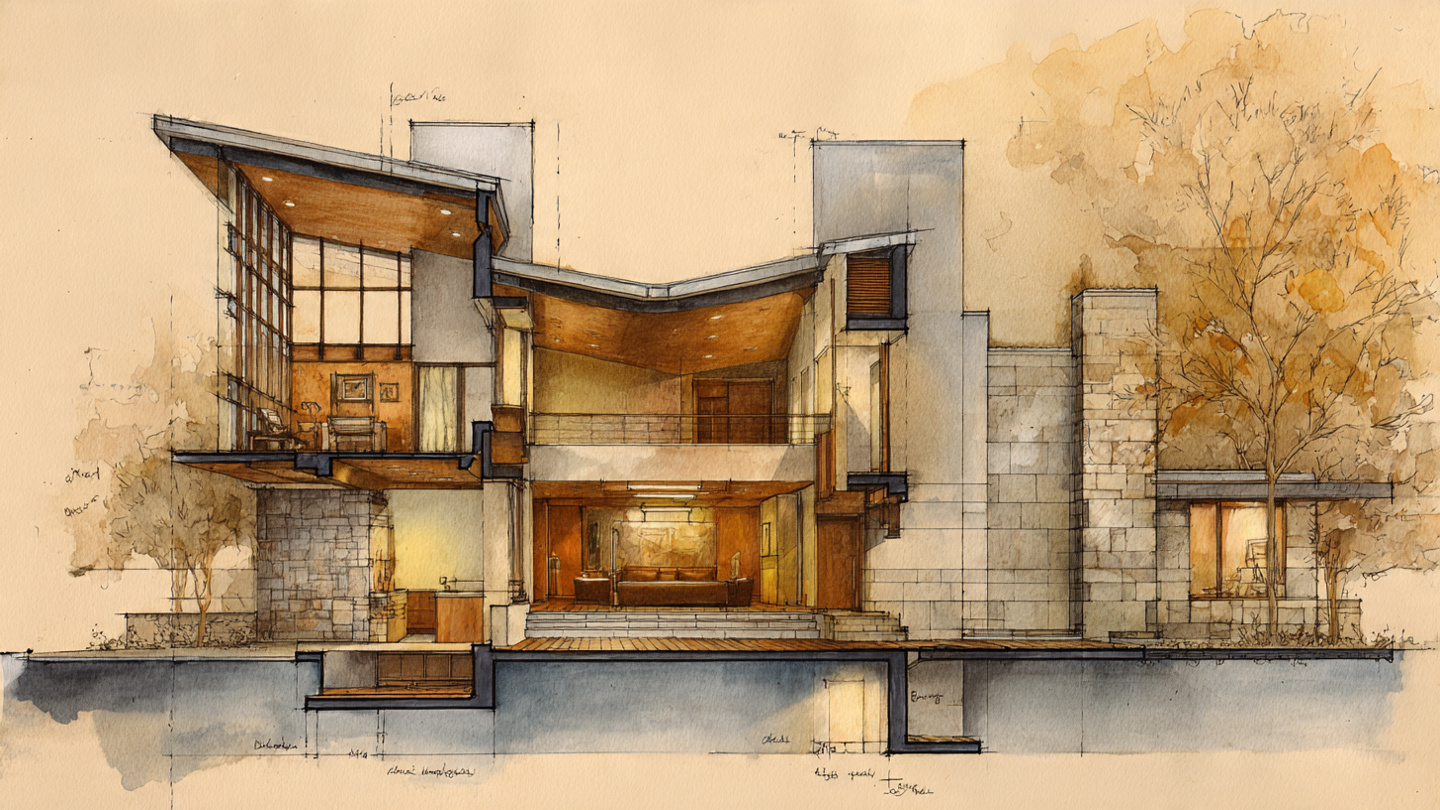
Stand in the entry of any well-designed home and you will feel it before you understand it: the low ceiling of the foyer pressing down gently, then the release as you step into a living room where the ceiling lifts to ten or twelve feet and the light changes and the air opens and something in your posture shifts. That compression-to-release sequence is the oldest spatial trick in residential architecture, older than electricity, older than central heating, and it works because human beings are animals who read vertical space as emotional information. Low means shelter, high means freedom. Architecture lives in that transition.
None of the consumer AI floor plan generators on the market can produce it.
Not one.
I spent two weeks auditing every major consumer AI design tool available to homeowners and small-project architects in 2026, testing whether any of them could model ceiling height as a design variable, generate a building section, or even allow users to specify different heights for different rooms. Maket.ai, which has served over a million users at $30 per month for its Pro tier, generates 2D floor plans from text prompts and renders them in 3D at a single default ceiling height. Planner 5D, with more than ten million downloads, extrudes every room to the same elevation. Coohom, RoomSketcher, ArchiVinci, TestFit: all plan-view tools that treat the vertical dimension as an afterthought or ignore it entirely, rendering your future home as a flat diagram with walls pushed upward to a uniform height like a cookie cutter pressing dough.
What the Section Actually Does
Architecture students learn to draw two things: the plan and the section. The plan is a horizontal cut through the building, showing room adjacencies, circulation, square footage. It is organizational, telling you where things are. The section is a vertical cut, and it tells you what those rooms feel like. It reveals ceiling heights, floor level changes, the relationship between interior volumes and the roof above them, the way natural light enters at different angles depending on window placement relative to ceiling slope. A UCLA architecture studio course on section and elevation describes it as both "an abstraction and a functional medium," a drawing that captures the experiential dimension of space that the plan cannot represent.
When Joan Meyers-Levy and Rui Zhu published their study in the Journal of Consumer Research in 2007, they gave the intuition a number. Test subjects in rooms with ten-foot ceilings activated abstract, relational processing. Subjects in rooms with eight-foot ceilings shifted toward concrete, detail-oriented thinking. The researchers called it the Cathedral Effect, and the finding has held: a brain imaging study at Aalborg University in Denmark later confirmed that ceiling height and perceived enclosure activate different neural pathways, with taller spaces engaging dorsal visual stream structures associated with approach behavior and shorter spaces triggering emotional avoidance responses.
These are not marginal effects. A room with a ten-foot ceiling is a neurologically different environment from a room with an eight-foot ceiling, even when the occupant is not consciously aware of the height difference, even when the floor plan is identical in every other respect.
The Flat World of AI Design
According to a 2025 survey of 665 architects by illustrarch.com, 46% now use AI tools in their practice. Nearly 69% of that usage occurs in early design phases, the conceptual stage where section decisions should be made because they cascade into structural framing, HVAC routing, window specification, and energy performance. AI home renovation planning adoption has nearly doubled, from 9% to 17% between 2024 and 2025 according to GlobeNewsWire market data.
Yet the tools homeowners and early-phase designers reach for are architecturally illiterate about the vertical. Maket.ai's own reviews note that "spatial reasoning and rendering quality lag behind competitors," a generous assessment for a tool that cannot distinguish between a room that should compress you and a room that should liberate you because it has no concept of either. Planner 5D lets you place furniture in a 3D view, but every room in that view shares the same ceiling plane, as if the entire house were a single extruded volume with partition walls dropped in.
To be precise about what is missing: none of the seven tools I tested can accept "9-foot ceilings in bedrooms, 10.5-foot in the living room, 8-foot in the hallway" as a design input. None generate a building section as an output. None optimize for the compression-to-release sequence or any vertical spatial metric. None reference the IRC 2018 minimum ceiling height codes (7 feet 6 inches for habitable rooms, 6 feet 8 inches around bathroom fixtures, and specific rules for sloped ceilings that must meet minimum height over at least half the floor area). None apply the Roche Spaces proportion guidelines suggesting optimal ceiling heights of 2.75 to 4 meters based on floor area, which would map a 12-by-14-foot room to roughly a 9.5-foot ceiling rather than the default 8.
| Tool | Variable Ceiling Height | Section Generation | Code Compliance (Vertical) |
|---|---|---|---|
| Maket.ai ($30/mo) | No | No | No |
| Planner 5D (10M+ downloads) | No | No | No |
| Coohom | No | No | No |
| RoomSketcher | No | No | No |
| ArchiVinci | No | No | No |
| TestFit | No | No | No |
| HomeDesigner (Chief Architect)* | Yes | Yes | Partial |
*HomeDesigner is traditional CAD software, not an AI-generative tool. It requires manual room-by-room ceiling specification and is included here for comparison.
What the Math Looks Like
Architectural proportionists have long worked with an ideal room ratio of approximately 1:1.5:2.5 for height to width to length. A 12-by-14-foot bedroom at the standard 8-foot ceiling height yields a ratio of 1:1.5:1.75. Compressed. It reads as wider than it is tall, which is why so many tract homes feel like boxes even when the square footage is generous: the ceiling-to-floor-area ratio is wrong, and the human eye, which evolved in a world of varied canopy heights and open skies, registers the mismatch as spatial monotony even when it cannot articulate why.
Raise that same room to 10 feet. The ratio shifts to 1:1.2:1.4, closer to a cube, and the room suddenly breathes. Now imagine the hallway leading to it at 8 feet, the transition dropping and then releasing as you cross the threshold. That sequence is what architects mean when they say the section reveals the architecture.
AI research confirms the blind spot from the academic side. TU Delft researchers studying AI floor plan generation note that "current models struggle with spatial understanding and environmental impact." The RFP-A evaluation framework published in MDPI journals measures AI-generated floor plans on room count compliance and spatial connectivity but includes no vertical metrics whatsoever. HouseDiffusion achieves over 90% accuracy on room count, but that accuracy metric exists entirely in two dimensions. GSDiff, a newer "vector floorplan design" framework, operates in 2D only. Text-to-Layout systems that generate plans compatible with Revit produce output that Revit can then extrude into 3D, but the generative step itself contains no vertical intelligence.
The Dollar Value of the Third Dimension
Witold Rybczynski's work at the Wharton School of Real Estate has documented that ceiling height variation commands premium pricing in residential markets. This is not surprising to anyone who has toured a $1.2 million home and a $3 million home and noticed that the difference between them is often less about square footage than about what happens when you look up. Double-height living rooms, coffered dining ceilings, the dramatic vertical connection of a two-story foyer: these are the spatial moves that separate commodity housing from architecture, and they are precisely the moves that AI design tools cannot make because they have no representation for "up."
A homeowner who uses Maket.ai to generate a floor plan and then hands that plan to a builder will get a house with uniform 8-foot ceilings unless the builder or an architect intervenes, because the tool's output contains no ceiling height information. If that homeowner is spending $400,000, roughly 15-20% of the emotional experience of the finished home, the part determined by vertical spatial sequences, was never part of the design process at all.
The Strongest Case for Ignoring All of This
Professional tools handle the vertical dimension. Revit, ArchiCAD, SketchUp: all fully three-dimensional, all capable of section generation and variable ceiling heights. Consumer AI floor plan generators are not attempting to replace architectural design. They are exploration tools, napkin-sketch equivalents that help homeowners think about room adjacencies and program before hiring a professional to develop the concept into a buildable set of drawings. Expecting Maket.ai to generate a building section is like expecting a restaurant sketch on a cocktail napkin to include structural engineering.
That argument deserves its full weight, and I want to be honest that it has force. The section traditionally comes later in the design process, after the plan is settled, when an architect develops the schematic into something that accounts for structure and systems and the full three-dimensional reality of the building.
But it misses two things. First, 68.94% of AI tool usage happens in the early design phase, which means the conceptual decisions that determine the vertical character of a home are being made with tools that are structurally incapable of representing vertical character. That analogy fails because napkin sketches don't claim to be design tools. Maket.ai does. Second, not everyone hiring a builder also hires an architect. For spec homes, small renovations, and owner-builder projects, the AI-generated floor plan may be the only design document that exists before framing begins. In those cases the vertical dimension is not deferred to a later professional phase. It is simply absent.
What to Do About It
If you are using an AI floor plan tool right now, print its output, then draw a line through each room at the height you want the ceiling. Eight feet in the mudroom, nine in bedrooms. Ten or eleven in the main living area. Eight again in the hallway between. That hand-drawn cross-section is the document your builder needs to see, and no AI tool will generate it for you.
Ask your builder about ceiling height options at the framing stage, before drywall, when changing a ceiling height is a matter of adjusting truss specifications rather than demolishing finished surfaces. The IRC requires 7 feet 6 inches minimum for habitable rooms, but minimum is not optimal, and the difference between minimum and optimal is the difference between a room that functions and a room that feels like somewhere you want to be.
For the AI tool developers reading this: ceiling height as a per-room input field is not a difficult feature to build. It requires a scalar value per room in the data model, a section-view rendering mode, and proportion-based recommendations that cross-reference room dimensions with architectural guidelines. Research data exists, building codes are public, and the gap is not technical. It is conceptual: these tools were built by people who think of homes as floor plans, and until someone builds one that thinks of homes as volumes, the most important spatial dimension of your future house will remain invisible to the software you are using to design it.
Limitations
This audit covered seven consumer-facing tools available in 2026. Professional-tier AI tools serving commercial architecture, particularly Autodesk Forma and Hypar, may model vertical dimensions for large-scale projects but fall outside the scope of this residential-focused review. The Cathedral Effect research by Meyers-Levy and Zhu was conducted in controlled laboratory environments, not actual homes, and the magnitude of the effect in lived residential settings is unstudied. The proportion guidelines cited from Roche Spaces and architectural tradition are recommendations, not empirically validated standards with controlled outcome measurements. No direct user study has compared homes designed with AI-generated plans against architect-designed sections using occupant satisfaction or well-being metrics. Finally, this audit tested tools as available in May 2026; AI development moves quickly, and any of these tools could add section capabilities in a future update.