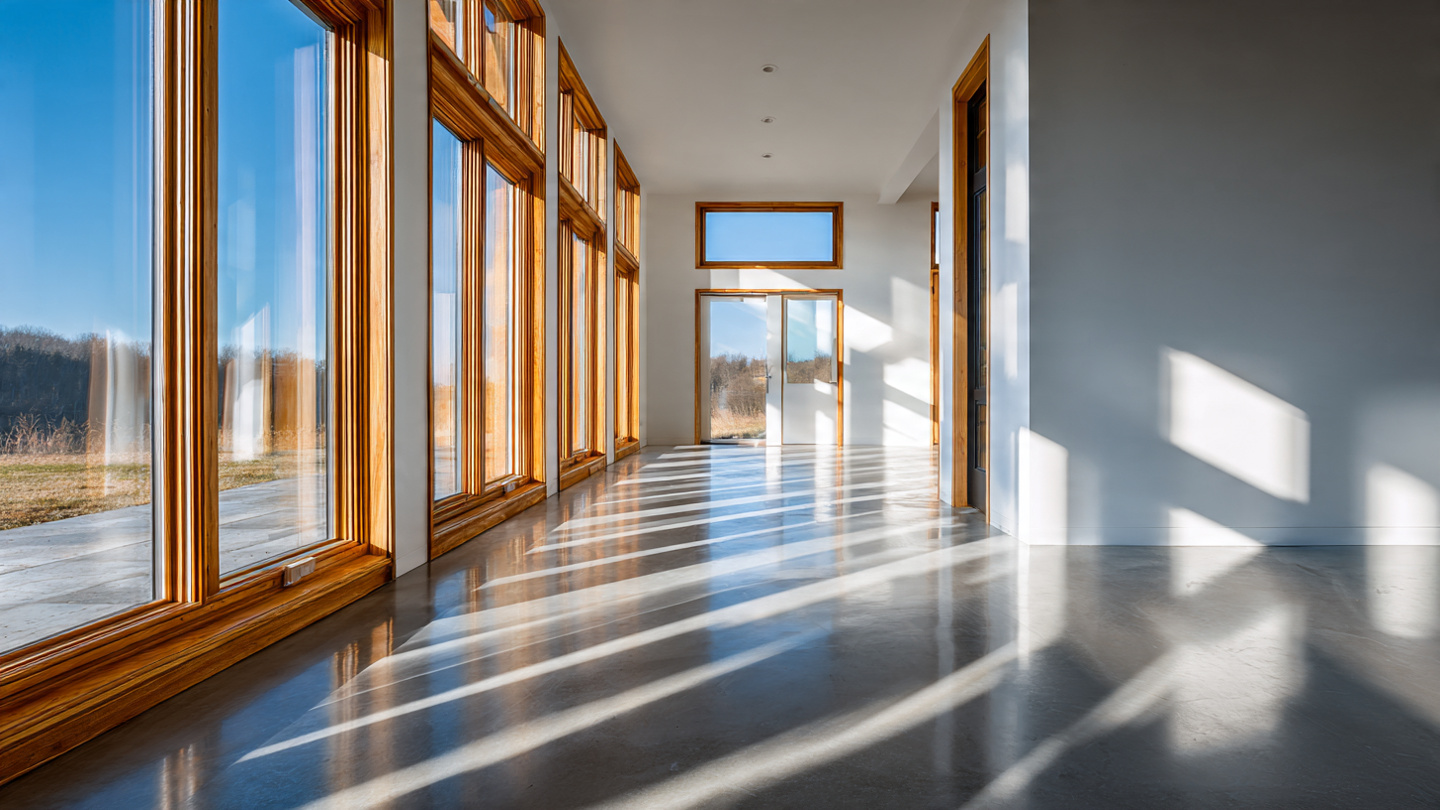
Walk into a Passive House and the first thing you notice is the silence. Not the dead, padded quiet of a recording studio, but something more alive: the absence of mechanical noise. No furnace cycling on. No window-unit rattle. No air handler pushing conditioned air through ducts that whistle at the register. Just rooms that hold their temperature the way a thermos holds coffee, through physics rather than brute force.
The second thing you notice, if you pay attention to how spaces feel rather than how they look, is the evenness. Stand by a Passive House window in January and your skin registers the same temperature it would in the center of the room. In a code-built home, that same window seat radiates cold. You feel a draft that isn’t wind; it’s convective current created by the temperature differential between single-pane glass and heated air. Passive House eliminates that differential through triple-pane glazing, insulated frames, and an airtight envelope that keeps the conditioned air where you put it.
It is, by most measures, the most rigorous residential building standard in the world. And almost nobody in America builds to it.
What 597 Projects Tells You
Phius, the Passive House Institute US, certified its 500th project in January 2025 and ended the year approaching 600. A record 155 projects achieved Design Certification in 2025. Those are real numbers showing real growth, and they are also laughably small against the scale of American homebuilding.
More telling is where the growth is happening. Median project size jumped from 6,000 to 7,000 square feet between 2019 and 2024 to 25,000 square feet in 2025. In New York and Massachusetts, the median hit 51,000 square feet. Outside those two states, it remained 3,300 square feet. Passive House in America is becoming a multifamily phenomenon driven by state incentive programs, not a single-family movement driven by homeowner demand.
Single-family Passive House remains an enthusiast’s pursuit. Why?
The Spreadsheet Problem
Certification requires energy modeling. Not the kind of energy modeling your architect might run in a general-purpose tool to check whether a wall assembly meets code. Passive House demands either PHPP (the Passive House Planning Package, developed by the German Passivhaus Institut) or WUFI Passive (the hygrothermal simulation tool adopted by Phius since 2015). Both are specialized. Both require a Certified Passive House Consultant, or CPHC, to operate competently. And both consume an extraordinary number of professional hours.
For a single-family home, a CPHC typically spends 40 to 100 hours on energy modeling. The work involves iterating on wall assemblies, window specifications, orientation, mechanical system sizing, thermal bridge calculations, and airtightness assumptions. Each change cascades: swap a window manufacturer and you must recalculate the frame’s thermal conductivity, the solar heat gain coefficient, the installed U-value including the installation detail, and the effect on the overall heating demand. Multiply by every window in the house. Then check whether the building still meets the airtightness target at 0.6 air changes per hour at 50 Pascals.
Brooklyn-based consulting firm bldgtyp described the process on Passive House Accelerator as “difficult, time-consuming, confusing, and frustrating.” They build Passive Houses for a living. If the experts find it frustrating, imagine what a first-time builder encounters.
The Math That Keeps Builders Away
Consider a $500,000 new-construction home. The consulting fee for CPHC energy modeling runs $5,000 to $15,000 depending on complexity. Call it $10,000 for a moderately detailed single-family design. That is 2% of total project cost dedicated to energy modeling alone, before a single stud is cut.
Then add the construction premium. Phius publishes cost data showing that experienced teams can build to Passive House standard at near-zero premium over code-built construction. Pennsylvania’s Low Income Housing Tax Credit program generated enough volume that passive projects eventually came in cheaper than conventional ones. But that convergence required repeated projects with the same teams. A first-time Passive House builder faces a 5% to 15% hard-cost premium for upgraded windows, thicker insulation, airtight membranes, and an HRV/ERV mechanical system.
| Cost Component | Code-Built ($500K Home) | Passive House (First Build) |
|---|---|---|
| Energy modeling | $0–$2,000 | $5,000–$15,000 |
| Construction premium | Baseline | $25,000–$75,000 (5–15%) |
| Certification fee | N/A | $2,500–$4,500 |
| Total added cost | Baseline | $32,500–$94,500 |
Against that upfront cost, the return is genuinely compelling. Passive House can reduce heating and cooling energy by up to 90% compared to code-built homes, according to the Environmental and Energy Study Institute. On a home where heating and cooling accounts for $2,400 of a $3,600 annual energy bill, that is $2,160 in annual savings. At a 5% discount rate, the present value of 30 years of those savings is roughly $33,200. The payback pencils out, barely, at the low end of the cost premium. At the high end, it does not, unless you value the comfort, durability, and resale premium that Passive House occupants consistently report but that appraisers struggle to quantify.
This is the trap. Every dollar of soft cost that stands between a builder and certification is a dollar that tips the ROI calculation from “worth trying” to “maybe next project.”
Where AI Enters the Conversation
Machine learning models trained on building simulation data can predict energy performance in seconds. Not approximate, hand-wavy predictions, but outputs correlated to the same physical parameters that PHPP computes: heating demand, cooling demand, peak loads, primary energy. A University of Notre Dame study published in Building and Environment combined deep-learning computer vision with machine learning regression to predict household energy burden from passive design indicators visible in Google Street View images, achieving 74.2% accuracy. Separate BIM-ML research published in Applied Sciences (2026) demonstrated that neural networks trained on BIM geometry can predict early-stage energy performance with meaningful accuracy, collapsing hours of simulation into seconds of inference.
Neither of these tools replaces PHPP. Not yet. But they suggest a workflow that could cut the modeling bottleneck dramatically: an AI pre-screening layer that evaluates dozens or hundreds of design variants against Passive House criteria before a human consultant touches the project. Think of it as triage. The architect feeds the AI a massing model, a climate zone, a window-to-wall ratio, and general assembly types. The AI returns a probability distribution: this design has a 92% chance of meeting the Phius heating demand target with R-40 walls and triple-pane windows, or a 34% chance with R-25 walls and double-pane. Only the promising configurations advance to full WUFI Passive modeling.
The economics shift substantially. Instead of paying a CPHC $10,000 to iterate through 15 design variants from scratch, the architect screens 200 variants through the AI model for perhaps $500, narrows to two or three viable configurations, and sends those to the CPHC for validation modeling at $1,500 to $3,000. Total modeling cost: $2,000 to $3,500 instead of $10,000. On a $500,000 home, that is the difference between 2% of project cost and 0.5%.
Why This Might Not Work
I want to state the strongest objection at full strength, because it comes from people I respect and it is not wrong.
PHPP is not merely a calculator. It is a design process. When a CPHC spends 80 hours modeling your home, they are not just checking boxes; they are learning where the thermal bridges hide, how the window installation detail interacts with the air barrier, why moving the mechanical closet three feet east changes the duct runs enough to shift the heating load. That iterative struggle produces understanding. Shortcut the struggle and you might get a certified building that checks the numerical targets but misses the craft that makes Passive House buildings genuinely excellent rather than merely compliant.
There is also the accuracy question. A 74.2% accuracy rate is interesting for academic research. It is nowhere near sufficient for certification-quality predictions where the margin between passing and failing is measured in fractions of a kBtu per square foot per year. Phius sets climate-specific heating demand targets; in Climate Zone 5, the limit might be 4.75 kBtu/ft²/yr. A model that is wrong 25% of the time will send bad designs to expensive validation modeling and reject good ones prematurely.
And the real bottleneck may not be modeling at all. It may be builder knowledge: how to install a continuous air barrier without puncturing it at every electrical box, how to detail a window sill so the thermal bridge calculation matches reality, how to commission an HRV system so it actually recovers the heat the model assumed. You can automate the spreadsheet and still fail the blower door test.
What You Can Do Now
If you are building a home and considering Passive House: Budget $10,000 to $15,000 for energy consulting on your first project. Interview CPHCs early, before schematic design, not after. The modeling informs the design; it cannot rescue a bad one. Ask whether the consultant uses Honeybee-PH or similar parametric tools that can evaluate multiple options faster than manual PHPP entry. Find your local CPHC through the Phius directory.
If you are a builder doing volume work: Your second Passive House project will cost significantly less than your first. Pennsylvania LIHTC data shows cost convergence within two to three projects. If you are doing 10 or more homes per year in climate zones 4 through 7, the upfront modeling investment amortizes quickly across your portfolio. Run one Passive House spec home. Document everything. Use that model as a template for subsequent units.
If you want the performance without the certification: Apply Passive House principles without pursuing formal Phius certification. Upgrade to triple-pane windows (Alpen, Zola, or European imports), add a continuous exterior insulation layer (mineral wool is forgiving for first-timers), install an HRV, and aim for 1.5 ACH50 or better on your blower door test. You will not get the certificate, but you will get 60% to 70% of the energy savings at perhaps half the premium. The certificate is a quality assurance mechanism, not a magic spell.
If you are a software developer or researcher: The dataset exists. Phius has certified 597 projects with full WUFI Passive models. If even a fraction of that data were anonymized and released for ML training, the resulting surrogate model could accelerate adoption more than any policy incentive. The Honeybee-PH open-source project already bridges Rhino/Grasshopper to PHPP. The gap is a training corpus, not an algorithm.
What This Analysis Did Not Prove
No commercial AI product exists today that can replace or substantially automate PHPP/WUFI Passive modeling for Passive House certification. The workflow I described, AI pre-screening followed by human validation, is a projection based on current ML research trajectories, not a product you can buy.
The $5,000 to $15,000 modeling cost range is based on industry interviews and published consultant rate cards, not a systematic survey. Costs vary significantly by region, project complexity, and whether the consultant is also providing design guidance or purely modeling services. Some CPHCs bundle modeling into architectural fees, making the energy modeling cost invisible.
The 90% energy reduction figure comes from EESI and reflects heating and cooling energy specifically, not total household energy consumption. A Passive House still uses electricity for lighting, cooking, appliances, and domestic hot water. Total energy savings are typically 60% to 75%, depending on occupant behavior and climate zone.
Phius cost data is heavily weighted toward multifamily projects in the Northeast, where state incentives (particularly LIHTC qualified allocation plans that award points for Passive House certification) distort the economics. Single-family cost premiums in markets without incentives are less well documented.
Sources
- Phius, “2025 Year in Review: Certification Milestones, Training Development & Policy Breakthroughs”: 597 certified projects, 9,000+ dwelling units, record 155 Design Certifications in 2025
- Phius, “Cost Data”: Pennsylvania LIHTC data showing passive projects becoming cost-competitive with code-built over multiple builds
- EESI, “Reducing Heating and Cooling Needs by 90 Percent? It’s Possible in a Passive House”: Energy reduction claims and Passive House fundamentals
- Passive House Accelerator, “New Honeybee-PH Tool Improves Workflows for Modelers”: bldgtyp on PHPP modeling difficulty and Honeybee-PH open-source tool
- Ghorbany et al., “Examining the Role of Passive Design Indicators in Energy Burden Reduction,” Building and Environment (2023): ML + computer vision achieving 74.2% accuracy in energy burden prediction
- BIM-Based Machine Learning Framework for Early-Stage Building Energy Performance Prediction, Applied Sciences (2026): Neural network surrogate models for building energy simulation
- Building Science Corp, “The Passive House (Passivhaus) Standard”: Technical comparison of Passive House requirements including 4.75 kBtu/ft²/yr benchmark