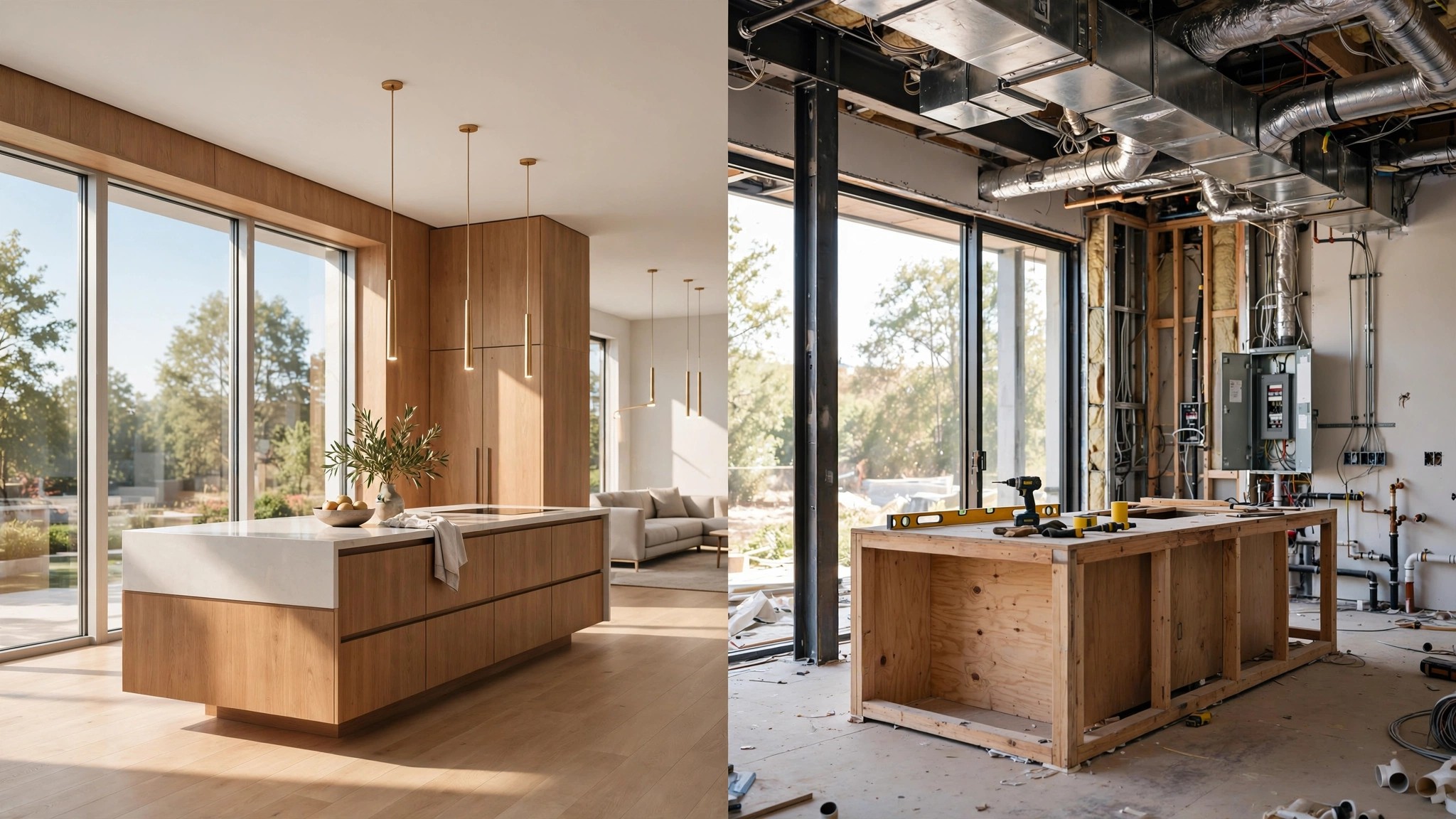
Pull up any AI rendering tool. Type "modern open-concept kitchen with floor-to-ceiling windows, warm wood tones, 12-foot ceilings." Wait nine seconds. The image arrives: luminous, proportionally flawless, the kind of space that makes you reach for your construction lender's number. Every surface catches light at precisely the angle that photographs best. The kitchen island floats in the center of a room that stretches, uninterrupted, from the front entry to the rear garden wall. No columns. No soffits. No bulkheads where ductwork has to cross a structural beam. No electrical panel occupying three feet of prime wall space because the National Electrical Code requires 30 inches of clear working depth in front of it.
That render is lying to you, not maliciously but structurally, showing you a surface and letting you believe you are seeing a building.
The Market for Beautiful Lies
Over one million people have registered for Maket, the Montreal-based AI floor plan generator that produces residential layouts and photorealistic renders from text prompts. CEO Patrick Murphy told the company's blog that the tool "really does 70 to 75 percent of the work," with the remaining 25 to 30 percent requiring professional structural review, code compliance analysis, and engineering. ICON's Vitruvius, an architectural AI chatbot from the 3D-printing construction company, offers free floor plans and interior renders in beta. Midjourney v7 generates architectural images so convincing that the Chaos Group, which makes the industry-standard V-Ray renderer, noted in its 2026 tool comparison that Midjourney has "no BIM integration" and "geometry hallucination issues." Veras, EvolveLAB's plugin recently acquired by Chaos Group, integrates directly into Revit, SketchUp, Rhinoceros, and Vectorworks for $29 a month, producing AI renders that at least begin from real geometry.
These tools exist on a spectrum. At one end, Veras renders from an actual 3D model, which means the columns, walls, and openings at least correspond to something designed in BIM. At the other, Midjourney and its imitators generate images from pure imagination, unconstrained by physics, codes, or the existence of gravity. The problem is that a homeowner looking at both outputs cannot tell the difference. A Midjourney kitchen and a Veras kitchen look equally real, equally buildable, equally like a place where you could scramble eggs on a Sunday morning while your children argue about cartoons. One is architecturally grounded. The other is a hallucination with good lighting.
Six Things Your Render Will Never Show You
Architecture is not the arrangement of surfaces. It is the negotiation between what you want a space to feel like and what the building needs in order to stand up, stay warm, move air, carry water, and comply with the jurisdictional codes that exist because people have died in buildings that did not. Every AI render systematically omits six categories of physical reality, each carrying a specific cost when it reasserts itself during construction.
| What the Render Shows | What the Building Requires | Discovery Cost |
|---|---|---|
| Open-plan living spanning 30+ feet | Load-bearing columns or steel beams every 16–20 ft in wood frame, 24–30 ft in steel | $5,000–$15,000 |
| Flat 9-ft ceilings in every room | HVAC duct runs requiring 12–16″ soffits that drop usable ceiling to 7’8″ or lower in corridors | $3,000–$8,000 |
| Thin, clean walls | Plumbing chases: 6″ minimum for DWV pipe (2×6 framing), 12″×16″ stack chases for multi-story runs | $2,000–$6,000 |
| Seamless wall surfaces | 200A electrical panel: 30″×36″ clear working space per NEC 110.26, usually consuming prime garage or utility wall | $1,500–$3,000 |
| Expansive bedroom windows | Egress code: min 5.7 sq ft opening, max 44″ sill height, min 24″ height and 20″ width (IRC R310) | $2,000–$5,000 |
| Level floors flowing room to room | Sloped-lot foundation steps; garage-to-house firewall transition with required step-up | $4,000–$12,000 |
The column problem alone deserves its own reckoning. Wood-frame residential construction in the United States typically uses engineered lumber beams that span a maximum of 16 to 20 feet without intermediate support, depending on species, grade, and load. A steel wide-flange beam extends that to perhaps 30 feet for residential loads, but at a material cost that transforms the structural budget. When a homeowner shows a builder an AI render featuring a 34-foot open span from kitchen to living room wall, someone has to explain that either a steel beam with a $4,000 to $8,000 fabrication and installation cost is entering the picture, or a column is appearing in the middle of that Pinterest-perfect island layout. This conversation happens after the homeowner has emotionally committed to the space as rendered. That column feels like a failure, but it is not one. It is physics.
The Architectural Fee Paradox
The average cost of residential construction in the United States reached $428,000 in 2024, representing 64.4 percent of the average new-home sales price of $665,298, according to the National Association of Home Builders' Cost of Construction Survey. A residential architect's fee for a custom new build typically runs 8 to 15 percent of construction cost, placing full-service architectural engagement between $34,000 and $64,000 for that average home.
A Maket subscription costs $29 a month. Six months of AI-assisted floor plan exploration totals $174. Apparent savings from replacing an architect with an AI tool are staggering: $34,000 to $64,000 reduced to less than $200. Homeowners see this arithmetic and reach the reasonable conclusion that architectural services are an extravagance.
But architectural services are neither renderings nor floor plans. They are the resolution of the six categories of hidden reality listed above, plus the production of construction documents detailed enough that a framer, plumber, electrician, and HVAC contractor can build from them without making interpretive decisions on your budget. When those documents do not exist, the trades improvise. Improvisation in construction has a precise, expensive name. It is called a change order, and its average contribution to residential project cost is 5 to 10 percent of the construction budget. On a $428,000 build, that is $21,000 to $43,000 in unplanned expenses, most of which arise from precisely the spatial conflicts that AI renders make invisible.
The math, honestly done: $174 in AI tools plus $33,000 in avoidable change orders (midpoint estimate) equals $33,174. A full-service architect at 10 percent costs $42,800 but prevents most of those change orders through resolved construction documents, structural coordination, and construction administration. Net savings from skipping the architect: roughly $9,600, if nothing else goes wrong. If one additional rework event occurs, you are paying more than you would have with professional design services, and you own a building that an architect did not shape.
What a Building Actually Knows
Professional architectural tools like Finch3D, the Swedish generative design platform, produce floor plans alongside real-time performance metrics: daylight scores, CO2 efficiency ratings, code compliance checks, and unit adaptivity analyses. Snaptrude's six-agent workflow can take a project from site analysis through zoning setbacks, buildable envelope, massing, program generation, and schematic design in under 30 minutes, all with live data connections between program and geometry. These tools begin from constraints. They generate within the boundaries of what physics and codes permit. They are not rendering tools. They are design tools that happen to produce visual output.
The distinction matters. A render answers the question: "What could this look like?" A design tool answers the question: "What can this be?" The first question is seductive. The second is useful. AI has made the first question trivially cheap to answer, and in doing so, has devalued the second question in the eyes of people who do not yet understand that a building is not a picture of a building.
When researchers at the University of São Paulo's Faculty of Architecture and Urbanism ran an experiment asking AI to generate contemporary homes across 15 countries, the results were visually homogeneous. Without specific cultural, climatic, or material prompts, AI produced the same house everywhere: white walls, flat roofs, floor-to-ceiling glass, floating stairs, open kitchens. Professor Giselle Beiguelman observed that AI "tends to perpetuate a hegemonic language of architecture and does not consider other possibilities, such as ancestral or vernacular architectures." ArchDaily published the results, noting that additional cultural specificity in prompts could diversify the output, but the default state of AI architecture is convergence toward a single visual language that exists nowhere and works everywhere equally poorly.
The Proportional Lie
There is a subtler deception at work, harder to quantify but architecturally devastating. AI renders produce spaces with perfect proportional relationships: rooms that feel balanced, windows that sit at exactly the right height, ceiling planes that convey spaciousness. These proportional decisions are the product of training data that includes thousands of professional photographs of completed buildings, each one carefully composed and lit to present architecture at its most flattering.
The AI has learned what good proportions look like in a photograph. It has not learned what good proportions feel like in a body moving through space at five feet eight inches tall, carrying a laundry basket, turning a corner where a hallway narrows from 42 inches to 36 because the HVAC chase consumed six inches of wall depth that the render did not depict. It has not learned that a window placed at 42 inches above finish floor reads as elegant in a render and claustrophobic to a person sitting on a couch whose seat height is 17 inches, creating an effective sill-to-eye distance that blocks the lower third of the view. It has not learned that a 12-foot ceiling in a 10-by-12-foot bedroom creates a vertical proportion that feels like standing in a well.
Proportion is not a visual property but a spatial one. You cannot evaluate it from a picture, no matter how many millions of pixels that picture contains. This is not a limitation of current AI. It is a categorical boundary. A render is a projection of three-dimensional space onto a two-dimensional surface, and the information lost in that projection is exactly the information that determines whether a space feels like a place where you want to live or a place where you want to leave.
Who This Actually Helps
AI rendering tools are genuinely powerful in one specific context: exploration. Before you hire an architect, before you commit to a floor plan, before you know whether you want three bedrooms or four, a $29 tool that generates 20 visual options in an afternoon is an extraordinary aid to imagination. It helps you articulate preferences you did not know you had. It shows you that you respond to double-height entries but feel overwhelmed by double-height living rooms. It reveals that you want the kitchen to face the backyard, not the street, a preference you never would have stated in an initial brief because you never saw the alternative.
This is valuable. It is also the equivalent of browsing a menu before deciding where to eat. It is not dinner. AI renders themselves are not the danger. They become dangerous when they arrive at such high visual fidelity that homeowners mistake the menu for the meal, commit to a floor plan because it rendered beautifully, and discover during framing that the building's physical requirements were never part of the conversation.
Maket's CEO acknowledged this boundary when he noted that 25 to 30 percent of the design work still requires a professional. He is right about the percentage. But he understates the consequence of skipping it. That remaining quarter is not the cosmetic finish. It is the structural skeleton, the mechanical systems, the code compliance, and the construction documentation that prevent the render from collapsing into reality at $200 per square foot.
Limitations
The $17,500 to $49,000 "render confidence gap" is an estimate assembled from contractor pricing surveys, change-order industry data, and residential construction cost references. It is not the product of a controlled study comparing outcomes of AI-rendered-only projects against architect-designed projects. No such study exists, in part because the phenomenon of homeowners commissioning custom construction from AI floor plans is too recent and too diffuse to aggregate into a dataset. The change-order percentage (5 to 10 percent of construction cost) draws from commercial construction research, including a ScienceDirect study that measured a 5.62 percent change-order contribution for a mass timber building; residential change-order rates may differ. BIM-integrated rendering tools like Veras, which work from actual building models, partially address the column-and-ductwork problem, though they do not resolve the proportional and spatial-experience gaps described here.