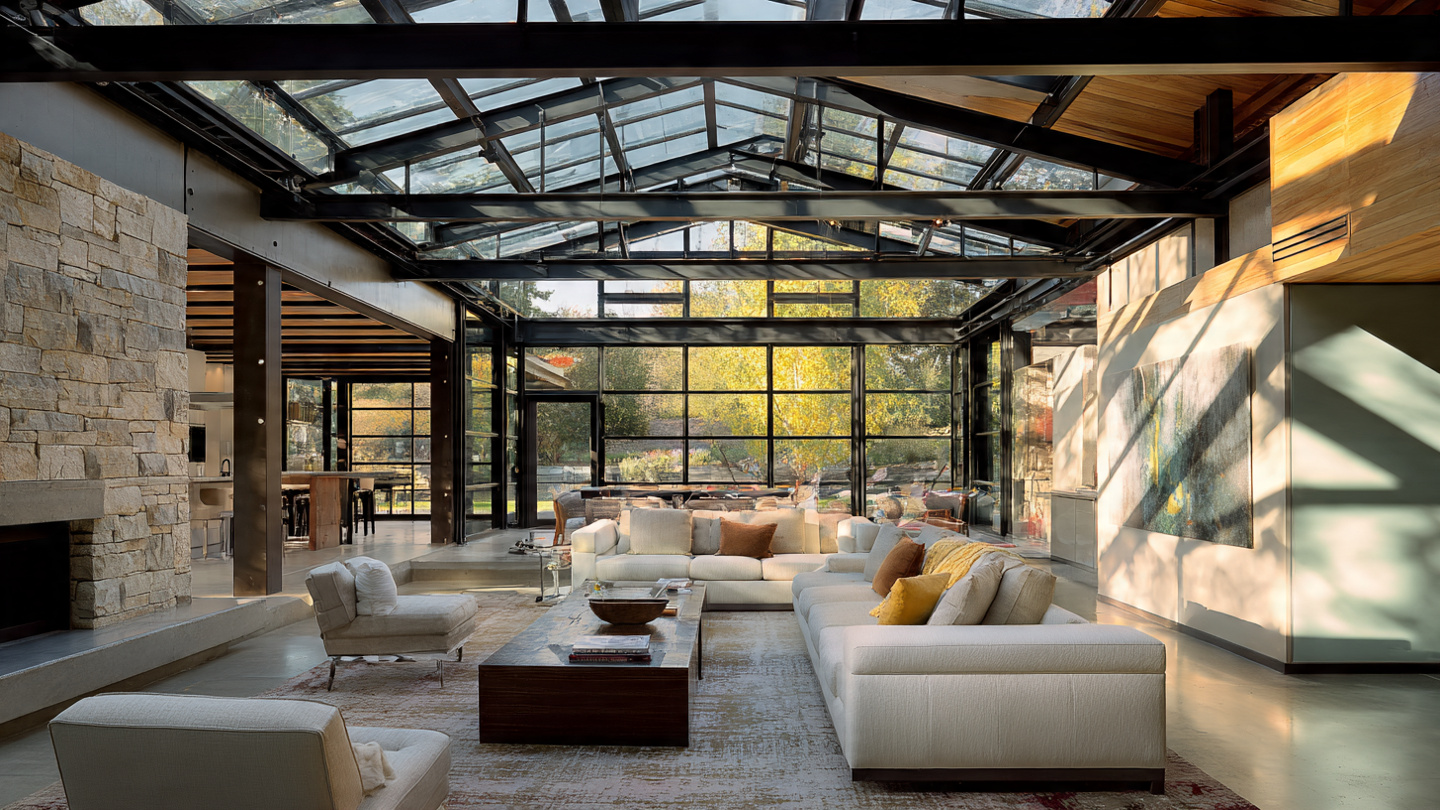
She pulled out her phone before I could finish my coffee. A Midjourney image: double-height living room, a wall of glass dissolving into a hillside garden, a staircase that appeared to float on nothing but light. Polished concrete floors reflecting a ceiling that seemed to hover without support. "This," she said. "This is what we want."
It was beautiful. It was also, in that particular configuration, roughly $93,000 more expensive than she believed her home would cost.
I did not tell her that immediately. I have learned, over 14 years of translating visions into buildings, that the first meeting is for listening. But I knew, within seconds of looking at that image, exactly where the money would hide. Because AI rendering tools are astonishingly good at one thing: making structure disappear.
What the Rendering Conceals
Every building is a negotiation with gravity. Walls hold up roofs. Beams span openings. Columns transfer loads to foundations. This is not optional. It is physics. And the single most consistent feature of AI-generated home imagery is the absence of any visible evidence that physics applies.
Midjourney, DALL-E, Stable Diffusion, and the architectural-specific tools like Maket and Archistar produce layouts and images optimized for visual impact. Maket, which has surpassed one million registered users as of early 2026, generates floor plans based on room counts, square footage, and adjacency rules. It checks zoning compliance. It exports to DXF for CAD refinement. What it does not do, and what no consumer-facing AI design tool currently does, is model structural loads, specify beam sizes, or flag the engineering cost of the design decisions embedded in its output.
This is not a minor omission. It is the omission.
Pricing the Invisible
I went through my last eight initial consultations where clients arrived with AI-generated reference images. Every one included at least three of these five features. I priced the structural premium for each against the standard construction approach for a 2,500-square-foot custom home in the $400,000 to $600,000 range.
| Feature in AI Rendering | Standard Approach | As Rendered | Structural Premium |
|---|---|---|---|
| Floor-to-ceiling glass wall (20 linear feet) | Standard windows: $8,000-$15,000 | $700-$3,000+/LF installed: $28,000-$60,000+ | $20,000-$45,000 |
| Floating staircase (mono-stringer steel) | Standard wood stair: $3,000-$5,000 | Viewrail's 3% rule: $15,000-$50,000 | $12,000-$45,000 |
| Open-concept great room (20-foot clear span) | Load-bearing wall stays: $0 | Steel beam + engineering: $5,000-$25,000 | $5,000-$25,000 |
| Seamless indoor-outdoor (multi-panel pocket glass) | Standard sliding door: $3,000-$6,000 | Multi-slide pocket system: $15,000-$40,000 | $12,000-$34,000 |
| Cantilevered balcony or overhang | Post-supported deck: $5,000-$10,000 | Cantilevered steel frame: $15,000-$35,000 | $10,000-$25,000 |
Combined potential premium: $59,000 to $174,000. On a $500,000 home, that is 12% to 35% beyond the client's working budget, attributable entirely to design features the AI generated without structural awareness.
Viewrail, one of the larger floating staircase manufacturers in the U.S., publishes a useful heuristic: floating stairs typically run about 3% of a home's market value. For a $500,000 home, that is $15,000. For the $1.2 million homes that increasingly show up in my practice, it is $36,000. A standard wood stair with newel posts and balusters costs $3,000 to $5,000 to build. The AI never generates the standard version. Nobody types "give me a house with a normal staircase."
Where the Money Actually Goes
Consider the glass wall from my client's rendering. Twenty linear feet of floor-to-ceiling glazing is not twenty feet of glass. It is an engineered assembly. A structural header spanning the full opening, sized by an engineer for the roof load above it. Tempered or laminated glass panels meeting IRC Section R308 safety glazing requirements. Steel or aluminum framing rated for wind loads per local amendments. A reinforced foundation at the base, because 20 feet of glass weighs considerably more than 20 feet of framed wall with insulation and siding.
HomeGuide's 2026 pricing data puts installed floor-to-ceiling windows at $700 to $3,000 or more per linear foot, with structural modifications adding tens of thousands for load-bearing wall removals. Basic installations start around $7,000 total, but the expansive walls in AI renderings routinely exceed $30,000 before you account for the structural engineer's involvement at $1,500 to $3,000 for the calculations alone.
None of this is visible in the rendering. The image shows light. It shows a seamless connection between interior and landscape. It does not show the W12x26 steel beam buried in the ceiling, or the moment connection at each end, or the Simpson Strong-Tie hardware bolting it to the posts concealed inside the walls on either side.
Why This Is Different from the Pinterest Problem
Builders have complained about Pinterest for a decade. Clients arrive with mood boards full of $4 million finishes for their $400,000 budget. That is a taste gap, manageable through conversation.
AI renderings create a different problem. NAHB noted in late 2023 that AI-generated home imagery had introduced "another level of complexity" beyond the social media trend cycle. Modern Splendor Homes co-owner Matthew Segerstrom told NAHB that clients were increasingly arriving with images that were not merely aspirational but structurally fictional. Pinterest shows real homes, built by real contractors, with real budgets behind them. AI shows homes that have never existed, built by algorithms that do not understand what a footing is.
A 2026 survey of 800 architects by Chaos and Architizer examined where AI is delivering value and where it falls short. The biggest unmet need: bridging the gap between AI visualization and buildable design intent. Seventy percent of respondents were architects, and they reported that the primary friction point was managing client expectations set by images that no structural system could support at the project's budget.
An Honest Case for the Rendering Anyway
I use AI visualization myself. I generate Midjourney images during schematic design to explore massing, proportion, and light quality before I commit hours to a detailed model. For a $200 investment in rendering time, I can show a client six spatial concepts instead of two. The speed is extraordinary. AI imaging compresses what used to take a week of 3D modeling into an afternoon of prompt refinement.
And many features that AI renders are buildable. Open floor plans, generous glazing, clean-lined stairs. The question is not whether you can build the image. It is whether you can build it for what the client assumes it costs. An architect's role has always included managing the tension between desire and physics. AI has widened that gap, not created it.
Architizer posed the question directly in 2025: who bears responsibility when the visualization and the built outcome diverge? The developer? The architect? The algorithm? For residential projects, the answer is straightforward. The architect or designer who takes a client's AI reference image and develops it into construction documents bears the professional obligation to price reality before the client falls in love with fiction.
What You Should Do Before Showing Anyone a Rendering
If you are a homeowner: Take any AI-generated image to an architect or experienced builder before you set a budget. Ask them to identify the structural systems implied by the image and estimate the cost of each one. Expect to pay $500 to $1,500 for a preliminary feasibility assessment. It is the cheapest insurance in residential construction.
If you are an architect or designer: When a client brings an AI rendering, walk them through the hidden structure within the first meeting. Point at the glass wall and say: that requires a steel beam, and the beam costs $8,000 to $15,000 before the glass. Point at the floating stairs and say: the mono-stringer system behind those treads starts at $15,000 for a straight run. Quantify it early. Every week you delay the cost conversation makes the eventual disappointment worse.
If you are building AI design tools: Add structural cost flags. If Maket can check zoning compliance, it can flag that a 20-foot unsupported span requires an engineered beam. If Archistar can generate massing studies, it can estimate that cantilevering a second floor 8 feet past the foundation line doubles the structural framing cost per square foot. The data exists. The cost databases are public. Integrating them is an engineering problem, not a research problem.
What This Analysis Cannot Tell You
All cost figures here reflect national averages. Bay Area labor and material costs run 1.5 to 2.5 times the national median. Rural Midwest markets can be 30% to 40% below. A $35,000 floating staircase in San Francisco might be $18,000 in Des Moines.
I do not have data on how many homeowners actually attempt to build AI-rendered features versus simply using them as inspiration. The structural premium calculation assumes the client wants to replicate the rendering faithfully. In practice, most clients compromise once they see the numbers, choosing two or three signature elements rather than all five. The $59,000 to $174,000 range represents a maximum exposure, not a typical outcome.
AI rendering tools are improving rapidly. Autodesk's Forma platform already integrates environmental analysis at the schematic design stage for commercial projects. Structural cost estimation for residential tools is technically feasible. It simply has not been prioritized by any platform shipping today.
The image on my client's phone was genuinely beautiful. I told her so. Then I told her what it would cost to make it real, and we spent the rest of the meeting finding the three elements that mattered most to her and redesigning around a budget that included the steel she could not see.
Sources
- Maket. maket.ai
- Archistar. archistar.ai
- surpassed one million registered users. illustrarch.com
- $700-$3,000+/LF installed. homeguide.com
- Viewrail's 3% rule. viewrail.com
- IRC Section R308. iccsafe.org
- NAHB noted in late 2023. nahb.org
- 2026 survey of 800 architects by Chaos and Architizer. chaos.com
- Architizer posed the question directly in 2025. architizer.com
- cost databases. costowl.com
- Forma platform already integrates environmental analysis. blogs.autodesk.com