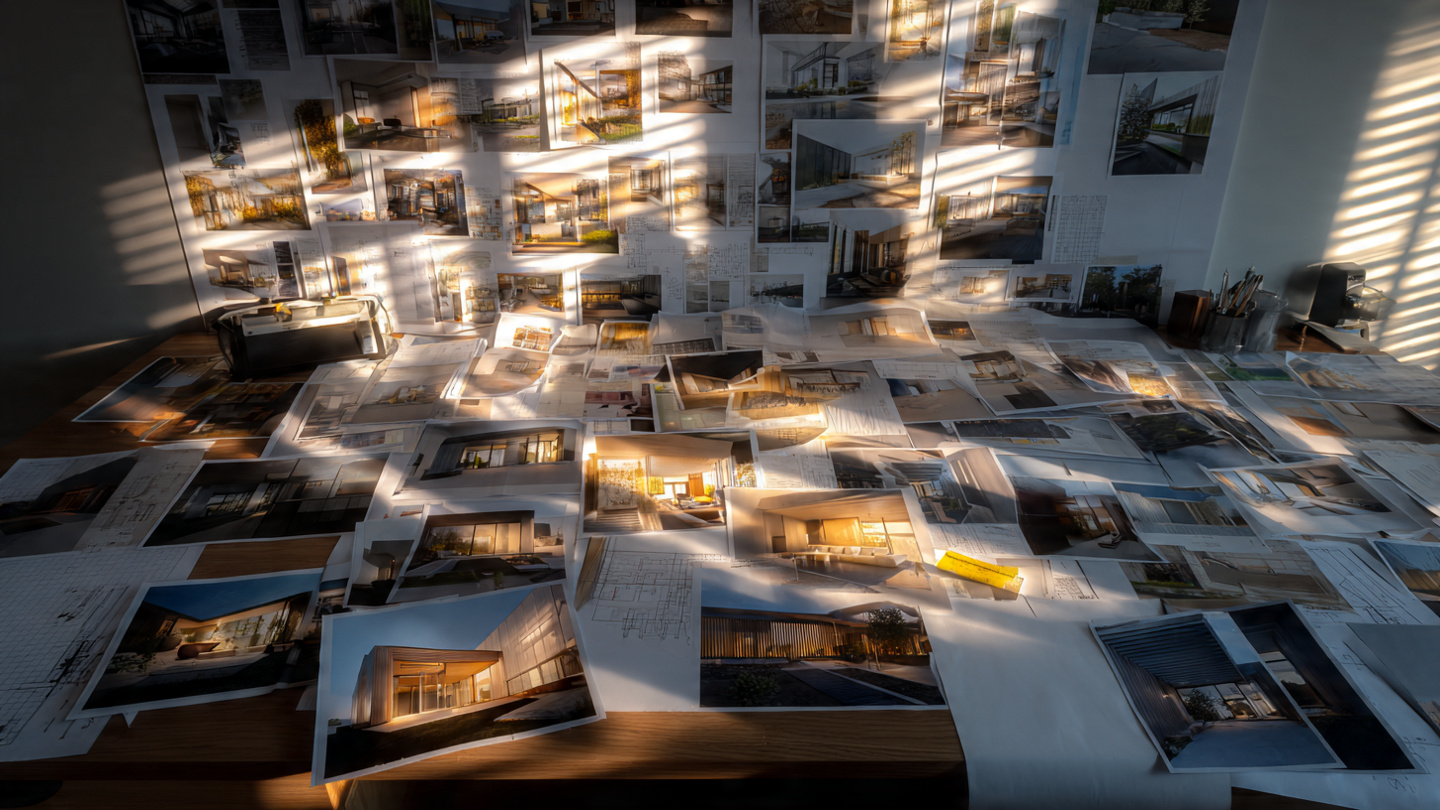
A Portland architect showed me her screen last month. She had generated 48 conceptual renders of a client's house in 40 minutes using Midjourney and a $30/month subscription. Warm light spilling through floor-to-ceiling glass, white oak floors catching golden hour, clean-lined furniture floating in negative space, slatted wood accents framing every window.
Beautiful, all 48 of them, and identical in every way that mattered.
Not identical in plan, obviously, because some were two stories and some were single, a few had flat roofs while others pitched. But the atmosphere, the material palette, the quality of light, the emotional register of the spaces that were supposed to feel distinct from one another and justify the conceptual breadth of 48 variations? One image repeated with the furniture rearranged. She recognized it instantly when I pointed it out, though she also admitted she had sent seven of those renders to her client that afternoon without noticing.
"I used to spend $4,000 per image on a visualization studio in Seattle," she told me. "Now I spend $30 a month and get unlimited iterations. But I'm starting to wonder what I lost."
100,000x Cheaper, and Converging
What she lost is becoming measurable. In 2025, a high-end architectural visualization studio charged $2,000 to $8,000 per image. AI rendering platforms like Fenestra now produce comparable-quality images for $0.02 to $0.08 each. At the extremes, that is a 100,000-fold cost reduction in two years.
That collapse is real, and for small firms it has been liberating, because a two-person studio in Tucson can now show clients photorealistic options that would have cost $20,000 a decade ago. But cost collapse creates volume, volume rewards speed, and speed rewards convergence, so when iteration is essentially free you stop thinking about what each image means and start thinking about how many you can generate before the client meeting at 2 p.m.
A 2026 survey by Chaos and Architizer of nearly 800 architects found that 64% had experimented with AI tools for design, with 43% identifying the concept and pre-design phase as the area where AI adds the most value, though 48% cited inconsistent or poor output quality as their biggest challenge and 69% described themselves as only "somewhat" satisfied with AI-generated visuals. Useful but not quite right; fast but not quite theirs.
51% Say It: Everything Looks the Same
In a VWArtclub poll of 174 architectural visualization professionals, 51% identified "oversaturation and repetitive visual trends" as the single biggest obstacle holding the industry back. Not AI automation (21%) or shrinking client budgets (25%). Sameness.
Simon Oudiette of Horoma Studio put it bluntly: "AI isn't the problem, because ArchViz was already boring way before it appeared." His point resonated throughout the thread and surfaces an uncomfortable truth that predates generative tools entirely: architectural visualization has always rewarded certain aesthetics over others, social media amplified those preferences long before Midjourney arrived, and AI simply made the feedback loop instantaneous so that what once took months of cultural convergence now takes seconds of statistical convergence.
Hrvoje Čop framed the economic consequence: "The fact that 'good enough' imagery has been democratized to a point where it costs a few cents and takes a few minutes has changed the game completely," and most clients now want "good enough" rather than extraordinary, a shift that has reshaped both the artistic ambition and the financial sustainability of the firms that once charged $5,000 to deliver something no one else could produce.
2,000 Images, One Aesthetic
Researchers at the University of Sharjah published a study in Scientific Reports analyzing over 2,000 AI-generated architectural images from Civitai, one of the largest platforms for sharing generative AI models and outputs. What they found was striking in its uniformity: 69.9% of the most popular images used ultra-modern or futuristic styles. Structural elements dominated user prompts at 31.11%, followed by environmental context at 24.5%.
Nearly seven out of ten images converged on a single aesthetic family, which is not surprising if you understand how generative models work.
Stable Diffusion, Midjourney, and their descendants are trained on billions of internet-sourced images that already overrepresent certain visual languages, particularly the Western contemporary aesthetic that dominates architectural media: clean lines, expansive glazing, natural materials photographed in soft natural light. When an architect in Bogotá or Bangalore prompts an AI to render "a beautiful modern home," the model reaches for the same visual average that an architect in Brooklyn would receive, because regional materiality, climatic adaptation, vernacular proportion, and local craft traditions simply do not survive the statistical averaging that produces an AI image.
A separate study on AI interpretations of Iranian pigeon towers found that generative models produce "an aesthetic average that smooths cultural distinctions into a global visual norm," and that while models can extrapolate missing surfaces with remarkable precision, they "rarely register material behavior or climatic adaptation," which means what you see is gorgeous while what you lose is everything a building needs to actually belong somewhere.
Designing FROM the Render Instead of TO It
Here is where the problem becomes structural, not just aesthetic.
Traditionally, a visualization was the last step. An architect designed a building, resolved its spatial logic, understood its site, and then hired a renderer to communicate the result to a client who could not read drawings. Rendering served design, functioning as translation rather than authorship.
AI has reversed that sequence for a growing number of practices, because when you can generate 50 photorealistic images before you have drawn a single plan, the image becomes the design origin, and clients fall in love with a render and then ask you to build backward from it, resolving structure, circulation, code compliance, and mechanical systems around a picture that was never constrained by any of them. Mario Carpo, in a lecture at the Harvard GSD, argued that generative AI is "essentially a machine for automating what we, as humans, have always done: imitate." That framing is generous. Imitation implies studying a source and choosing what to carry forward; what AI does is average, compressing the entire visual history of architecture into a weighted mean and returning that mean to you as a starting point for a building that a real family will live in and a real site will have to accommodate.
As ArchDaily observed, algorithmic synthesis "yields results without clear authorship, flattening the depth and intention carefully developed over time within a design language." For an architect who spent a decade cultivating a recognizable approach to light, or to thresholds between interior and landscape, or to the way a roof meets a wall, that flattening is not a productivity gain. It is an erasure.
What It Costs Beyond Money
Ciro Sannino of Realistic Interiors warned that "many traditional 3D jobs will vanish, especially in big firms that no longer need as many visualizers," while Miguel Casso, working in Peru, reported that agencies are already "cutting costs by replacing artists with AI workflows," and that "it's not the brands asking for it, it's the agencies themselves," a distinction that matters because it means the aesthetic compression is being driven not by client demand for sameness but by intermediary cost-cutting that treats design communication as a commodity.
A 2025 D5 Render survey of 665 professionals across 100 countries found that small studios of 2 to 10 people are adopting AI tools far faster than large firms, which remain stuck in management approvals and compliance reviews, creating an irony where the firms best positioned to resist aesthetic convergence through institutional design culture are the slowest to adopt the tools while the small studios driving adoption are the most vulnerable to the "good enough" trap that collapses their design language into AI defaults.
Architects report an emotional split that the survey data confirms quantitatively: they acknowledge AI makes them faster and sometimes better, but they also worry about "design becoming too homogenized," about overreliance, about questions of authorship and originality that did not exist when producing a single render cost $5,000 and required making deliberate choices about every material, every light source, and every angle of view.
What You Can Actually Do About It
If you are a homeowner reviewing AI-generated renders from your architect, ask one question: what is specific to my site? Sunlight enters your lot from specific angles at specific times of year. Wind moves across your property in patterns shaped by terrain and neighboring structures. Your soil has a particular bearing capacity, your street has a particular noise profile, and the view from your kitchen window includes actual trees, not procedurally generated ones. If the render could be placed on any lot in any city without looking wrong, it was not designed for your house. It was generated.
If you are an architect, the research suggests a few concrete practices to maintain design specificity in an AI-assisted workflow:
Use AI for iteration, not origination. Generate renders after you have resolved a spatial concept, not before, because when the image arrives first you spend your design energy defending a picture rather than developing an idea, and the picture was never grounded in the physical constraints of the site it was supposed to represent.
Feed your models local data. Several architects I spoke with have begun training LoRA (Low-Rank Adaptation) models on photographs of their own completed projects, regional materials, and local light conditions, and a LoRA fine-tuned on the raking light of a New Mexico afternoon produces renders that look like New Mexico rather than like a Dwell magazine cover shoot in a location-neutral void.
Show the clients the convergence. Print ten renders from ten different AI prompts and lay them side by side, because if the client cannot distinguish them that is your argument for why design fees exist, why an architect's eye matters, and why a $0.05 image is worth exactly what it costs.
Limitations of This Analysis
VWArtclub polls surveyed self-selected visualization professionals rather than a random sample of all architects, and Civitai is an AI enthusiast community whose 69.9% futuristic convergence reflects what that community produces and upvotes rather than what gets built. Rendering cost comparisons use advertised pricing, and real project costs vary with scope, revision rounds, and the complexity of the architecture itself. Aesthetic "sameness" is inherently subjective, even when supported by frequency data across 2,000 images, and no study has yet tracked whether AI-rendered homes are actually built more similarly than homes rendered by human visualizers, because that research would require comparing built outcomes rather than images, and it does not yet exist.
A $5.85 Billion Market for the Average
Generative AI in architecture is a $1.48 billion market growing at 41.1% annually to $5.85 billion by 2029, and that growth will not slow because an architecture critic wrote an essay about aesthetic convergence or because a visualization professional in Athens posted a poll about repetitive trends. Money flows where efficiency lives, and AI rendering is efficient beyond anything the profession imagined five years ago.
But efficiency is not architecture, and it never was. Architecture is the discipline of making specific decisions about specific places for specific people, and the tool that makes those decisions fastest is not necessarily the one that makes them best; a render that costs $0.05 and takes four seconds is an extraordinary invention for exploring possibilities and a terrible one for replacing judgment.
That Portland architect now asks her clients to pick their three favorite AI renders and explain what they love about each one. Then she ignores the images entirely and designs to the words. Because the words describe a feeling about light, or intimacy, or how a kitchen connects to a garden, and those things cannot be averaged.
The images can.