I sat through an AI scheduling demo last month. Slick interface. Gantt charts that rebalanced themselves in real time. The sales rep clicked a button, and the algorithm compressed a 9-month custom home build into 7.2 months by resequencing trades and eliminating slack. Beautiful.
I asked one question: where are the inspection holds?
Blank stare. "What do you mean?"
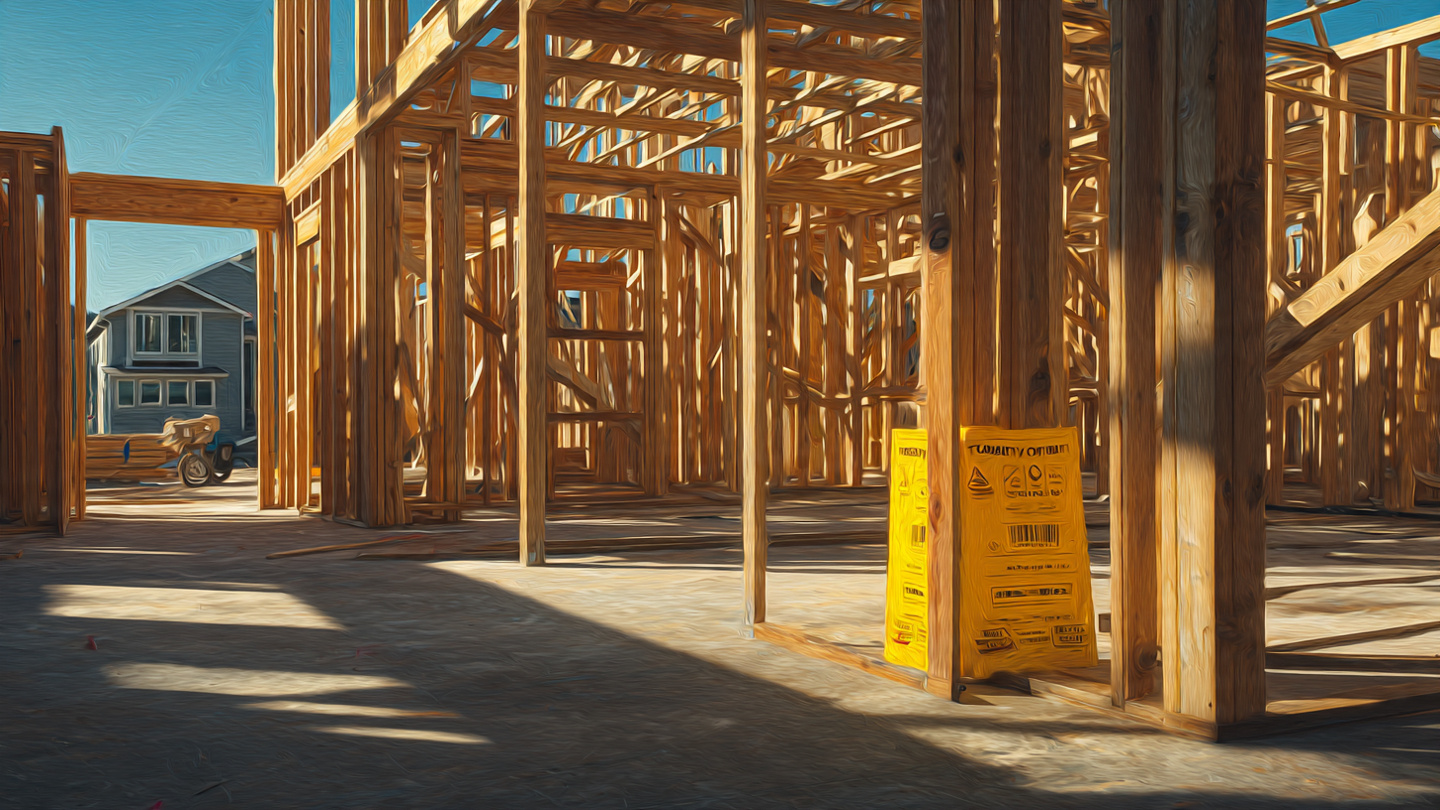
I mean the 11 times during a new home build when all work stops, the crew goes home, and you wait for a municipal inspector who may or may not show up within the week. The longest pause in residential construction is not a late lumber delivery or a subcontractor no-show. It is a phone call to the building department that gets returned in three to five business days. Sometimes ten.
Count the Holds
A typical new single-family home under the International Residential Code requires between 10 and 14 mandatory inspections before you get a certificate of occupancy. The exact number depends on your jurisdiction, but a standard build hits most of these:
Footing. Foundation wall. Slab or under-floor. Rough framing. Rough electrical. Rough plumbing. Rough mechanical. Insulation. Drywall nailing in some jurisdictions. Final building. Final electrical. Final plumbing. Final mechanical. Some counties add erosion control, setback verification, energy compliance checks.
Eleven inspections is a conservative count for a straightforward build. Each one is a gate. Framing cannot begin until the foundation passes. You cannot close walls until rough-ins pass. You cannot move a homeowner in until finals clear. These are not optional milestones. They are legal requirements.
$123 a Day to Watch Your Phone
Every day between "inspection requested" and "inspector arrives" is a day your construction loan accrues interest, your builder's risk insurance ticks, and your property taxes accumulate. On a $500,000 home with a $400,000 construction draw at the current average construction loan rate of about 8.5%, daily carrying costs break down like this:
Loan interest: $400,000 at 8.5% divided by 365 equals $93.15 per day. Builder's risk insurance and property tax accrual adds roughly $30. Total: about $123 every day the project sits idle waiting for an inspector.
Multiply that across 11 inspections. If your jurisdiction averages 3 business days per inspection request, that is 33 business days of dead time. At $123 per day: $4,059.
In high-cost markets, the math gets ugly fast. An $800,000 draw at 9% with California insurance and tax rates pushes daily carrying to $252. At the same 3-day average: $8,316.
In overloaded jurisdictions where inspectors are booked 5 business days out, that is 55 business days. Eleven weeks. At $252 per day: $13,860 in pure wait cost. Not materials. Not labor. Just time.
Why AI Schedulers Cannot Fix This
AI scheduling tools are genuinely useful for optimizing what builders control. Trade sequencing, material staging, crew allocation. Procore's AI Copilot, ALICE Technologies, Outbuild. They can compress the work between inspections. That compression is real and it matters.
But they cannot schedule the inspector. Municipal building departments are not APIs. They do not accept webhook callbacks. An algorithm cannot optimize a queue it cannot see, controlled by a government agency that staffs inspectors based on last year's budget, not this year's permit volume.
The National Multifamily Housing Council found in 2022 that 77% of respondents reported permitting delays. That number has not improved. The Census Bureau's Survey of Construction shows the average single-family home took 9.1 months from permit to completion in 2024, including 1.4 months just waiting for authorization to start. That 1.4-month gap is before a single shovel hits dirt. The inspection waits come on top of that.
In Florida, Freedom Code Compliance reported in February 2026 that Miami-Dade plan reviews run 6 to 8 weeks. Every week of delay costs contractors $5,000 to $8,000 in carrying costs on commercial projects. Residential numbers are lower per unit but hit harder because the builder's margin is thinner.
What Good PMs Actually Do
Experienced project managers have always known this. The workaround is not technology. It is relationships, timing, and stacking.
Batch your rough-ins. In most jurisdictions, you can request rough electrical, rough plumbing, and rough mechanical on the same day. That turns three inspection waits into one. Not every inspector will accommodate this, but many will if you ask. Three separate calls, three separate waits, three separate windows of idle time. One combined call saves 6 to 10 business days.
Know your inspector's schedule. Some jurisdictions publish next-available dates online. Most do not. Call the department, ask which days are lightest. Tuesday mornings in my county are consistently faster than Friday afternoons. This is local knowledge that no AI tool has.
Front-load your documentation. A failed inspection does not just cost you the re-inspection wait. It costs you the rework time plus a second wait. I have seen a failed framing inspection add three weeks to a project. Not because the fix took three weeks, but because the rework took two days and the re-inspection took thirteen business days. Have your framing contractor self-inspect against the code checklist before you call. It is cheaper to spend an extra hour on the ladder than to wait two weeks for a second chance.
Use third-party inspectors where legal. Florida allows private inspection providers under Florida Statute 553.791. Private providers in Florida deliver plan reviews in 24 hours versus weeks through building departments. Starting July 1, 2026, HB 405 requires building departments to reduce permit fees 50% to 75% when contractors use private providers on commercial projects. Residential adoption is growing. Check whether your state has equivalent provisions. Most do not, but the ones that do can cut weeks off your timeline.
An Honest Case for the AI Scheduler Anyway
I am not saying these tools are useless. A BD+C survey found that 87% of contractors report delays, with materials (71%), weather (65%), and labor (38%) as the top causes. AI scheduling legitimately addresses all three by predicting lead times, incorporating weather forecasts, and optimizing crew allocation. If a tool saves you even two weeks on trade sequencing across a 9-month build, that is $1,722 to $3,528 in carrying costs avoided, depending on the market.
The mistake is believing that the schedule the algorithm produces is the schedule you will live. It never is. The work between inspections might compress from 6 weeks to 5. But the 3 days waiting for the inspector does not change. And there are 11 of those gates.
What Would Actually Help
If an AI scheduling company wanted to solve the real problem, it would integrate with municipal inspection scheduling systems. A few cities have online portals. Most still use phone calls. An algorithm that could pull real-time inspector availability, predict wait times by jurisdiction, and adjust the critical path accordingly would be worth its subscription fee ten times over.
Nobody has built this. The data is fragmented, proprietary, and in many cases does not exist digitally. It is a government infrastructure problem masquerading as a construction technology problem.
Until someone solves it, the most valuable scheduling tool in residential construction remains a superintendent with 15 years of local relationships who knows that if you call Building and Safety before 7:30 a.m. on a Tuesday, you get Maria, and Maria can usually fit you in by Thursday.
What This Estimate Cannot Account For
The $4,059 to $13,860 range assumes inspections are fully sequential. In practice, competent PMs overlap some waits with ongoing work on other phases. You can frame the second floor while waiting for the first-floor rough-in inspection. The actual idle cost per inspection is lower than the pure calculation suggests, perhaps 50% to 70% of the theoretical maximum.
Inspection wait times vary enormously. Rural counties with low permit volume may inspect next-day. Overloaded urban departments may take two weeks. No comprehensive national dataset on residential inspection wait times exists. This analysis uses 3 business days as a midpoint based on contractor reports from suburban jurisdictions. Your mileage, literally, will vary.
Construction loan terms range widely. Some lenders draw down in stages, so interest accrues on a smaller balance early in the project. The carrying cost calculation uses a flat draw for simplicity, which overstates early-stage costs and understates late-stage costs when the balance is higher.
AI scheduling tools are evolving rapidly. Procore, ALICE, and others may add inspection wait modeling. If they do, the gap this article describes will narrow. But as of April 2026, none of the major platforms account for it.
Sources
- International Residential Code. iccsafe.org
- the current average construction loan rate of about 8.5%. bankrate.com
- Procore's AI Copilot. procore.com
- The National Multifamily Housing Council found in 2022. nmhc.org
- Census Bureau's Survey of Construction. eyeonhousing.org
- Freedom Code Compliance reported in February 2026. fcc-website-main.up.railway.app
- Florida Statute 553.791. leg.state.fl.us
- BD+C survey found that 87% of contractors report delays. outbuild.com