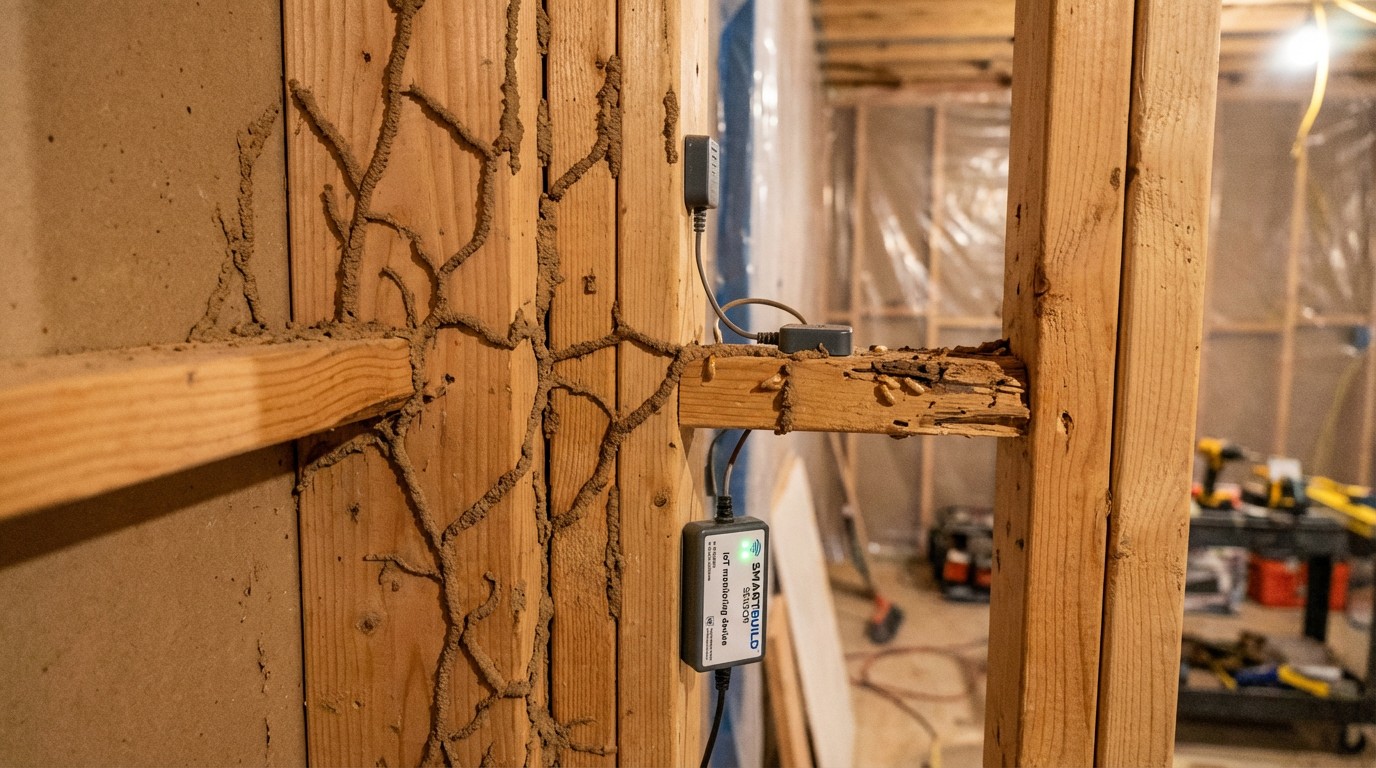
A standard pre-construction termite treatment runs about $1 to $2 per linear foot. For an average home, that is $150 to $400. The builder checks a box, the soil gets sprayed, and everyone moves on. Five years later, the chemical barrier starts to degrade. By year seven, your home is protected by optimism.
Termites cause $6.8 billion in annual property damage in the United States. More than floods. More than fires. More than earthquakes. Standard homeowners insurance covers none of it.
What $400 Actually Buys
Liquid soil treatments using bifenthrin or fipronil create a chemical perimeter around the foundation. When applied correctly during construction, they work. Termites that cross the treated soil die or are repelled. That part is real.
But chemical barriers don’t last forever. Most products carry a 5-to-10-year warranty, and actual efficacy depends on soil type, drainage, and whether anyone bothered to treat around the plumbing penetrations. When a landscaper digs a trench for irrigation two years after closing, the barrier is breached. Nobody tells you. Nobody knows. Termites are cryptic creatures, according to University of Kentucky entomologists. Colonies eat wood from the inside out. By the time you see damage, you are looking at years of undetected feeding.
Average treatment after infestation runs $575 to $2,500 for liquid retreatment, $2,500 to $3,500 for fumigation. Structural repair on top of that: $3,000 to $30,000 depending on how long the colony had before someone noticed. Call it what it is. A $400 treatment buys you five quiet years followed by a surprise bill.
What Monitoring Actually Looks Like
Three technologies have matured enough to change the math. None of them existed at consumer scale a decade ago.
Termatrac’s iTraker PRO uses low-energy microwave radar to detect termite movement through walls without drilling. Pair that with thermal imaging and moisture readings from the same handheld device, and a pest inspector can scan your entire home in under an hour without opening a single wall. Australian-developed, now used by certified inspectors in 40+ countries.
Anticimex SMART takes a different approach: permanent IoT monitoring stations placed around structures. Sensors detect activity 24/7. AI analyzes patterns and alerts pest professionals before damage begins. Over 3 million connected devices deployed globally, with the system learning to distinguish termite behavior from ambient vibration, temperature fluctuation, and moisture changes.
Sentricon Always Active from Corteva protects 4 million homes with bait monitoring stations. While not AI-driven itself, the continuous monitoring model proves the concept: check the stations, feed the data, catch colonies before they reach your floor joists.
Below these commercial products sits a research layer. Acoustic emission detection at the University of Florida and CSIRO in Australia uses machine learning to classify termite feeding sounds within wood. Lab accuracy exceeds 90%. Thermal imaging combined with computer vision models shows 85 to 92% detection accuracy for termite-indicative heat signatures in wall cavities, according to papers in the Journal of Pest Science from 2023 and 2024.
Build It In or Pay Five Times Later
Every one of these technologies works better when installed during construction. Before drywall goes up, you can place moisture and temperature sensors inside wall cavities for $5 to $15 per sensor. Wireless units with 20-year battery life. IoT monitoring stations can be positioned in-wall for $200 to $500 for a whole-home system. Physical barrier mesh at slab-to-wall junctions costs $0.50 to $1.00 per linear foot when installed during the pour.
| Protection Layer | During Construction | Retrofit |
|---|---|---|
| Chemical soil treatment | $150–$400 | $575–$2,500 |
| Physical barrier mesh | $500–$1,500 | Not feasible post-slab |
| Borate-treated lumber | $300–$600 | Not feasible post-frame |
| IoT monitoring system | $200–$500 | $1,500–$3,000 |
| In-wall moisture sensors | $100–$300 | $2,000–$4,000 (wall opening) |
| Total integrated package | $1,500–$3,000 | $5,000–$10,000+ |
A builder who installs borate-treated lumber throughout the framing package adds $300 to $600 to the material cost. Borate is toxic to termites and fungi, nontoxic to humans, and does not degrade over time. It cannot be applied after the walls are closed. Once drywall is up, the opportunity is gone permanently.
Why Builders Don’t Do This
Same reason they didn’t install CO detectors until code required it. Same reason radon mitigation wasn’t standard until states mandated testing. A $1,500 add for a problem the buyer cannot see competes against a $1,500 upgrade the buyer can see. Granite countertops win every time.
IRC Section R318 requires termite protection in mapped infestation zones, but the bar is low: chemical soil treatment during construction satisfies the requirement in most jurisdictions. Eighteen states require pre-construction treatment for new homes. Zero states require ongoing monitoring.
That regulatory gap is the whole story. Treatment is mandated. Monitoring is optional. So builders do the minimum: spray the soil, document the application, and hand it off. If the barrier fails in year six, that is the homeowner’s problem.
The Counterargument Is Honest
Chemical soil treatment works. Bifenthrin has decades of field data. A properly applied barrier will protect a home for its warranty period, and retreatment every five to ten years costs a fraction of the damage it prevents. Many builders and pest control operators argue, correctly, that the existing approach has protected millions of homes without elaborate sensor networks.
Fair enough. But the argument breaks down at the transition points. Barriers degrade on a timeline the homeowner rarely tracks. Construction activity after closing breaches treated soil constantly. Landscaping, utility work, pool installation, fence posts. Every shovel through the perimeter is an invitation. And the chemical barrier cannot tell you when it has been compromised. You find out when a swarm emerges from your wall or an inspector taps a floor joist and hears hollow.
Continuous monitoring fills the gap between treatments. Not as a replacement. As an insurance policy that the insurance company refuses to sell you. Smoke detectors don’t prevent fires. They catch them early enough to limit the damage. Termite monitoring does the same thing, at a fraction of the cost of the damage it prevents.
What Actually Needs to Change
Building codes need to catch up with building technology. If IRC Section R318 required continuous monitoring in high-infestation zones the way it requires smoke detectors in every bedroom, the installed cost would drop as manufacturers scaled production. A $200 monitoring system at volume drops to $120. A $5 wireless sensor drops to $2. Production builders ordering 500 systems at a time would negotiate rates that custom builders cannot.
Until then, the buyer who wants smart termite protection has to ask for it. Specifically. In writing. Before framing starts. After drywall, the most effective options disappear. You can still install external bait stations and retrofit surface-mounted sensors. But you cannot embed them in the wall cavity where they detect moisture changes earliest, and you cannot treat framing lumber that is already enclosed.
Termites are in every state except Alaska. They were here before the house and they will be here after it. A $400 chemical spray is a bet that nothing will change for five years. A $1,500 monitoring system is a bet that something will, and you will know about it before the floor gives way.