Forty-seven degrees and drizzling. November in Connecticut. I watched a framing crew sit in their trucks for four days because the foundation contractor would not sign off on form stripping. Seven-day break results were not back from the lab yet. It had been poured at 58°F with an accelerated mix. It almost certainly hit 75% of f'c by day four. Nobody knew, because nobody measured.
That was 2019. Those four idle days cost the project roughly $500 in construction loan interest, $200 in form rental, and whatever you want to assign to a framing crew that drove 40 minutes each morning to stare at plywood. Multiply that across four concrete pours in a single-family build. Then multiply across an entire year of homes.
A $50 sensor could have answered the question in real time.
What a Maturity Sensor Actually Does
Concrete does not gain strength on a calendar. It gains strength through a chemical reaction between cement and water, and that reaction is governed almost entirely by two variables: time and temperature. Warmer concrete cures faster. Cooler concrete cures slower. The relationship is predictable enough that ASTM C1074 codified it decades ago as the "maturity method," using either the Nurse-Saul equation or the Arrhenius formulation to convert a time-temperature history into an estimated compressive strength.
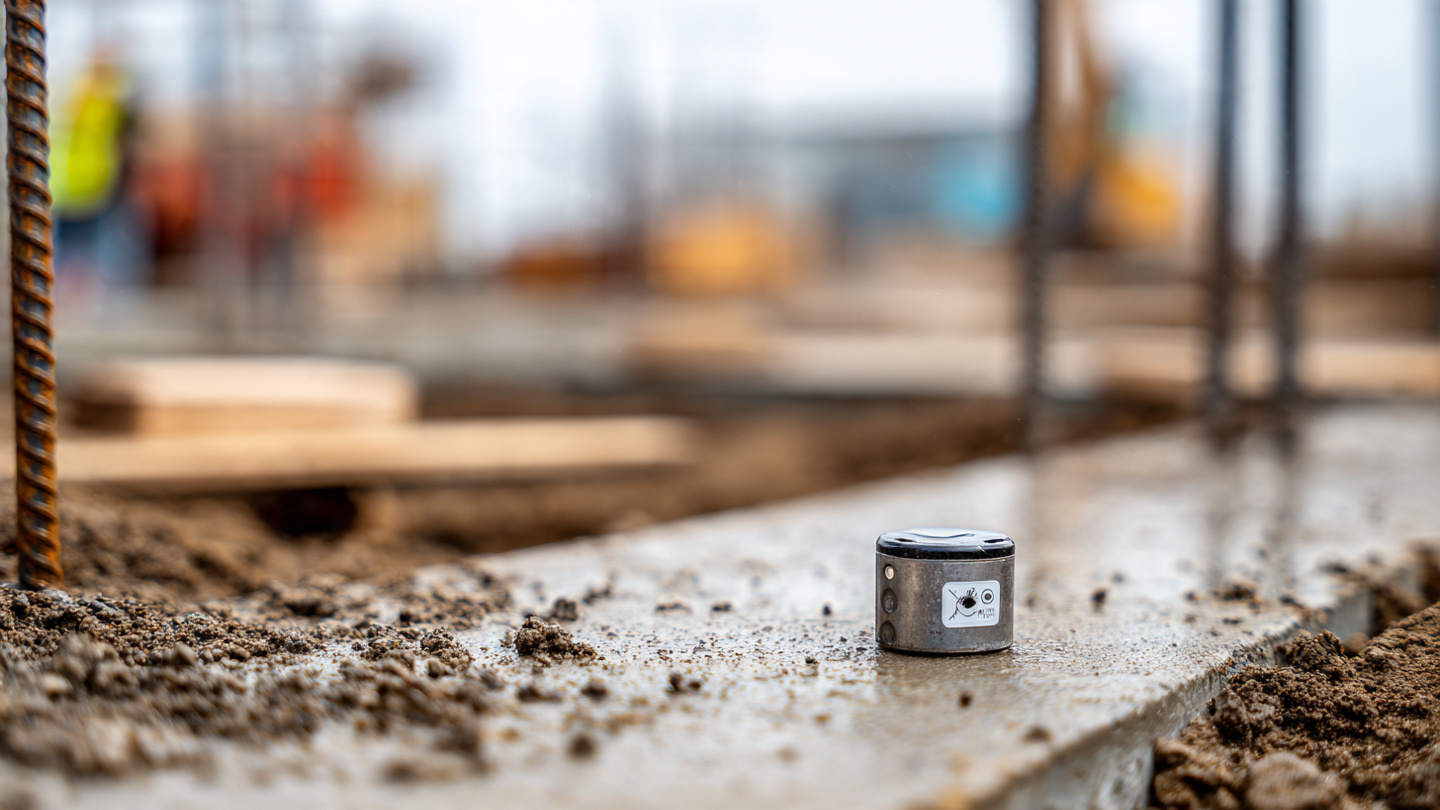
A wireless maturity sensor is a small device, roughly the size of a deck of cards, that you zip-tie to a piece of rebar before the pour. It gets buried in the concrete. It measures internal temperature continuously and transmits data to a phone app via Bluetooth. Your phone app applies the maturity curve for your specific mix design and tells you, in real time, what percentage of target strength the concrete has reached.
No waiting for the lab. No guessing. No tradition-based scheduling.
Giatec's SmartRock sensors run about $40 to $60 each, sold in 10-packs. Maturix (owned by Saint-Gobain) and Hilti's HCS T2 offer competing products. All are ASTM C1074 compliant. All require an initial calibration of your concrete mix, which means making about 15 test cylinders alongside embedded sensors and building a maturity-strength curve. Once you have the curve for a given mix design, every subsequent pour using that mix can rely on sensor data alone for operational decisions.
Where the Money Actually Goes
Most people think of construction costs as materials plus labor. They forget about the clock. A $500,000 single-family home typically runs on a construction loan of around $400,000 at 7% to 9% interest, drawn in stages. During the foundation phase, the outstanding balance is roughly $150,000, representing land acquisition, site preparation, and the concrete work itself.
At 8% interest, that $150,000 balance costs $32.88 per day in interest alone.
But interest is not the only daily expense. Form panels and bracing rent at $50 to $75 per day. Builder's risk insurance runs about $6.85 daily ($2,500 annually). A superintendent's allocated time adds another $25. When you add it all up, every day the project sits waiting for concrete clearance costs roughly $115 to $140.
Under the traditional approach, a builder pours concrete and makes six to twelve test cylinders at the same time. Those cylinders go to a lab. You break some at 7 days, some at 28. The 7-day break confirms operational strength for form stripping. The 28-day break confirms the mix met its design specification. Cylinder compression testing runs $70 to $250 per set, according to WirelessEstimator and PrimeTest Engineering, plus on-site technician fees of $35 to $50 per hour.
Even in warm weather, most builders wait a full seven days before stripping. They schedule the lab break, wait for results, get the report on day 8 or 9, then schedule their next trade. In practice, I have seen projects lose 8 to 9 days per pour following this rhythm.
Four Pours, Sixteen Lost Days
A typical residential build includes four major concrete pours: footings, foundation walls, basement or slab-on-grade, and garage slab. Some projects add retaining walls or porch footings, but four is the baseline.
With maturity sensors, the timeline compresses. In warm weather (above 60°F ambient), concrete routinely hits 75% of its specified compressive strength by day 3 or 4. You know this because the sensor on your phone says so. You strip the forms, move on. Beton Consulting Engineers documented a case where a contractor planned 7-day form removal, but maturity data showed the concrete was ready at day 4. That project saved a full month across all pours.
| Method | Wait per Pour (Warm) | Wait per Pour (Cold) | 4-Pour Total (Warm) |
|---|---|---|---|
| Traditional cylinders | 8-9 days | 10-14 days | 32-36 days |
| Maturity sensors | 3-4 days | 6-8 days | 12-16 days |
| Days saved | 4-5 | 4-6 | 16-20 |
Sixteen days at $125 per day is $2,000. Twenty days (cold weather) is $2,500.
For a production builder running 50 homes a year, that adds up to $100,000 to $125,000 in annual carrying cost savings. For the custom home builder doing three to five projects, it is $6,000 to $12,500 a year. Not transformational money. But not nothing, either, especially when the investment is twelve sensors at $50 each.
A 5-to-1 Return on a $400 Investment
Sensor cost for a full residential project: $600 (12 sensors). You still need 28-day acceptance cylinders for final QC, which runs about $480 across four pours. But you can eliminate most early-break testing (3-day and 7-day cylinders), saving roughly $200. Net additional cost over the traditional method: about $400.
Schedule savings: $2,000 to $2,500.
That is a 5-to-1 return. In construction, where margins on spec homes run 8% to 12%, recovering $2,000 per unit is the equivalent of selling the home for $2,000 more without raising the price.
Why Almost Nobody Uses Them
This is the part that frustrates me. The maturity method has been in ACI 318 for years. ASTM C1074 is well established. State DOTs use maturity sensors on highway projects routinely. Commercial concrete contractors adopted them a decade ago.
Residential builders have not. Predictable reasons, all of them. Seven-day waits are tradition. It works. Nobody has complained. The calibration requirement for each mix design costs $500 to $1,000 upfront, which feels expensive if you are pouring a single foundation. And most importantly, the carrying cost savings are invisible. They do not appear as a line item on any budget. They manifest as interest that accrues quietly, insurance that ticks daily, and rental equipment that sits idle. No one writes a check for "days we waited unnecessarily." It just disappears into the project's overall timeline.
That invisibility is exactly why the savings persist. If someone handed your builder a $2,000 invoice labeled "waiting for concrete you already know is strong enough," they would find a solution by Thursday.
Strongest Counterargument
Most residential builders already strip forms at day 7 without waiting for lab results at all. They pour on Monday, strip the following Monday, move on. The cylinder breaks are a compliance formality processed in parallel. In that workflow, sensors do not save time because the builder was never actually waiting for data. The seven-day rule is a heuristic, and for standard 4,000 psi mixes in moderate climates, it is a reliable one. The concrete almost always reaches 75% of f'c by day 7, often well before.
Sensors provide the most value at the edges. Cold weather pours where cure times are genuinely uncertain. High-early-strength mixes where you might strip at day 2 instead of day 4. Projects with tight schedules and real liquidated damages. For the builder doing five ranch homes a year in Phoenix, where it is 95 degrees in July and the concrete is probably ready by dinner, the sensor tells you something you already suspect. Real ROI, but the urgency is absent.
What AI Adds to This
Current maturity sensors are straightforward data loggers with a time-temperature calculation baked in. Giatec's "Roxi" AI layer claims to predict optimal pour timing and flag calibration errors, though independent validation of those predictions is sparse. Machine learning models trained on regional weather data, mix design libraries, and historical maturity curves could eventually forecast cure schedules before the truck even arrives. That would let a superintendent plan the next two weeks of trades with confidence on day zero, rather than reacting to sensor readings on day three.
We are not there yet. But the raw material, thousands of time-temperature curves from real pours, is exactly what those models need. Residential builders have not generated that data because they have not adopted the sensors. And they have not adopted the sensors because nobody has shown them the schedule math. Someone will eventually solve this by giving sensors away to production builders in exchange for the cure data. Until then, the gap persists.
Limitations
The carrying cost model assumes a $500,000 home with $400,000 in construction financing at 8%. Builders who self-finance or use different draw structures will see different daily costs. The maturity method requires lab calibration for each unique concrete mix design, costing $500 to $1,000 per mix. Production builders using a single mix across dozens of homes amortize that cost trivially. Custom builders with unique mixes on every project may not. Not all jurisdictions accept maturity data in lieu of cylinder breaks for form stripping. Some authorities having jurisdiction require traditional testing regardless, eliminating the schedule benefit entirely. Warm-weather savings (4-5 days per pour) are based on typical accelerated curing above 60°F. Actual cure times depend on ambient temperature, mix water temperature, cement type, and admixtures. Cold-weather savings assume the builder was actually waiting for results rather than stripping at a fixed interval, which, as noted above, many do not. The 28-day acceptance cylinders are still required in all cases; sensors address operational timing, not final quality control.