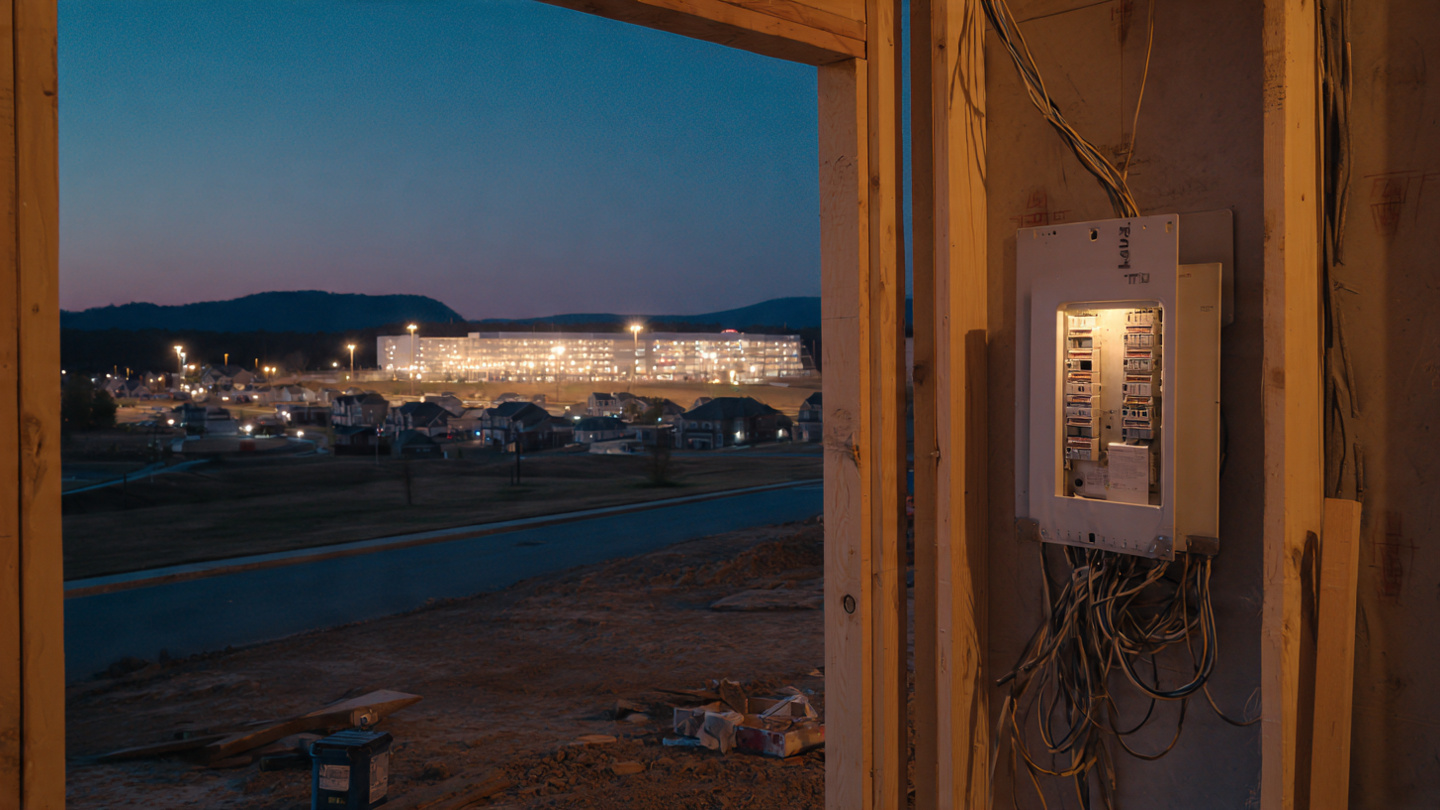
Gene Lantrip has been building houses in Abilene, Texas, for decades, and he has never lost an electrician the way he lost three last year. They did not quit the trade, did not retire, did not move to Dallas for a bigger firm. They drove eleven miles to the Stargate AI data center campus on the south side of town, where the starting wage for pulling wire through server rack enclosures is $35 an hour, nearly double the $20 Lantrip had been paying them. "It's taken us two months longer to build the houses than it did before the data centers arrived," he told TechSpot in April. Two months on a seven-month build is not a delay. It is a different business.
Lantrip's problem is not unique to Abilene, and it is not temporary, and it is not confined to electricians. Across Texas, across Virginia, across every corridor where AI infrastructure is being poured into the ground at a pace that makes the postwar housing boom look restrained, the same labor dynamics are playing out: data center construction pays more, demands the same skills, and operates on timelines that punish any contractor who cannot staff a crew by next Monday morning. Residential builders, who schedule subcontractors weeks in advance and negotiate rates that were competitive eighteen months ago, are discovering that their labor pool has been reclassified as someone else's workforce.
What Abilene Looks Like When 6,000 Workers Show Up
Abilene is a city of 130,000 people in west-central Texas. Before Stargate, its biggest employer was Dyess Air Force Base. Stargate brought approximately 6,000 construction workers into the metro area in under a year, according to reporting by KACU, the local NPR affiliate, and the community organizing groups tracking the fallout.
Rents increased by nearly $1,000 in under twelve months. Housing authority waitlists swelled to 8,000 households. Abilene already had a 5,600-unit housing shortage before the first GPU rack was installed, and every electrician, plumber, and HVAC technician who left residential projects for the data center campus made that deficit harder to close, because the homes those tradespeople would have been wiring and plumbing simply did not get wired and plumbed on schedule.
Gene Reed, CEO of the Abilene Housing Authority, described the situation to local reporters as a market where supply and demand pressures were "intensifying in ways we've never experienced." That is bureaucratic language for: the people who need affordable housing the most are now competing for apartments with data center electricians earning $72,000 a year, and the apartments those data center electricians need were supposed to be built by the same tradespeople who are now wiring server rooms instead.
Abilene Christian University announced plans to add 300 student beds in 18 months because its students could no longer afford off-campus rent in the city where they had enrolled specifically because it was affordable.
The Numbers Behind the Drain
Texas employs roughly 71,000 electricians. Approximately 20,000 leave residential construction annually through retirement, career changes, and lateral moves to commercial or industrial work. That attrition rate was already unsustainable before data centers began absorbing electricians at wage premiums residential builders cannot match.
Between the two sectors, the wage gap tells a story of pure economic gravity. A residential electrician in Texas averages $20 per hour, per TechSpot's reporting on the labor displacement. A data center electrician performing comparable work on higher-voltage systems earns $35 per hour. That 75 percent premium requires no additional certification in most cases, no relocation, and no change in union status. The worker simply shows up at a different job site on Monday and makes $600 more per week doing work that is, from a craft perspective, less varied and more repetitive than residential wiring. For a journeyman electrician supporting a family in Abilene, that math does not require contemplation.
Nationally, the picture is no less severe. The U.S. construction workforce stood at 8.32 million in April 2026, according to Amtec's workforce data report, and 82 percent of firms reported difficulty filling skilled craft positions. According to the Home Builders Institute, the industry needs 723,000 additional workers annually just to maintain current output. Meanwhile, nonresidential construction added 19,000 jobs in April alone, with data center spending rising 34 percent year over year, per the Associated General Contractors of America.
| Metric | Residential | Data Center |
|---|---|---|
| Electrician hourly wage (TX avg) | $20 | $35 |
| Wage growth YoY (March 2026) | 2.1% | Not reported separately |
| Jobs added, April 2026 | Flat | +19,000 (nonresidential total) |
| Share of large-firm backlogs | Declining | 42% |
| Construction starts, Jan 2026 | Sluggish | $25.2B (record) |
The Paradox Nobody Wants to Name
The irony has a precise shape. America is short roughly four million homes, per Freddie Mac. The technology industry's answer to that shortage includes AI-powered design tools, robotic framing systems, automated permit review, and machine-learning-optimized construction scheduling. We have covered all of them in this publication, and several of them genuinely work. But every one of those AI tools requires compute infrastructure, and every megawatt of compute infrastructure requires a building, and every building requires electricians, and those electricians are no longer available to wire the houses that AI was supposed to help us build faster.
Strip data center projects from the March 2026 construction planning data, and commercial construction planning would have dropped 12.7 percent month-over-month, according to Construction Dive's analysis of the Dodge Momentum Index. Data centers are not supplementing the construction economy. They are replacing it. For firms with over $100 million in annual revenue, data center work now represents 42 percent of total backlogs, per the Associated Builders and Contractors' April 2026 report. Construction backlogs hit a 10-month high of 8.8 months, and nearly all of that growth came from nonresidential projects.
Residential construction, meanwhile, is what the analysts at Bricks & Bytes called "quietly unraveling." Material costs are up 45.3 percent since February 2020. Residential wages rose 2.1 percent year over year in March 2026, but inflation-adjusted wages actually fell 1.2 percent, meaning residential construction workers took a real pay cut while data center workers received raises that residential builders cannot afford to match.
It Is Not Just Texas
Virginia has 663 operational data centers and 595 more planned or under construction, per Payscale. Texas has 405 operational and 442 planned. Nationally, nearly 3,000 data centers are in some stage of construction or advanced planning. Each one requires the same skilled trades that build houses: electricians for power distribution, HVAC technicians for cooling systems that run twenty-four hours a day, plumbers for the liquid cooling loops that have replaced air cooling in modern GPU clusters, welders for structural steel, and concrete workers for foundations designed to support loads that would crack a residential slab.
A JLL report on data center labor found that labor shortages in the sector are twice the national average for construction, with 10 percent of roles unfilled and only 15 percent of applicants meeting minimum qualifications. That last number is the one that should alarm residential builders, because it means data centers are not just hiring qualified tradespeople away from housing projects. They are also hiring marginally qualified workers and training them on site, which means the pipeline of apprentices and helpers who would have learned residential wiring by working alongside a journeyman electrician on a subdivision are instead learning high-voltage distribution in a server farm, developing skills that will never transfer back to residential work because the pay differential makes the return trip irrational.
The Counterargument, at Full Strength
Data center construction creates high-paying jobs in communities that need them. Abilene's economy has benefited from the influx of workers spending money at restaurants, hotels, and retail stores. Over the long term, economic output from AI infrastructure may generate enough productivity gains across the economy to increase housing supply through lower costs, better design tools, and automated construction methods that reduce labor intensity per unit built. If data centers accelerate AI capabilities that eventually let a four-person crew do what currently takes twelve, the short-term labor displacement could be a bridge to a more productive equilibrium where fewer workers build more homes at lower cost.
That argument is internally consistent and may ultimately prove correct, and I am going to explain why it does not help the person whose house is two months late right now.
Construction labor markets are local and immediate. A homeowner in Abilene who signed a contract in January 2025 for a $380,000 house with a seven-month completion date does not benefit from theoretical productivity gains arriving in 2029. Their builder cannot offer their electrician $35 an hour without repricing the entire project, because residential margins typically run 8 to 12 percent on custom homes and the labor component represents 40 to 50 percent of total cost. A 75 percent wage increase for one trade cascades through the bid, because HVAC techs and plumbers also know what data centers pay, and the builder either absorbs the cost, passes it to the buyer, or waits. Most are waiting. The buyer is the one who feels it.
What Builders Can Actually Do
Lock in subcontractor agreements earlier and longer. Multi-project commitments with guaranteed volume give residential subs a reason to stay even at a wage discount, because steady work spread across twelve months has a different risk profile than a six-month data center contract followed by an unknown gap. Several Texas builders have shifted from per-project subcontractor relationships to annual retainer structures that guarantee a minimum number of crew-days per month.
Push harder on prefabrication. Factory-built electrical panels, pre-wired wall assemblies, and modular rough-in kits reduce the number of on-site electrician hours per home from approximately 40 to 60 hours down to 15 to 25 hours for the connection and finish work that still requires a licensed tradesperson on site. The labor you cannot find does not need to be found if the work was done in a controlled environment by a different workforce.
Advocate for apprenticeship funding that is not captured by industrial employers. Current federal and state apprenticeship subsidies flow disproportionately toward the sectors with the loudest lobbying presence, and right now that is data centers, energy infrastructure, and semiconductor fabrication. The residential construction industry's voice in workforce development policy has historically been quiet, decentralized, and underfunded relative to its economic significance. That needs to change, and it needs to change before the current generation of potential apprentices has already been absorbed into industrial trades with no economic incentive to return.
Limitations
Abilene is a small city that absorbed an unusually large project relative to its population, making it an extreme case. The $20 versus $35 hourly wage gap is specific to Texas and varies significantly by market, union status, and project type. Larger metro areas with deeper labor pools may experience the labor drain as a gradual tightening rather than an acute crisis. No controlled study exists isolating data center construction as a cause of residential delay from the broader construction labor shortage that predates the AI boom by at least a decade. The 42 percent backlog figure applies only to large firms with over $100 million in revenue and does not represent the experience of the small and mid-size residential builders who construct the majority of single-family homes in the United States. Residential construction wages are influenced by factors beyond data center competition, including immigration enforcement, material cost inflation, and interest rate effects on housing demand. This article relies on reported wage figures from trade publications rather than a primary wage survey conducted by this publication.