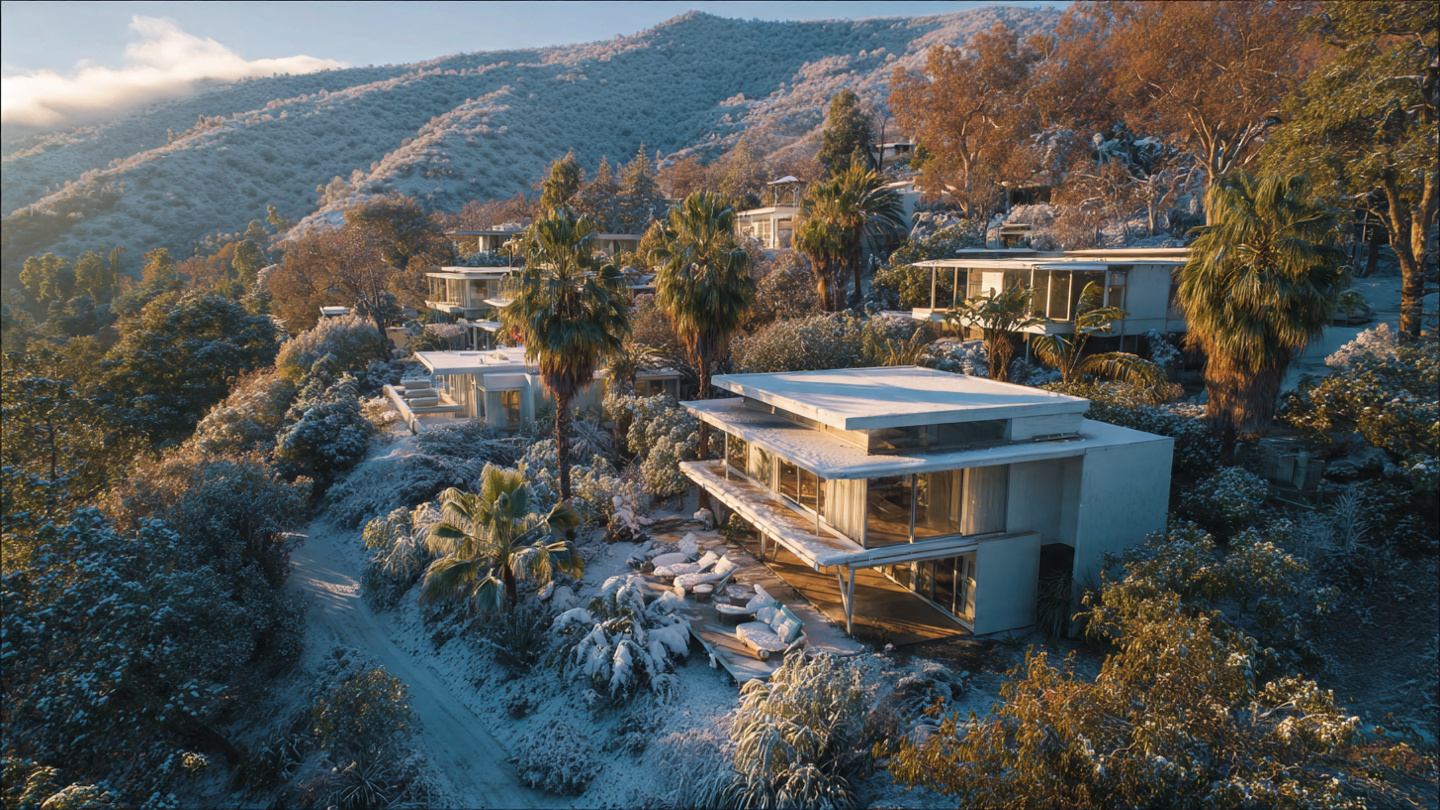
I asked three different AI home design platforms for a three-bedroom, 2,200-square-foot family home. I specified three locations: Coral Gables, Florida, where hurricanes shred anything not bolted through a concrete bond beam; Duluth, Minnesota, where frost penetrates 42 inches into the earth and snow loads crush roofs designed for gentler latitudes; and Daly City, California, where the San Andreas Fault runs close enough to make seismic bracing a matter of when, not if. Three radically different places with three radically different relationships to gravity, wind, water, and ground movement.
All three tools gave me the same house.
Flat roof. Floor-to-ceiling glass on at least two elevations. Open plan flowing from a floating kitchen island toward a living area defined by nothing except a change in flooring material. White walls, warm wood accents, the suggestion of a courtyard. Clean. Contemporary. Beautiful in the way that a stock photograph of a hotel lobby is beautiful, which is to say: it could be anywhere, which means it belongs nowhere.
A Monoculture in Glass and Concrete
That 69.9 percent figure comes from a peer-reviewed analysis published in Scientific Reports by researchers at three universities who examined 2,000 of the most popular AI-generated architectural images on Civitai, one of the largest platforms where designers, architects, and hobbyists train and share AI drawing models. Nearly seven in ten images converged on the same aesthetic language: ultra-modern, futuristic, geometrically assertive, materially detached from any identifiable place or tradition. Structure prompts accounted for 31.11 percent of the aesthetic emphasis, and environment accounted for another 24.5 percent. Historical context, vernacular tradition, climate responsiveness, and the hundred other qualities that distinguish a house built for a specific piece of earth from a render built for a mood board? Statistically invisible.
This convergence is not a coincidence but rather the inevitable output of systems trained on datasets that over-represent a particular slice of contemporary design culture: the Scandinavian-inflected, Dwell-magazine, Instagram-optimized minimalism that photographs well under studio lighting and generates engagement in feeds algorithmically tuned to reward visual novelty within narrow aesthetic bands. ArchDaily's editorial team, analyzing the phenomenon in June 2025, identified the core problem with unusual directness: "Algorithmic synthesis yields results without clear authorship, flattening the depth and intention carefully developed over time within a design language." Architecture, they argued, "is more than just an image." The AI does not agree. The AI has only ever seen images.
What the Algorithm Cannot See
A house is not an image. A house is a negotiation between a human being and the specific patch of planet they intend to inhabit, conducted through materials that respond to forces the rendering engine does not model. Consider what changes when you move a home from one IRC climate zone to another.
| Requirement | Coral Gables, FL (Zone 1A) | Duluth, MN (Zone 7) | Daly City, CA (Zone 3C) |
|---|---|---|---|
| Design wind speed | 170–180 mph | 115 mph | 110 mph |
| Frost line depth | 0 in. (no frost) | 42 in. minimum | 6–12 in. |
| Wall insulation (R-value) | R-13 | R-20 + R-5 CI | R-20 |
| Attic insulation (R-value) | R-30 | R-49 | R-38 |
| Seismic design category | B | A–B | D1–D2 |
| Primary structural threat | Hurricane uplift & flooding | Snow load & ice dams | Earthquake & wildfire |
| Glazing requirement | Impact-rated or shuttered | Triple-pane, low-E | Fire-rated in WUI zones |
That table represents the absolute minimum. It does not capture the knowledge embedded in regional construction traditions that evolved over centuries of trial, failure, and adaptation. In South Florida, hip roofs outperform flat roofs in hurricane conditions by a factor that has been measured in hundreds of damaged homes after every major storm since Andrew in 1992. In northern Minnesota, a steeper roof pitch sheds snow before cumulative weight exceeds the structural capacity of the trusses, and ice-and-water shield membrane running three feet past the exterior wall line prevents the melt-refreeze cycle from driving water under shingles and into the ceiling cavity. Along the San Andreas, moment-frame connections and plywood shear walls turn a house from a rigid box that cracks into a flexible structure that absorbs lateral displacement and stays standing.
None of this information enters an AI floor plan generator when you type "3-bedroom home in Daly City." You get an image. You do not get a building.
The Vernacular Is Not Nostalgia
Kenneth Frampton's concept of critical regionalism has been circulating through architecture schools since the 1980s, and it has aged better than most theoretical frameworks precisely because the problem it diagnosed has gotten worse. Frampton argued that architecture should resist the placelessness of the International Style by responding to local conditions: the angle of light, the prevailing winds, the materials the land offers, the way people in a particular place have learned to gather, eat, sleep, and shelter across generations of accumulated adaptation.
AI design tools are the International Style on autopilot.
ArchDaily published a separate analysis in May 2025 examining the relationship between AI and vernacular building traditions. The conclusion was blunt: "The gap between technology and the vernacular was evident not so long ago. Today, with the rapid acceleration driven by AI, that gap persists and may even be widening." Generative AI, the editors noted, can replicate the visual patterns of traditional architecture with startling fidelity. It can generate an image that looks like a Kassena compound in Burkina Faso or a Mongolian ger adapted for permanent habitation. What it cannot do is understand why those forms exist, what thermal or structural or social logic produced them, or how to adapt those principles to contemporary construction in the same climate and cultural context.
That distinction matters for anyone spending money on a house. A vernacular tradition is not a Pinterest board. It is a body of engineering knowledge encoded in physical form, tested by every storm, freeze, earthquake, and drought that the local climate delivers over generations. When AI tools ignore that knowledge, they do not just produce aesthetically homogeneous homes. They produce homes that are less well adapted to the places where people actually live.
Where the Industry Stands
A 2025 survey conducted for Homes.com found that 82 percent of interior designers now use AI tools regularly, with 67 percent relying on platforms like ChatGPT for design visualization. Respondents expressed concern about "homogenized design outcomes," a polite way of saying that their clients are bringing in AI-generated images of the same house and asking for it to be built in locations where it would perform terribly, look out of place, or violate local building codes that exist for reasons the algorithm never learned.
Maket.ai, one of the more capable AI floor plan generators with over a million registered users, offers a zoning compliance tool that lets you upload local zoning PDFs and ask plain-language questions about setbacks, lot coverage, and height restrictions, which represents a genuine step forward. But its core product still generates the same open-plan layouts regardless of climate zone, and the platform's spatial reasoning capabilities, according to a March 2026 review by illustrarch, "lag behind competitors" in ways that matter when the output is supposed to inform actual construction rather than populate a mood board.
Meanwhile, researchers at MDPI demonstrated in 2025 that AI-guided optimization of passive solar design produces radically different results depending on climate zone: heating demand reductions of 43 percent in Toronto, 65 percent in Barcelona, and over 95 percent in Riyadh, achieved through window-to-wall ratios and glazing configurations that are fundamentally different for each location. Climate-specific design is not an aesthetic preference but a physics requirement, and the AI tools that homeowners are actually using have not absorbed this lesson.
The Strongest Case for These Tools
AI design platforms are not pretending to produce construction documents. They are ideation tools, meant to accelerate the earliest and most speculative phase of design exploration, the stage where an architect sketches 15 napkin concepts to find the three worth developing. Used that way, with a licensed architect standing between the AI output and the permit application, the aesthetic convergence matters less because the professional downstream will adapt the concept to local conditions, code requirements, and the specific topography of the lot. Professional-grade tools like Autodesk Forma and TestFit already incorporate site-specific data for feasibility analysis, and the gap between those platforms and the consumer-facing generators that produce the 69.9 percent monoculture is significant.
The 69.9 percent figure itself may reflect user preferences rather than tool limitations. People who generate architectural images on Civitai are, to some degree, selecting for the styles they want to see, and the ultra-modern aesthetic is genuinely popular among younger homebuyers who have been marinating in the same Instagram-driven design vocabulary that the models were trained on. If the market wants glass boxes, perhaps the tools are simply efficient at delivering what has been requested.
That argument has merit, and it also misses the point.
The people using these tools for actual home design decisions are not trained architects selecting from a range of options and evaluating structural fitness. A 2025 survey by the American Society of Interior Designers found that the fastest-growing user segment for AI design tools is homeowners without professional design training who use the outputs directly to brief contractors, select materials, and make purchasing decisions. When the tool presents a flat roof as the default and the homeowner builds a flat roof in a climate zone where standing water, ice dams, or snow loads make flat roofs a maintenance liability, the aesthetic choice becomes an engineering mistake. The algorithm does not flag the risk. It was never trained to.
What to Do If You Are Designing a Home
Use the AI to explore. Use it the way you would use a magazine: to see what catches your eye, to test your reactions to spatial arrangements and material combinations, to discover that you prefer a courtyard entry to a front porch or a floating staircase to an enclosed one. Those are legitimate discoveries that the tools enable faster and cheaper than any previous technology.
Then stop. Hire someone who knows where you live. An architect who has built in your climate zone, who knows your local building department's interpretation of the IRC, who has watched homes in your neighborhood perform through a decade of weather and can tell you which materials hold up and which ones the previous developer used because they looked good in the rendering. That person will look at your AI-generated mood board, appreciate the parts that translate to your site, and quietly discard the parts that would have cost you $40,000 in repairs within five years.
Architecture has always been local. The best buildings fit their landscapes so precisely that they look inevitable, as though the hill or the coastline or the stand of oaks produced them rather than the other way around. An algorithm trained on two million images from everywhere produces buildings that belong to nowhere. That is not a failure of technology. It is a failure of application, and the correction is as old as the discipline itself: look at the land before you draw the house.
Limitations of This Analysis
The 69.9 percent convergence figure comes from Civitai, a platform that skews toward digital artists and architecture enthusiasts rather than practicing architects or licensed homebuilders. The population generating these images may not represent the users making real construction decisions. The climate zone comparison table reflects IRC minimum requirements and does not constitute a controlled test of specific AI tool outputs across locations. Professional-grade generative design platforms like Autodesk Forma or TestFit may incorporate site-specific data that consumer tools lack, and the limitations described here may not apply to their outputs. Consumer AI design tools are evolving rapidly, and the spatial reasoning and climate awareness gaps documented in this article may be addressed in future versions. This analysis focuses on U.S. building codes and climate zones; international contexts, local amendments, and non-IRC jurisdictions will differ.