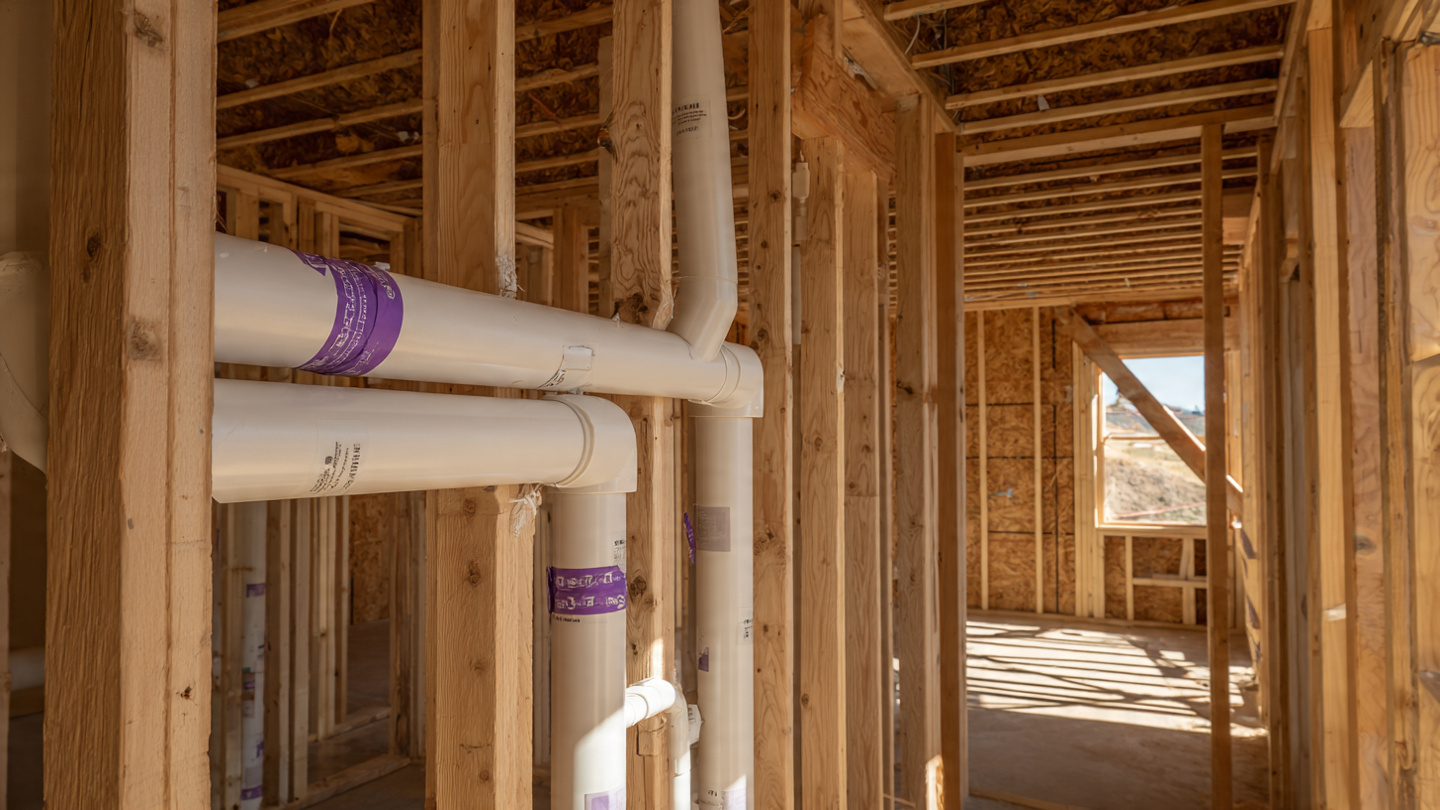
A plumber in Sacramento finishes roughing in a four-bedroom spec home. Twenty-three drain connections, every one feeding a single 4-inch sewer lateral to the street. Showers, bathroom sinks, washing machine, kitchen sink, toilets. All of it merges into the same pipe, hits the municipal treatment plant, and eventually returns to the river.
Roughly half that water never touched food or feces. Shower runoff, washing machine rinse cycles, bathroom sink drainage: warm, mildly soapy water that could flush toilets or irrigate a yard without treatment more complex than a mesh filter. Instead, it joined the sewage stream.
Adding a second set of drain lines during rough-in, separating reusable graywater from blackwater, would have cost $500 to $1,500 in extra PVC and labor. The walls were open. The plumber was already there.
Nobody asked. Nobody offered.
The $1,000 Divide
EPA WaterSense data puts graywater-eligible sources (showers, bathroom sinks, washing machines) at 50 to 65% of indoor residential water use. For a four-person household, that's 160 to 260 gallons per day sent to the sewer when it didn't need to go there.
During rough-in, with stud walls exposed, adding dual plumbing costs $500 to $1,500 per Greywater Action and Green Builder Media estimates. On a $500,000 house, the top end is 0.3% of construction cost. Retrofitting after drywall? Angi's 2026 cost data and Santa Clara Valley Water District documentation put whole-house graywater retrofits at $5,000 to $15,000+. You're cutting finished walls, rerouting drains below floor level, patching, repainting. A half-day framing job becomes a multi-trade, multi-week project.
| Scenario | Cost | % of $500K Home |
|---|---|---|
| Rough-in (walls open) | $500 to $1,500 | 0.1% to 0.3% |
| Retrofit (walls closed) | $5,000 to $15,000+ | 1.0% to 3.0%+ |
Pre-plumbing is infrastructure optionality. It costs almost nothing during construction and unlocks a future that gets cheaper every year.
Where the Payback Falls
Whether graywater reuse pencils out depends overwhelmingly on water price. We ran the numbers for a four-person household reusing 200 gallons daily, with a $5,500 total system cost (pre-plumbed rough-in connection plus a self-contained treatment unit like the Hydraloop H300, approximately $4,000 to $5,000 installed).
| Water Rate ($/1,000 gal) | Region | Annual Savings | Payback |
|---|---|---|---|
| $3.50 | Indianapolis | $256 | 21.5 yr |
| $10.00 | San Jose (Tier 2) | $730 | 7.5 yr |
| $18.00 | San Diego (Tier 3+) | $1,314 | 4.2 yr |
200 gal/day × 365 × combined water+sewer rate. Sewer rates assumed equal to water rates (common municipal structure).
Alfred Tetzner in Southern California documented a sharper case: his Hydraloop H600 dropped monthly water bills from $350 to under $160, paying for itself in 2.2 years at high-tier pricing, per a Green Builder Media profile. He had year-round irrigation demand and punitive tiered rates. Most households won't match that.
The pre-plumbing piece shifts every scenario. Without it, add $5,000 to $15,000 in retrofit costs on top of the treatment unit. In San Jose, that pushes payback from 7.5 years to 13+.
Regulation Is Ahead of Builders
California's SB 404 (2018) made laundry-to-landscape graywater systems permit-exempt statewide. Route your washing machine drain to subsurface irrigation through a three-way valve, no permit needed. More complex whole-house systems fall under California Plumbing Code Chapter 15. Arizona goes furthest: A.R.S. §18-9-711 allows residential graywater irrigation up to 400 gallons daily with no permit at all. About 30 states now have some graywater framework. Several still have none, leaving systems in a regulatory gray zone that builders resolve by doing nothing.
What AI Adds to the Equation
A $650,000 NSF Convergence Accelerator grant is funding UC Berkeley, UC Merced, and UT Austin research on AI-integrated graywater treatment: machine learning that optimizes solar photocatalytic treatment cycles based on real-time water quality, occupancy patterns, and building energy loads. On the commercial side, Hydraloop already ships IoT monitoring with daily recycling data and filter alerts. Smart water meters from Flume and Phyn can baseline consumption to right-size systems before installation.
None of it matters if the pipes aren't in the wall. Every one of these technologies assumes dual plumbing exists.
The Strongest Case Against
Where combined water and sewer rates sit below $5 per thousand gallons, the ROI on graywater treatment stretches past 15 years. Longer than most homeowners stay. Maintenance adds friction: filter cleaning, system monitoring, and the reality that most homeowners won't maintain equipment they didn't choose. In cold climates, outdoor irrigation works five to seven months per year, halving savings. Indoor toilet-flushing reuse works year-round but needs a treatment unit and pressurized supply, pushing costs above the laundry-to-landscape simplicity that makes graywater accessible.
Hardest question: no large production builder has standardized dual plumbing anywhere. If the economics were as clear as the spreadsheet suggests, Lennar or DR Horton would have moved. They haven't. Either at-scale incremental costs exceed small-project estimates, or the perceived warranty exposure outweighs marketing value. Probably both.
What You Can Do
If you're building in a state with graywater regulations (California, Arizona, Texas, and roughly 27 others), ask your builder to add dual plumbing rough-in during framing. Get the quote in writing. Under $1,500 on a $500K+ build, it's insurance against water at $20 per thousand gallons and treatment units at $2,000 instead of $5,000.
If you're a builder running spec homes in drought-prone markets, price out the rough-in as a standard option. At 0.2% of home cost, it's a marketing differentiator that costs less than the upgraded cabinet hardware you already upsell.
If your water bill is under $60/month and you're in a cold climate, the math doesn't work yet. But if you're building new, run the pipes anyway. Drywall is permanent. Optionality isn't.
What We Don't Know
Our rough-in cost estimates ($500 to $1,500) come from Greywater Action and trade media interviews, not verified production-builder data at scale. Long-term residential graywater maintenance costs are poorly studied; most data comes from commercial installations. Health and safety evidence for residential-scale indoor graywater reuse (toilet flushing) is limited compared to the well-documented subsurface irrigation pathway.
Water rate projections are inherently uncertain. Utilities in water-stressed regions have raised rates 5 to 8% annually over the past decade, which would compress payback periods further. We did not model escalating rates because compounding assumptions exceed the precision of the underlying cost data.