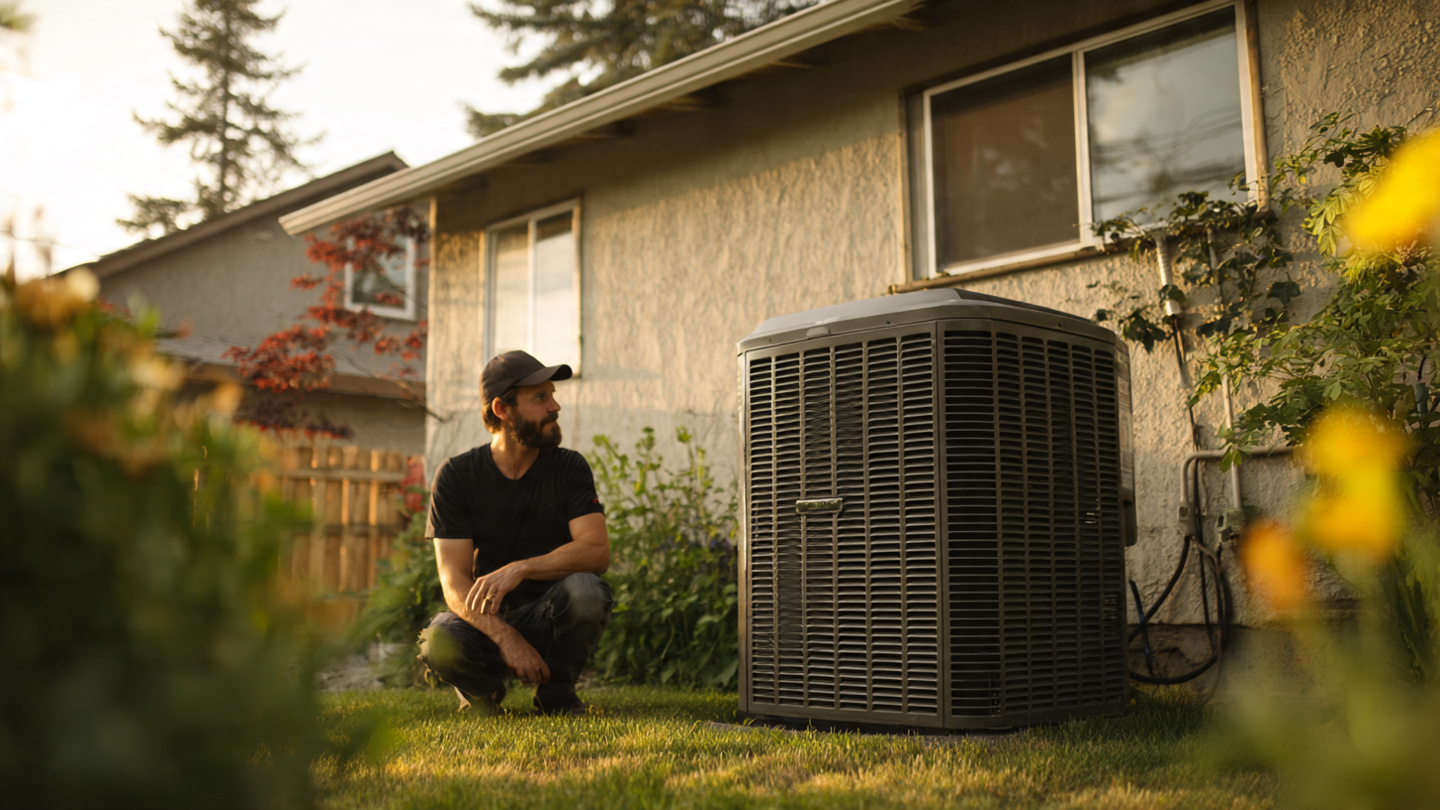
A woman in Savannah, Georgia, wanted to replace her gas furnace with a heat pump. Her old furnace pumped out 89,000 BTU per hour. An energy consultant ran a Manual J load calculation and determined her 2,600-square-foot home needed 60,000 BTU per hour for heating. So the furnace had been 50 percent oversized. Bad enough.
Then they measured runtime data from the furnace during the previous winter, comparing operating minutes against outdoor temperature near the design point of 29°F, and the actual heat demand turned out to be just 46,000 BTU per hour, which meant the furnace was now twice as large as necessary and the Manual J calculation itself had been generous.
She installed a two-stage heat pump rated at 37,000 BTU per hour on high and 24,000 on low, and it ran mostly on low stage through the coldest weeks of winter, never once triggering auxiliary electric heat, delivering a generous estimate of about 30,000 BTU per hour of actual heating capacity to a house that her old furnace had been blasting with nearly three times that amount. Even the Manual J calculation had overestimated by a factor of two. This case, documented by Allison Bailes at Energy Vanguard in March 2026, is not an anomaly but a reliable portrait of how the residential HVAC industry operates when nobody checks the math.
(ACCA/Farmington Consulting Group survey of 1,000+ contractors, 2025)
The Numbers Are Brutal
Heat pumps outsold furnaces by 30 percent in 2024, according to ACHR News reporting on industry shipment data, and twenty-five million American homes now operate heat pumps while the Inflation Reduction Act pours $8.8 billion into rebates and the national conversation treats this transition as an environmental victory without pausing to ask whether the equipment being installed will actually perform as advertised.
Nobody is talking about what happens when the contractor who shows up to install your $12,000 heat pump sizes it the same way he sized furnaces for 20 years.
A survey of more than 1,000 contractors by ACCA and the Farmington Consulting Group, published in 2025, found that 16 percent of HVAC contractors perform no load calculations whatsoever before installing equipment. Of the 71 percent who do their own calculations in-house, 35 percent do them manually, relying on rules of thumb like "one ton of cooling per 500 square feet." Only 65 percent use software.
That rule of thumb is catastrophically wrong, and the data proving it has been publicly available for a decade. Energy Vanguard analyzed 40 residential Manual J load calculations and found the average actual cooling need was 1,431 square feet per ton, with not a single calculation coming in below 624 square feet per ton. A contractor using 500 square feet per ton is installing a system roughly three times larger than the building requires, and the homeowner will never know because "it keeps the house cool" is the only performance metric most people apply.
What Oversizing Actually Costs You
An oversized heat pump does not just waste money, it makes your house actively uncomfortable in ways that are difficult to diagnose because the system appears to be working perfectly while delivering precisely the wrong conditions for human habitation.
Single-stage units short-cycle: they blast on, overwhelm the thermostat, shut off, and repeat, with each startup drawing a surge of power and each shutdown leaving the evaporator coil wet, which means the system never runs long enough to dehumidify properly. In humid climates, an oversized air-source heat pump produces a house that is cold and clammy simultaneously, the kind of discomfort people describe as "feeling like a cave," and the homeowner blames the equipment, or the ductwork, or the insulation, when the real culprit is a contractor who typed 500 into a square-footage-per-ton formula instead of spending 45 minutes with load calculation software.
Oak Ridge National Laboratory research for the Department of Energy confirmed that oversizing reduces equipment efficiency, accelerates compressor wear, and increases indoor humidity during cooling season. The EPA has reported that 60 percent of buildings have oversized HVAC systems. HVAC equipment represents 48 percent of residential energy consumption in the United States.
Run those numbers together and the national scale becomes visible. If 25 million homes have heat pumps and roughly 60 percent are oversized, that is 15 million homes running equipment that cycles too frequently, dehumidifies poorly, and wastes energy through surge losses and part-load inefficiency. At an average household heating and cooling cost of $2,000 per year (EIA residential energy data) and a conservative 15 percent efficiency penalty from oversizing, the national waste reaches $4.5 billion annually. At 25 percent, the more likely figure given the degree of oversizing documented by Energy Vanguard, it exceeds $7 billion.
Compare that to the IRA's entire residential heat pump rebate program, which costs $8.8 billion: if the nation is losing $4.5 to $7 billion per year to oversizing waste, then the climate benefit of those rebates evaporates in roughly 12 to 24 months of excess energy consumption from equipment that was installed correctly by every standard except the one that actually determines whether it works.
The Software Exists. It Works. Nobody Adopts It.
ACCA-approved Manual J software packages have existed for decades. Wrightsoft, the market leader, is used by 27 percent of contractors who do load calculations. Cool Calc comes in at 15 percent. Elite RHVAC at 6 percent. MiTek Wrightsoft claims it reduced one contractor's load calculation time by 90 percent, turning a multi-hour process into something that completes in under 60 minutes.
Newer tools push further. Kwik Model 3D can import LiDAR scans from an iPhone Pro or iPad Pro and generate a three-dimensional building model for HVAC load calculation in 10 to 15 minutes. A contractor with a $1,000 phone already owns the scanner. LennoxPros offers a free Manual J calculator through Cool Calc that generates ACCA-compliant MJ8 reports at zero cost.
At Johns Hopkins, researchers published a Decision-Focused Learning model in the E-Energy '25 proceedings that predicts HVAC energy costs with greater precision than traditional physics-based models by aligning predictions with real outcomes rather than intermediate forecasting steps. The technology to right-size HVAC equipment is not emerging. It exists, it is validated, and some of it is free.
And yet, according to ServiceTitan's 2026 industry survey, while 60 percent of HVAC contractors say they are familiar with AI, only 12 percent have embedded it into their workflows. The AI they do use goes to scheduling, call management, and customer communications. Not to the load calculation that determines whether your $12,000 investment will actually perform as designed.
(ServiceTitan, 2026)
Strongest Counterargument
Variable-capacity inverter-driven heat pumps mitigate the oversizing problem substantially, and their market share is growing. These systems modulate output continuously, ramping down to 30 or 40 percent of rated capacity when the building needs less heating or cooling. A variable-capacity system that is 50 percent oversized will not short-cycle the way a single-stage unit does. It simply runs at a lower output level, maintaining temperature without the brutal on-off hammering that destroys comfort and efficiency.
This is a legitimate counterargument, and it matters. If the market were transitioning entirely to variable-capacity equipment, oversizing would become a performance drag rather than a catastrophe.
But variable-capacity units cost 30 to 60 percent more than single-stage models. IRA rebates cover $2,000 of that gap at most. In a market where price sensitivity drives the majority of residential HVAC purchases, single-stage and two-stage equipment still dominates installations, particularly in retrofit situations where ductwork is already in place. And even variable-capacity systems lose efficiency when forced to operate at minimum modulation for extended periods, because the compressor, fan, and defrost cycles all carry fixed losses that become proportionally larger as output drops. Oversizing a variable-capacity heat pump by 100 percent does not waste as much energy as oversizing a single-stage unit by the same amount, but it still wastes energy, and it still costs the homeowner more upfront for capacity they will never need.
What to Demand from Your Contractor
Before signing a contract for heat pump installation, ask four questions.
First: "Will you perform a Manual J load calculation for my home?" If the answer is no, or if they propose sizing based on square footage alone, walk away. This is the single most important quality signal in residential HVAC installation.
Second: "What software do you use?" Acceptable answers include Wrightsoft, Cool Calc, Elite RHVAC, Adtek, or any ACCA-approved tool. "I do it by hand" is not acceptable for a heat pump installation, where sizing sensitivity is higher than for gas furnaces because heat pumps operate across a wider range of outdoor temperatures.
Third: "Can I see the load calculation report?" A proper Manual J report is a multi-page document showing room-by-room loads, design temperature assumptions, window counts, insulation values, and infiltration estimates. If your contractor cannot produce one, they did not perform one.
Fourth: "What is the ratio between the equipment capacity you are recommending and the design load?" ACCA Manual S guidelines generally limit oversizing to 15 percent for cooling and 40 percent for heating (because heating load calculations carry more built-in conservatism). If your proposed system exceeds the cooling load by more than 25 percent, ask why.
If you want a second opinion, LennoxPros' free Cool Calc tool and Kwik Model 3D (which can work from a phone LiDAR scan of your home) both generate ACCA-compliant load calculations that you can compare against your contractor's recommendation. You should not have to do this. But until the industry catches up to its own software tools, the informed homeowner is the last line of defense against a heat pump that costs $12,000 and performs like a $6,000 unit because nobody bothered to count the windows.
Limitations
The $4.5 to $7 billion annual waste estimate extrapolates the EPA's 60 percent oversizing rate from general building stock to heat pump installations specifically. No nationwide study has measured heat pump oversizing rates independently of broader HVAC data. The 15 to 25 percent efficiency penalty range is synthesized from DOE, ORNL, and industry sources across different system types, climates, and degrees of oversizing. It is not drawn from a single controlled experiment. Energy Vanguard's 40-building sample is concentrated in the Southeast and Southwest and may not represent cooling loads in Northern or marine climates. The ACCA/Farmington survey captures self-reported contractor behavior, which may differ from actual practice. Manual J itself tends to overestimate loads, as the Savannah case study demonstrates, which means even contractors using software may be installing equipment larger than strictly necessary. The IRA rebate cost comparison treats all rebated installations as potentially oversized, when some percentage are correctly sized. Variable-capacity heat pump market share data is not broken out at the residential level in publicly available sources, so the installed base of single-stage versus variable-capacity units in U.S. homes is estimated, not measured.