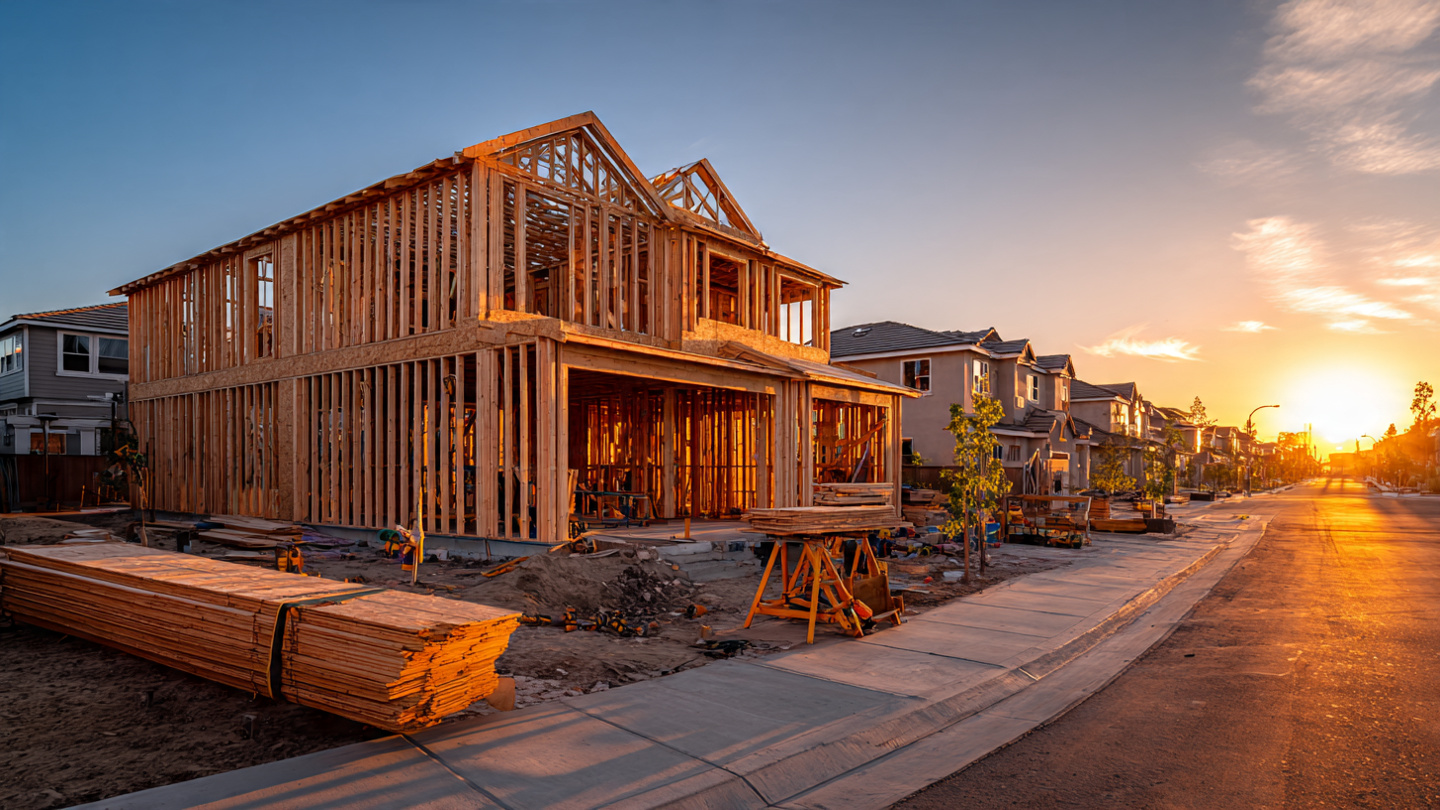
Six roofers showed up on Monday where eighty had been working the previous Friday.
A large homebuilder in the Minneapolis metro, who spoke to CNN on the condition of anonymity because ICE officers had been stationed at his job sites, described what happened to his residential pipeline in February 2026 after Immigration and Customs Enforcement agents parked at one of his apartment projects for weeks: nine crews walked off, roofers and painters and concrete finishers all at once, and legal status did not matter because workers with green cards stayed home alongside workers without them when the enforcement presence at the gate made no visible distinction between the two and neither did the fear that spread through every crew text chain within hours.
"I think most of us would probably take Covid over this," the builder told CNN, reporting a 25 to 30 percent revenue decline as homes that were supposed to close in spring sat roofless and homes that were supposed to start framing sat as bare slabs while the waiting lists for subcontractors stretched into months, not because demand had surged but because the supply of people willing to stand on a job site had collapsed overnight.
That was one market, one month, one enforcement operation that the White House later said it would wind down, but the aftershocks did not wind down and instead rippled out to every trade, every project, and every homeowner waiting on a completion date that quietly slid from June to September to "we'll let you know."
Who Actually Builds Your House
Start with the numbers, because the numbers are not ambiguous and they tell a story that policy debates tend to obscure. Foreign-born workers made up 26.3 percent of the U.S. construction workforce in 2024, according to an NAHB analysis of Census data, which is the highest share on record. Hispanics accounted for approximately 31 percent of all construction workers nationally, per the 2026 State of Hispanics in Construction Report from the National Hispanic Construction Alliance.
But the national average hides the real exposure. In the seven metros that issue the most residential building permits, immigrants comprise 54 percent of construction trades workers, according to a Harvard Joint Center for Housing Studies analysis, with Dallas-Fort Worth-Arlington leading at 61 percent foreign-born while Houston, Miami, Atlanta, Phoenix, and Tampa all sit above 40 percent and are adding permits faster than any other region in the country.
Drill into specific trades and the concentration sharpens further. More than half of all drywall installers nationwide are immigrants, and more than half of all roofers, and these are not management roles or equipment operators sitting in air-conditioned cabs but the hands that close the building envelope, the bodies on scaffolding in August heat, the people who turn lumber and shingles into a structure you can live in. Remove a quarter of them and you do not have a labor shortage. You have a work stoppage.
What the NBER Found
Proponents of enforcement argue that removing unauthorized workers opens jobs for American-born citizens who were being undercut on wages. Economists Elizabeth Cox and Chloe N. East at the University of Colorado Boulder tested that claim with national data. Their NBER working paper, published in 2025, is the first causal analysis of how the current enforcement surge has reshaped construction labor markets.
They used geographic variation in ICE arrest intensity across 58 U.S. regions from January 2024 through November 2025, tracking labor outcomes via the Current Population Survey. In areas where arrests roughly doubled, they measured what happened to both immigrant workers and native-born men without college degrees who work in the same sectors.
Two findings matter, and both of them contradict the assumptions that underpin the enforcement rationale.
First: likely undocumented workers who remained in the country worked fewer hours, not because they were deported but because they stopped going to job sites out of fear that any interaction with law enforcement could end in detention. A Pew Research Center survey found that 43 percent of immigrants in the U.S. in summer 2025 worried that they or someone they knew could be deported, and that fear is not selective because it hits the roofer with a visa and the roofer without one in the same week when enforcement at the gate does not check papers before it changes the atmosphere of every crew on every lot within a ten-mile radius.
Second, and this is the result that should end the comfortable assumption behind the policy: native-born men without college degrees did not fill the gap, and their employment in construction and agriculture in high-enforcement areas actually declined relative to low-enforcement areas rather than rising or even staying flat.
Cox and East offer a mechanism: when immigrant workers leave, the businesses that employed them contract, which means fewer projects start, fewer subcontractors bid, and general contractors who depended on a mixed crew cannot simply swap in an all-native workforce because the native workforce was never large enough to staff those projects alone, and the physical willingness to do roofing, drywall taping, and concrete finishing at current wage levels does not scale with a press release.
Your House Costs More. Here Is How Much.
Labor accounts for roughly 40 percent of residential construction cost, according to NAHB builder surveys, and when labor supply tightens, wages rise and timelines extend, both of which add cost in ways that compound through every phase of a project.
Construction labor costs escalated 4 to 6 percent in 2025, with a 7 to 10 percent risk scenario for 2026, according to the Urban Land Institute's 2026 outlook. Pike Construction Services estimates that labor shortages risk more than $100 billion in lost construction output nationally in 2026.
Run the per-home math, because nobody else has connected these data sets explicitly. Median new-home price in the U.S. sits near $420,000 to $450,000, and labor share at 40 percent means $168,000 to $180,000 of that price is the cost of human beings swinging hammers, pulling wire, and hanging drywall. A 10 to 15 percent increase in labor costs, driven by the combination of general shortage and enforcement-induced contraction, adds $17,000 to $27,000 to the price of a single home, and that number does not show up as a line item on your closing statement because it arrives embedded in your contractor's bid, invisible and non-negotiable, reflecting a premium every builder in the metro pays for the same diminished pool of workers.
349,000 Workers Needed. Nobody Coming.
Associated Builders and Contractors projects the industry must attract 349,000 new workers in 2026 to meet demand. That number rises to 456,000 by 2027. Eighty-five percent of the projected demand growth comes from data center construction, according to Bisnow, which means data centers and residential builders are competing for the same electricians, the same concrete crews, the same laborers.
Meanwhile, net immigration to the U.S. fell significantly from 2024 to 2025, with some analyses suggesting the rate may already be negative, and an IndexBox analysis of Census data published April 2026 concluded that the immigrant share of the construction workforce peaked in 2024 and is now declining rather than stabilizing.
Ninety-three percent of construction firms report talent shortages as a major barrier, per a May 2026 industry survey cited by RoofersCoffeeShop, and two hundred thousand jobs sit unfilled right now, not projected and not modeled but open, posted, and generating zero applicants in markets where the people who used to fill them are either gone or afraid to show up.
What About Robots and AI?
We published a story yesterday about a robot that frames houses in ten days, which is impressive engineering applied to a real bottleneck, but framing is 10 to 15 percent of a residential build and nobody has automated roofing, drywall finishing, plumbing rough-in, or electrical panel wiring for the kinds of homes people actually live in. Painting robots exist in commercial settings and cannot navigate a three-story colonial with seven different room geometries and crown molding that has to meet a homeowner's expectations. AI scheduling tools can optimize the sequence of tasks, but they cannot generate a human being willing to stand on a pitched roof in Phoenix in July when the surface temperature exceeds 160 degrees.
Automation is a decade away from meaningfully reducing the residential construction headcount, if it ever does, and the labor crisis is happening this quarter while builders in Minnesota, Texas, and Florida are not waiting for a Kuka arm but for the drywall crew to answer the phone.
Who Pays
Not the enforcement agency, and not the policy architect who never had to schedule a roofing crew. You pay. If you are buying a new-construction home in a metro where immigrant workers comprise 40 to 60 percent of the trades workforce, you are absorbing a cost increase that is structurally invisible because it lives inside every subcontractor bid, baked into every estimate, and passed through to you at closing without a line item that says "labor market contraction surcharge." If you are a homebuilder, your margins are compressing while your timelines extend and your customers lose patience and your best superintendent is fielding calls from data center GCs offering 20 percent more for the same electricians you need tomorrow. If you are one of the 200,000 unfilled positions, you are a line on a spreadsheet that nobody with hiring authority can fill.
Major contractor associations are pushing for a market-based visa system that creates legal pathways for employers to sponsor qualified foreign workers, and whether that policy materializes is a political question beyond the scope of this article, but what is not a political question is the arithmetic: 26.3 percent of the workforce is immigrant, that share is declining, native workers are not replacing them, and the industry needs 349,000 new bodies this year alone.
My father spent thirty years in a union shop. He used to say that you can argue about who deserves the work, but you cannot argue with an empty job site. An empty job site builds nothing for nobody.
What This Analysis Cannot Tell You
Our per-home cost calculation uses NAHB's 40 percent labor-share figure and ULI's 2026 escalation projections, both of which are national averages. Actual cost impacts vary significantly by metro, trade mix, and project type. A custom home in Dallas with 61 percent foreign-born trades exposure will see different pressure than a production build in Cleveland. Cox and East's NBER study covers January 2024 through November 2025 and does not capture 2026 enforcement dynamics. Their identification strategy compares high-arrest regions to low-arrest regions, which means results reflect relative, not absolute, labor market effects. We could not independently verify the Minneapolis builder's claim of a 25 to 30 percent revenue decline because he spoke anonymously. NAHB workforce data is from 2024, the most recent available. Finally, the $17,000 to $27,000 range assumes the full labor cost escalation is shortage-driven. In reality, general inflation, material tariffs, and interest rates also contribute, and no published methodology isolates the immigration-enforcement component from these other cost pressures with precision.