A Level 5 drywall finish on a 2,000-square-foot home takes a two-person crew five to seven days. They arrive Monday, tape and mud, wait for compound to dry, sand, apply another coat, sand again, apply a skim coat, sand a third time, and leave the following week with a fine white powder coating everything in a 30-foot radius. The homeowner's HVAC filter dies two weeks later from the particulate it inhaled. Nobody notices until the furnace starts wheezing in October.
Canvas built a robot that does the same job in two days. Two days.
In January 2026, JLG Industries acquired Canvas, the San Francisco company behind the 1200CX drywall finishing platform. JLG is a division of Oshkosh Corporation, which means the machine that finishes your walls is now owned by the same company that builds the scissor lifts and boom lifts sitting in the parking lot of every commercial job site in the country. Shashank Bhatia, JLG's access segment CTO, told Engineering News-Record that the plan is to pair Canvas robots with JLG lift equipment and push the combined system through their 700-plus dealer network. That is not a startup pitch but distribution at a scale the construction robotics industry has never seen.
What the 1200CX Actually Does
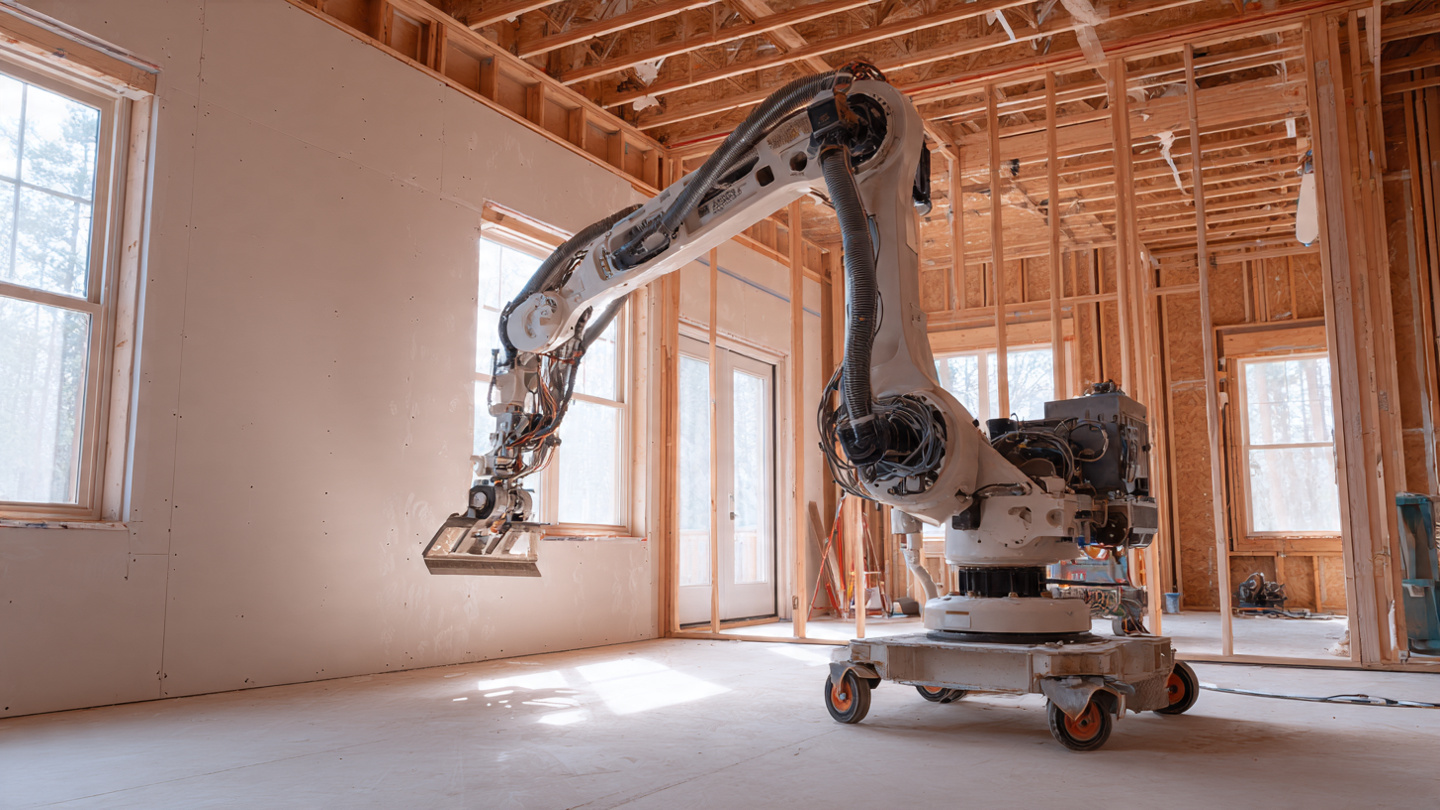
I need to be specific here, because "drywall robot" conjures images of a humanoid holding a trowel. The 1200CX is a compact mobile platform, roughly the footprint of a large floor scrubber, that carries a Universal Robots cobot arm fitted with custom spraying and sanding heads. It rolls up to a wall, its AI vision system scans the surface for joint locations and irregularities, and then it applies compound and sands in automated passes while an operator monitors from a tablet. The system requires no floor plans and no pre-scanning of the space.
Canvas claims the 1200CX delivers both Level 4 and Level 5 finishes, captures 99 percent of airborne dust, and reduces work at height by 70 percent. Tech Briefs reported that the system compresses a five-to-seven-day finishing schedule into two days for both finish levels, with cycle times of eight to ten minutes per wall section.
That dust capture number matters more than it sounds. OSHA's respirable crystalline silica standard, which applies to every construction site in the country regardless of trade, sets the permissible exposure limit at 50 micrograms per cubic meter, and drywall sanding is one of the worst offenders. Compliance requires respirators, wet sanding methods, or vacuum-equipped sanders that slow the work. A machine that captures 99 percent of dust at the source eliminates most of the compliance burden and the associated productivity drag.
I Ran the Numbers for Residential
Canvas has not published pricing for the 1200CX, and JLG has not announced lease rates through their dealer network. So I built the estimate from comparable industrial cobot deployments.
A Universal Robots UR10e arm, which is the hardware backbone of the Canvas system, runs $50,000 to $60,000 for the arm alone. Add the mobile platform, the AI vision stack, the dust capture system, the spraying and sanding heads, and the software license, and a reasonable all-in estimate for the 1200CX system is $150,000 to $200,000 to purchase outright, or $80,000 to $120,000 per year on a full-service lease that includes maintenance and software updates.
Now put that against what you currently pay. According to HomeGuide's 2026 cost data, drywall finishing labor runs $1.00 to $2.70 per square foot, with labor representing 65 to 75 percent of total drywall cost. On a 2,000-square-foot home with roughly 4,500 square feet of wall and ceiling surface to finish, your labor cost sits at $4,500 to $12,150, call it $7,400 at the midpoint.
| Builder Type | Homes/Year | Savings/Home | Annual Savings | Verdict at $100K Lease |
|---|---|---|---|---|
| Custom builder | 5–10 | $2,600–$3,900 | $13K–$39K | Doesn't close the gap |
| Small production | 25–50 | $2,600–$3,900 | $65K–$195K | Break-even at 26–38 units |
| National production | 100+ | $2,600–$3,900 | $260K+ | Clear ROI by unit 30 |
How I got the per-home savings: Canvas claims 50 percent labor cost reduction, but that number assumes zero human involvement, which is wrong because you still need an operator and someone to handle corners and non-standard geometry. I used a conservative 35 percent labor reduction, yielding $2,590 in direct savings on the $7,400 midpoint. I then added the schedule compression value, because cutting three to five days off the finishing timeline at roughly $400 per day in construction loan carry costs on a $500,000 build at 7.5 percent interest, which works out to $102.74 per day, plus site overhead, insurance, and supervision at roughly $300 per day combined, adds $1,200 to $2,000 per home. Blended savings per home: $2,600 to $3,900, depending on your carry costs and local labor rates.
At a $100,000 annual lease, you break even somewhere around 26 to 38 homes per year. A builder running 50 or more units clears a meaningful return. PulteGroup, Lennar, D.R. Horton, or any regional production builder finishing dozens of homes per subdivision would recoup the cost partway through the first year.
A custom builder finishing five houses? Not remotely close. You would need to share or rent the robot with other contractors to make the economics work, and nobody has built that rental market yet, which means the technology that makes perfect sense at scale remains economically inaccessible to the builders who could most benefit from it because their finishing crews are the hardest to staff in the first place.
The 90 Percent Problem
A skilled drywall finisher earns a median salary of $58,800 per year, and the ones who are good can handle anything: archways, tray ceilings, curved walls, bullnose corners, the awkward junction where a soffit meets a cathedral ceiling at an angle the architect drew in five seconds and the framer cursed at for three days. The 1200CX handles flat walls and standard 90-degree corners. It does not handle radiused surfaces, complex trim details, or the geometry that exists in every home more architecturally ambitious than a box.
That means the robot covers roughly 85 to 90 percent of finishing surface area in a typical production home, where floor plans are standardized and walls are straight. In a custom home with vaulted ceilings and arched doorways, that number drops to 60 to 70 percent, and you still need the finisher for everything the machine cannot reach or cannot navigate.
This is not a fatal flaw but rather the strongest argument for the technology. The finisher spends most of their week doing flat, repetitive, dust-generating work that destroys their lungs and wrists. If the machine handles that 90 percent and the human handles the 10 percent that requires actual craft, you get a finisher who works on the interesting parts, stays healthier, and finishes more homes per year because the bottleneck moved. NAHB and SBCA data show 22.3 percent of construction workers are 55 or older, with the industry median age at 42. The skilled finisher retiring in 2030 is not being replaced by a younger finisher. The 1200CX does not need to be better than a 30-year veteran. It needs to be good enough to fill the gap that veteran leaves behind.
What JLG's Dealer Network Changes
Canvas existed for nine years as a San Francisco startup with a problem that had nothing to do with the quality of its technology and everything to do with the reality of selling unfamiliar machines to general contractors who buy equipment from people they have bought equipment from for twenty years, who have local service departments, established parts supply chains, and the kind of institutional trust that no demo, however impressive, can replicate in a single meeting. Good technology, limited distribution.
JLG has 700-plus dealers and rental partners globally. Every major equipment rental company, United Rentals, Sunbelt, BlueLine, Herc, already stocks JLG lifts. If the 1200CX becomes available through that network, a GC could rent one for a specific project phase without committing to a purchase. That rental model, not outright ownership, is how the technology will most likely enter residential construction. Bhatia told ENR that the combined vision is to move "from enabling work to executing work," which makes sense only if the machine is as easy to rent as a scissor lift. No rental pricing has been announced, and no dealer availability timeline exists, but the gap between acquisition announcement and dealer availability in construction equipment is typically 12 to 24 months.
If You Are a Residential GC
Do not place a pre-order. Not yet. The 1200CX has been deployed on commercial projects, primarily data centers and large multifamily, not production residential. Whether the machine handles the tighter spaces, lower ceilings, and varied floor plans of single-family homes as well as it handles a 10,000-square-foot data center floor is unproven. Watch for JLG pilot programs in 2027, and ask your local JLG dealer what the rental timeline looks like.
If you build 50 or more homes a year and your drywall sub is quoting longer lead times or higher prices because they cannot staff crews, this technology is coming for you whether you seek it out or not. Your competitors will adopt it, so start budgeting for it now by tracking your per-home finishing cost, timeline, and callback rate. Those three numbers are the baseline you will need to evaluate the robot's ROI when it becomes available.
If you build five custom homes a year, the calculus does not change for at least three to five years, or until a rental market for finishing robots matures enough to let you rent one for a two-week window at a per-project cost rather than an annual lease. That rental market does not exist today.
What This Analysis Does Not Know
Canvas has published no pricing for the 1200CX, so every cost figure in this article is extrapolated from comparable industrial robotics deployments. Canvas's claim of 50 percent labor cost reduction has not been independently verified, and the 30 to 40 percent callback reduction figure comes from Canvas marketing materials. No third-party blind comparison between a Canvas-finished wall and a human-finished wall has been published. Cycle time data comes from Tech Briefs and Canvas's own demonstrations, not from independent field measurements on residential job sites. JLG has not announced a dealer availability date, lease pricing, or a residential pilot program. This article assumes a lease cost range based on industrial cobot pricing; the actual number could be materially higher or lower once JLG brings the product to market.