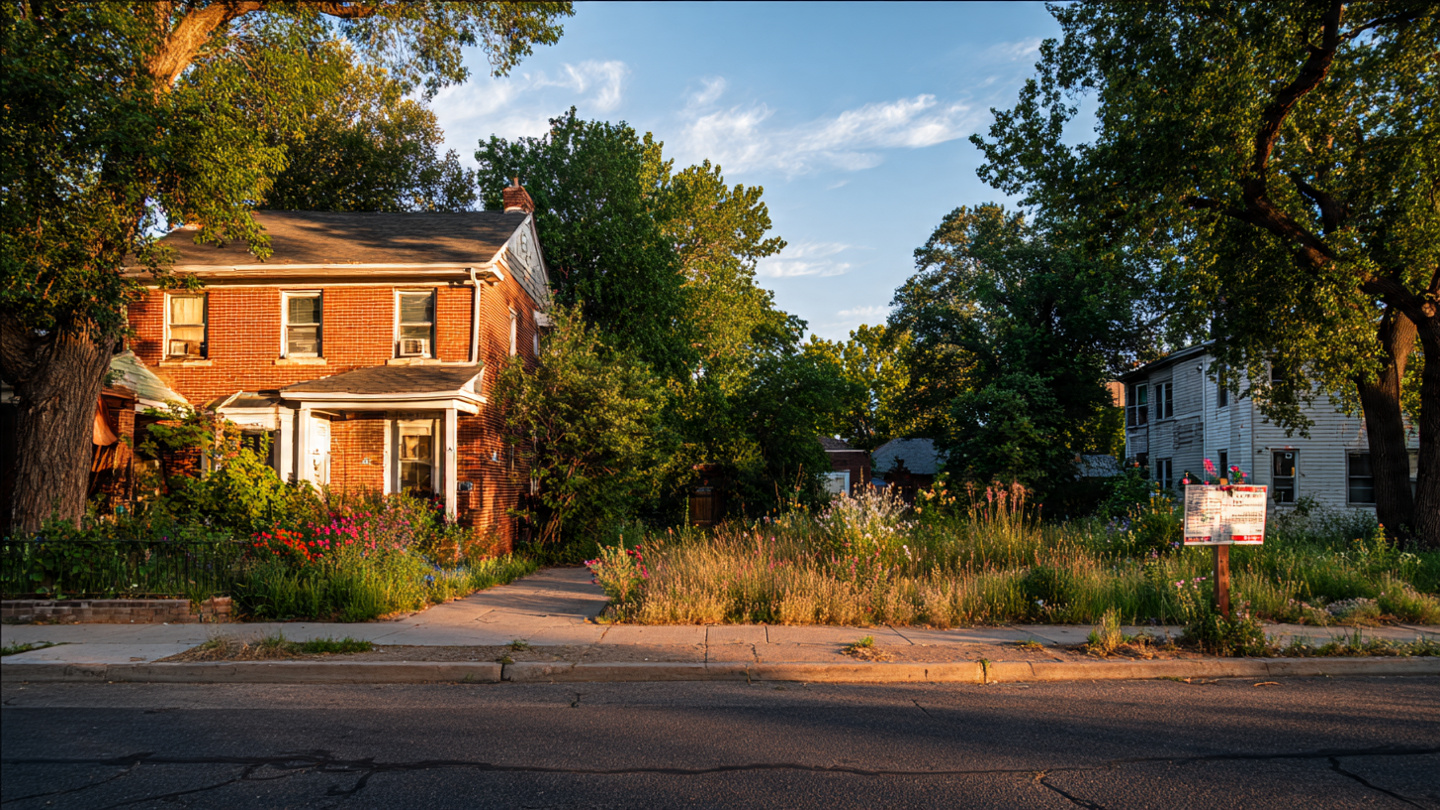
In Austin, Texas, a residential builder I know pulled a duplex permit last March: two units on a shared lot, straightforward IRC construction, the kind of project she has completed dozens of times. She could have built a fourplex on that same parcel, doubling her unit count and her potential rental income on a lot the city had explicitly upzoned for exactly that kind of density. Austin's zoning code, revised in 2023, allows fourplexes by right on most residential lots. She chose not to. Adding a third unit would have pushed her project out of the International Residential Code and into the International Building Code, requiring commercial-grade engineering, a different class of permit review, fire-rated assemblies she has never spec'd, and consultants she does not have on retainer. So she built two units instead of four, on a lot that could legally hold four, in a city that is begging for housing.
She is not unusual. Far from it. In a country where residential builders rationally avoid the complexity and expense of IBC compliance, she represents the overwhelming majority of small-scale developers who stop at two units even when the zoning code invites four.
According to the National Association of Home Builders, the United States started 19,000 units in 2- to 4-unit buildings during 2025, the best year since 2007. Read that number again and let its inadequacy settle: 19,000 units in a country with a 7.1-million-unit housing shortfall, where more than a dozen states have legalized duplexes, triplexes, and fourplexes on formerly single-family lots in the past six years. Oregon did it in 2019, California followed with SB 9 in 2021, and Washington's deadline for local compliance is June 30 of this year. Minneapolis, Portland, Raleigh, Berkeley, and dozens of smaller cities have all rewritten their zoning to welcome these buildings back into neighborhoods that banned them half a century ago.
And still. Nineteen thousand.
Where Two Becomes Commercial
Most people outside the construction industry have no idea this line exists, this invisible boundary in the model building code that determines whether a small residential project proceeds as a straightforward permit or transforms into a commercial-grade undertaking with consultants, engineers, and months of additional review. I certainly did not, for the first decade of my career, because nobody told me.
The IRC governs one- and two-family dwellings and townhouses, and it does so with a prescriptive simplicity that lets builders work from standardized tables rather than hiring structural engineers to run custom calculations for every load path. Loan products are built around it. Fannie Mae and Freddie Mac offer residential mortgage financing for up to four units, but the building code does not return the favor. Once a project reaches three units that are not configured as townhouses, it enters the IBC, which governs everything from triplexes to skyscrapers, from a modest three-flat in Chicago to a 40-story residential tower in Miami.
"Our code today treats a four-plex the same as a 200-unit apartment building," Dallas council member Paul Ridley told the Dallas Observer. "That doesn't make sense." He is right.
Consider a builder standing on a newly upzoned lot in Austin, weighing a duplex against a triplex of similar total square footage, running the numbers on both options, and discovering that the third unit changes everything about the regulatory and financial calculus of the project. Under the IRC, the duplex at national averages costs approximately $388,000 to build, about $194,000 per unit. Adding a third unit triggers the IBC threshold. That third unit does not cost $194,000. It costs substantially more, because crossing the code boundary adds a cascade of requirements: commercial-grade structural engineering in place of prescriptive IRC tables, fire-rated wall and floor assemblies between all dwelling units, ADA accessibility review, commercial sprinkler systems, and a plan review process designed for large multifamily buildings. Conservative industry estimates put the additional soft costs at $35,000 to $55,000 per project, meaning the third unit in a triplex arrives at roughly $229,000 to $249,000, an 18 to 28 percent penalty over the per-unit cost of the first two.
For a fourplex, the penalty dilutes across four units instead of three, which helps at the margins but does not fundamentally change the calculus for a residential builder who has never navigated a commercial permitting process. But the builder still needs an architect licensed for commercial work (in many states, the IRC does not require one at all), structural engineering beyond prescriptive tables, and months of additional permitting time, during which the lot sits idle and the construction loan accrues interest. In a market where residential builders operate on 8 to 12 percent margins, the code cliff eats the profit. Every time.
What AI Can and Cannot Do About This
In Atlanta, Cove Architecture's Vitras.ai platform is attacking the problem from the design side. Their AI agents ingest zoning codes, evaluate lot constraints, run financial feasibility in real time, and generate site layouts optimized for density within whatever code framework applies. On a 16-townhome project in Atlanta's West End, their AI-driven scenario testing nearly doubled the site capacity from conventional planning estimates of 8 to 9 units, while maintaining full compliance with Atlanta's Inclusionary Zoning policy, which reserves 20 percent of units for households earning 80 percent or less of Area Median Income. Cove reports a 60 percent reduction in design timelines across their portfolio, a claim that, if it holds under independent verification, represents one of the largest productivity gains in residential architecture this decade.
Notice, however, what Cove built in the West End: townhouses, a configuration that stays in the IRC regardless of unit count because each dwelling has its own entrance, its own utility connections, and its own structural separation from foundation to roofline. The AI optimized brilliantly within the code boundary, squeezing nearly twice the density from a lot that conventional planning had underestimated, but it did not cross the line into IBC territory, because crossing that line would have destroyed the economics that made the project feasible. That distinction matters.
This is the pattern. It repeats across every city where AI design tools meet the missing middle, and the conclusion is always the same: the technology works, the economics pencil, but the code says no. Norfolk, Virginia released a Missing Middle Pattern Book with free, modular architectural plans that can be assembled into duplexes, triplexes, or multiplexes. Mel Price of Work Program Architects, the firm behind the book, told Next City the plans save developers 15 to 20 percent on design fees, which constitute roughly 10 percent of total construction cost. Vermont launched 802 Homes, a statewide build-ready catalog. Cincinnati won a $2 million federal grant for six pre-approved middle-density housing designs, with public submissions open and two demonstration projects planned for 2027.
All of these tools accelerate design. Meaningfully. None of them can rewrite the building code. And pre-approved plans, which work beautifully under the prescriptive IRC, fall apart under the IBC, which requires project-specific engineering review that defeats the purpose of standardization.
Who Actually Solves This
Architects Matthew Petty and Matthew Hoffman, writing for the Congress for New Urbanism in April 2026, laid out the structural fix: expand the IRC to cover 3- and 4-unit buildings. Move the code cliff from two units to six, or eliminate it entirely for buildings under a certain height. Dallas has already done this locally, extending IRC-style regulations to small multifamily buildings. It works. But a patchwork of local amendments creates the inconsistency that drives builders away from these projects in the first place.
National action through the International Code Council, which publishes both the IRC and the IBC and updates them on three-year cycles, would be the cleanest path to resolving the discrepancy without creating a patchwork of local workarounds. Nineteen states have introduced or passed single-stair reform legislation for taller IBC buildings, demonstrating that code modernization can move at political speed when the housing pressure is severe enough. Extending the IRC to fourplexes is a simpler technical lift, because the life-safety differences between a duplex and a fourplex of comparable height and construction type are modest, well-understood, and manageable within the IRC's existing prescriptive framework with targeted amendments for fire separation and egress.
Meanwhile, the Brookings Institution's Home Genome Project proposes a different kind of AI intervention: building shared datasets, open models, and institutional playbooks that help cities understand which parcels can absorb density, which code barriers actually bind, and where the leverage is greatest. Starting with a pilot cohort of four to six cities including Atlanta and Santa Fe, the project aims to help 50 partner cities unlock measurable housing supply gains by 2030.
That is the right ambition, a systematic approach to identifying where density can absorb into existing infrastructure without the friction of case-by-case review, but it requires the building code to cooperate with the zoning code, and right now the two systems are working at cross purposes. Badly.
What Is Lost When the Middle Stays Missing
I think about missing middle housing the way I think about sentence structure. A neighborhood composed entirely of single-family homes and apartment towers has the rhythmic range of a paragraph written in only two sentence lengths: short declarative, long compound. Technically functional. Spiritually dead. A duplex side by side with a fourplex across from a six-unit courtyard building is a neighborhood that breathes, that modulates between intimate and communal, that lets a 25-year-old rent above a retired couple who owns the building, which is exactly the arrangement that built every beloved pre-war neighborhood in America before we outlawed it in the 1940s and 1950s.
AI design tools can help us draw these buildings faster, cheaper, and with better spatial efficiency than any prior generation of architects managed by hand. Cove's work in Atlanta proves the design problem is solvable. Norfolk's pattern book proves the knowledge can be shared freely, that the tools for drawing these buildings already exist and need only the economic conditions to deploy them at scale. What cannot be solved by faster algorithms or prettier renderings is a building code that criminalizes the third bedroom door.
Strongest Counterargument
A fire engineer would point out, fairly, that the IRC was never designed to govern buildings where three or more families share structural elements, utility risers, and egress paths. A fire in a duplex behaves differently than a fire in a fourplex with a shared corridor and stacked mechanical chases. Lowering the code threshold without commensurate safety provisions could produce buildings that fail in ways nobody has modeled at scale, and the liability exposure for municipalities that adopt a relaxed code would be real. The RAND Corporation's 2025 study of multifamily construction costs confirmed that California's costs run 2.3 times higher than Texas, partly because of exactly these safety-driven regulatory layers. Cutting those layers to reduce costs is not a neutral act, and the safety record that justifies many of them is real.
This is a serious concern. But it conflates two distinct problems. A 3-unit building with separate entrances, individual utility connections, and fire-rated party walls between each dwelling is not a high-rise with a shared corridor. Dallas proved that these buildings can be regulated under residential-grade standards with modest, targeted safety additions. Treating the third unit as categorically equivalent to the 200th is not caution. It is absurd. It is a rounding error in the building code that happens to destroy an entire housing typology.
Limitations
This analysis synthesizes cost estimates from multiple sources rather than a single controlled study comparing IRC and IBC construction costs for identical buildings. Cove Architecture's 60 percent timeline reduction is self-reported and has not been independently verified by a peer-reviewed audit. Norfolk's 15 to 20 percent design savings have not been measured at scale across multiple projects. NAHB's 19,000-unit figure for 2-to-4-unit starts does not distinguish between markets where builders chose not to build missing middle housing and markets where code or financing barriers prevented them. State-by-state legalization counts are approximate, as many jurisdictions have partial or conditional reforms that do not fully enable by-right construction. RAND's cost multiplier compares California to Texas at the state level; individual metro-area cost ratios vary significantly.
If you are a builder deciding between a duplex and a fourplex on a newly upzoned lot, call your local building department before you call your architect. Ask one question: does the third unit push you into the IBC? If the answer is yes, build the duplex and write your state legislator. If it is no, you may be in one of the few jurisdictions that has fixed the code. Build all four.