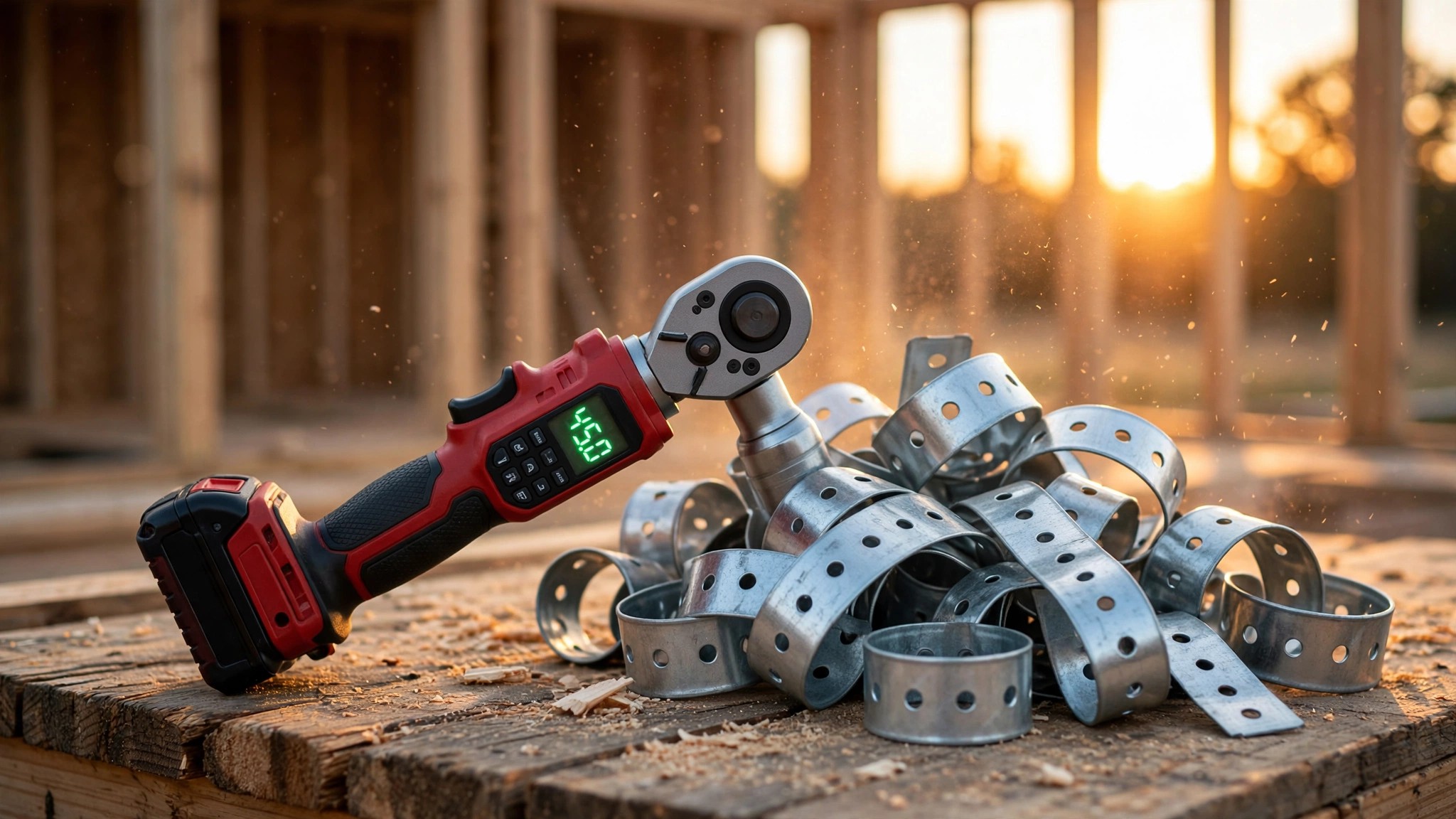
One hundred and seventy-four thousand. That is how many nails go into an average house, according to Habitat for Humanity Saint Louis. About $880 worth of fasteners at roughly a nickel apiece, each one driven by a framing crew moving fast because time is money and the drywall crew shows up Wednesday whether the framers are ready or not.
Zero of those nails get individually verified.
Not one is digitally recorded, torque-checked, or logged to a database. No GPS stamp, no cloud sync, no downloadable report for the inspector or the homeowner or the insurance company that will eventually pay when a wall peels off the foundation in a windstorm because a critical connection failed where nobody was looking, which, according to the forensic record, is exactly what happens with clockwork regularity every hurricane season.
Meanwhile, a $300 anchor bolt going into a data center ceiling gets its torque recorded to the cloud by a Milwaukee smart wrench, documented in a One-Key report, and delivered to the building owner before the electrician packs up for the day.
Your $500,000 house gets less fastener documentation than a server rack mount.
What Exists Right Now
Milwaukee Tool's M12 FUEL Digital Torque Wrench is the industry's first cordless torque wrench with an integrated motor and digital reporting. It costs about $600 with a battery, delivers 12.5 to 150 foot-pounds of torque at ±2% accuracy, and connects via Bluetooth to Milwaukee's One-Key platform. Every fastener event gets recorded, synced to the cloud, and compiled into customizable reports for inspectors, building owners, or anyone else who wants proof that the bolt was driven to spec rather than just hoping it was.
Four notification modes alert the operator as they approach, hit, or exceed target torque: an audible click, an LED bar, an LCD readout, and a haptic vibration through the grip. Fifteen programmable presets store torque targets for different fastener types, and a calibration certificate ships in the box with recalibration required every 5,000 cycles or twelve months.
Milwaukee built this for commercial electrical contractors wiring data centers, partnering with Oracle to demonstrate it at their Industry Lab, where contractors walk through an immersive simulation that starts with driving fasteners on a real steel structure and ends with pulling the torque report from a back-office terminal.
"We've found that any professional installer who needs to operate within precise manufacturers' specifications can find this tool useful," Milwaukee's construction technology team wrote in describing the Oracle collaboration. "Steel contractors, solar panel installers" all made the list.
Residential framers did not.
Hilti Went Further
Hilti's Tracefast technology puts a data matrix code on every single fastener, making each installed anchor, screw, and bolt uniquely identifiable and traceable by scanning it with the Hilti Connect smartphone app. Scan the code and you get setting instructions, training documentation, inspection records, and certifications tied to that specific fastener in that specific location.
"Connected anchors is another expansion of that value that only Hilti is positioned to provide," said Muthu Manohar, Senior Director of Fastening and Protection at Hilti North America. "The anchor identification that we bring to the market now paves the way for increasing jobsite productivity across the application chain, helps provide traceability from design and ordering to installation, and eventually smarter products."
Individual fastener traceability means each anchor gets an identity, and in commercial construction this is already shipping, but in residential the concept does not exist. Your home's critical structural connections are anonymous from the moment they are installed until the moment one of them fails.
Why Anonymous Nails Kill People
Hurricane Andrew hit South Florida on August 24, 1992, destroying or damaging 125,000 homes and causing $27.3 billion in damage. Researchers at the Insurance Research Lab for Better Homes (IRLBH) and the Boundary Layer Wind Tunnel Laboratory at the University of Western Ontario spent years studying what failed and why, documenting every nail in full-scale test houses with the kind of precision that actual construction never receives, and their conclusion was blunt.
"A lot of the damage in Hurricane Andrew, the worst wind disaster in U.S. history, was caused because so many nails on so many houses missed their mark."
Gregory A. Kopp and Murray J. Morrison, the researchers who wrote those words, went on to quantify what "missing the mark" actually means structurally. A nail that sinks into solid wood behind the sheathing can hold 80 pounds of force or more under uplift loading. A nail that misses the joist or truss, driven through sheathing into empty air behind it, holds essentially nothing. An improperly sunk nail might hold a few pounds before it pulls free. A properly placed fastener versus a sloppy one is not an incremental difference but a binary one: the connection either works or it does not, and the only way to know which you got is to check, which nobody does, because checking 174,000 nails would take longer than framing the house.
But you do not need to check all 174,000.
The Eighty Connections That Actually Matter
Most of those 174,000 nails are holding sheathing to studs, trim to walls, and shingles to decking. Important work, but not where houses come apart in storms.
Houses come apart at the structural connections: the hold-downs that anchor shear walls to the foundation, the hurricane ties that clamp rafters to top plates, the anchor bolts that pin the sill plate to the concrete, the shear wall nailing that turns a collection of studs into a lateral-force-resisting system. A typical 2,000-square-foot wood-frame house has roughly 40 to 80 of these critical structural connections, depending on the seismic design category, wind exposure, and engineering requirements.
Take the Simpson Strong-Tie H2.5A, one of the most commonly specified hurricane ties in residential construction. Proper installation requires exactly ten nails: five driven into the rafter or truss member and five into the top plate. Every pre-punched hole must be filled with the specified 0.131-inch diameter by 2.5-inch common nail or rated connector nail to achieve the published load capacity. Leave one hole empty and the rated capacity drops. Substitute a drywall screw for a structural nail, which happens with dispiriting regularity on job sites, and the connection might hold half the rated shear load or less. Drive a nail through the metal truss plate on an engineered truss and you have damaged the truss itself.
A University of Florida study published in 2026 examined why aluminum light poles failed during Hurricane Ian despite meeting all design code requirements. The researchers found that installation errors on the order of a fraction of a turn of a nut, combined with manufacturing material variability, pushed stresses past yield strength during the storm.
"In a perfect world, materials are flawless and installations are exact. Design codes account for real-world variability by building in safety factors. In this case, the structures met key code requirements, but material deficiencies and installation issues caused behavior that exceeded those built-in safety margins, leading to failure."
A fraction of a turn on a nut: that is the margin between a structure that survives a Category 4 hurricane and one that does not, and right now the verification method for that margin in residential construction is a building inspector with a flashlight and a clipboard who has twenty minutes to look at an entire house before the drywall crew buries everything.
The Inspection Gap
A private pre-drywall inspection, the kind a conscientious homebuyer or builder orders voluntarily, takes 1.5 to 3 hours according to multiple inspection firms. It covers framing, electrical rough-in, plumbing, HVAC, and structural components before walls get sealed.
Municipal framing inspections, the mandatory code-compliance check that a building department sends an inspector to perform, are considerably shorter. The inspector walks the house, checks that the framing matches the approved plans, looks for obvious deficiencies, verifies that structural connectors are present and generally installed correctly, and moves on to the next house. There is no torque verification of any connection. No nail count on any shear wall panel, no pullout test on any anchor bolt. The inspector cannot test what the inspector does not have time or tools to test.
In the same amount of time, a commercial electrical contractor installing structural fasteners in a data center has recorded the torque on every bolt, synced the data to One-Key, and generated a PDF report that the building owner can file with the insurance carrier.
Residential inspectors verify by looking; commercial contractors verify by measuring. Your house costs more than a server rack, yet the rack gets better documentation.
What Smart Verification Would Actually Cost
One Milwaukee M12 FUEL Digital Torque Wrench: approximately $600 with battery and calibration certificate. A framing crew already owns several hundred dollars worth of Milwaukee tools. Adding one smart wrench to the loadout is not a capital expenditure decision; it is a rounding error on the tool budget.
For the approximately 80 critical structural connections in a 2,000-square-foot house, that works out to $7.50 per connection on the first house. By the tenth house, the tool cost is under $1 per connection. Fifty houses in and the per-connection cost is twelve cents, which is less than the fastener itself.
| Item | Cost |
|---|---|
| Milwaukee M12 FUEL 1/2" Digital Torque Wrench (bare tool) | ~$500 |
| M12 battery + charger | ~$100 |
| Annual recalibration | ~$75 |
| One-Key platform | Free |
| Cost per critical connection (first house, 80 connections) | $7.50 |
| Cost per critical connection (10th house) | <$1.00 |
| Cost per critical connection (50th house) | $0.12 |
Compare that to what a single structural connection failure costs. Post-hurricane structural repair on a wood-frame house runs $50,000 to $200,000 if the damage is repairable. If it is not, you are looking at a total loss on a structure that was insured based on the assumption that the structural connections were installed correctly, an assumption nobody verified with anything more rigorous than a glance.
That math is not subtle: twelve cents per connection for digital verification versus six figures for one failure, and the reason nobody avoids it is not cost but culture. Residential construction has never required fastener documentation, so nobody provides it, and because nobody provides it, nobody requires it, and the cycle continues until the next hurricane season provides the forensic data that proves, again, that the nails were the problem.
What You Should Demand
If you are building a house in Seismic Design Category D or higher (most of California, the Pacific Northwest, parts of the Intermountain West) or in a wind-borne debris region (Florida, the Gulf Coast, the Carolinas), you should be asking your builder for fastener verification documentation on every structural connection: hold-downs, hurricane ties, anchor bolts, and shear wall nailing at the panel edges.
Those tools already exist and cost less than the tile selection you agonized over for three weeks. The reports are generated automatically and delivered as a PDF you can hand to your insurance company, which might, if enough homeowners start doing this, eventually offer premium discounts for documented structural verification the way they already offer discounts for monitored alarm systems and impact-rated windows.
If you are a builder, buying one smart torque wrench and documenting your structural connections is the cheapest competitive advantage in residential construction. Every other builder in your market is offering the same floor plans, the same LVP flooring, the same quartz countertops. None of them are handing the buyer a PDF that says: "Here is the torque record for every structural connection in your house, digitally verified, cloud-synced, and tied to the serial number of a calibrated tool." That is a sales pitch, an insurance argument, and a liability shield.
If you are an inspector, ask your building department to evaluate whether smart torque documentation should become part of the framing inspection checklist for high-seismic and high-wind jurisdictions. The Florida Building Code already specifies nail type, spacing, and penetration depth as structural variables after Hurricanes Charley and Ivan proved that getting the nail wrong is indistinguishable from skipping it entirely. The next step is verifying that the spec was met, and the tools to do that now cost less than a decent circular saw.
Limitations
The 174,000-nail figure comes from Habitat for Humanity Saint Louis and should be treated as a rough industry estimate; actual nail counts vary substantially by house size, design complexity, and framing methodology. The "40 to 80 critical structural connections" estimate is an engineering approximation based on typical shear wall layouts, hold-down schedules, and connector requirements for a 2,000-square-foot wood-frame house in a moderate-to-high seismic or wind zone. No authoritative published count of structural metal connectors per typical single-family home was identified during research. Milwaukee does not publish residential adoption data for its digital torque wrench, so the claim that residential framers are not using it is based on product positioning (commercial electrical contractors, data centers) rather than sales figures. No peer-reviewed study directly comparing digital versus manual fastener verification outcomes in residential construction exists at this time.