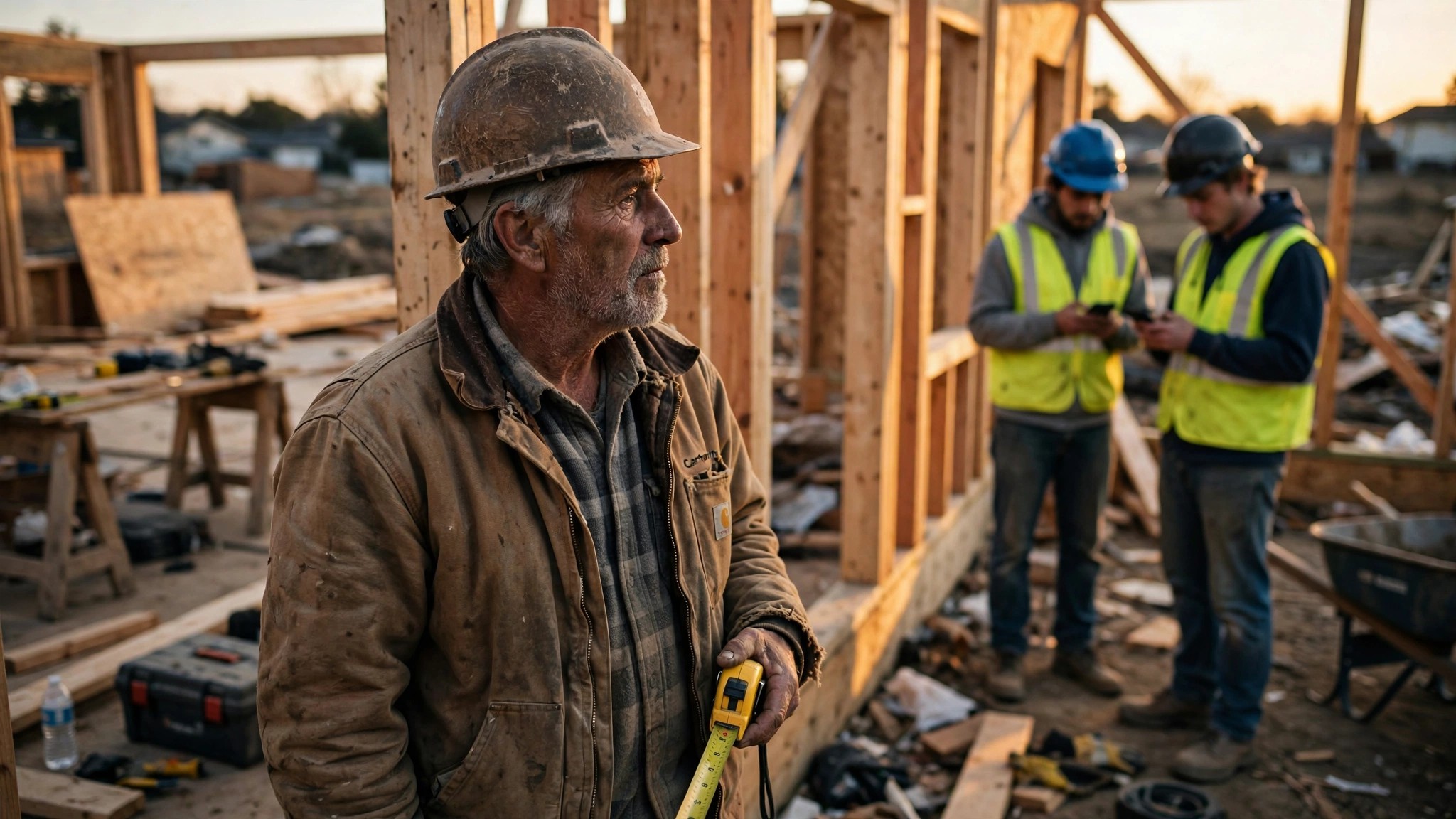
Keith Bunn Sr. has spent 65 years in the trades. He recently wrote about plumbing on LinkedIn, and the post reads less like industry analysis than eulogy. "That master plumber who has spent decades honing his craft can show up on a project, assess what needs to be done, and lay out the best method to get the job done," he wrote. "He has been there." Bunn then described what the industry has done to compensate for the fact that it is running out of people like him: it started making pipes dumber. Modular parts. Products that almost install themselves. Smart fittings designed to deliver consistent results with nearly no skill required, because the 550,000 plumbers the country will be short by the end of this year cannot be trained fast enough, and the ones who remain are being asked to do less thinking and more assembling.
Bunn calls this deskilling, and he is not wrong, but the word is too polite for what is actually happening. This is a mass extinction event for institutional knowledge that took generations to accumulate. Nobody is archiving it. Once it is gone, it stays gone.
What Walks Out the Door
Run the numbers and they are brutal: between 2024 and 2032, an estimated 18.4 million experienced, credentialed workers across manufacturing and trades will retire, while only 13.8 million younger workers are projected to replace them. That is a 4.6-million-person deficit before you consider that the replacements arrive with zero field experience and, according to a June 2026 survey of 1,000 skilled-trade workers by Bourne AI, 47 percent of those new hires take seven or more months to reach full productivity.
Seven months. Think about that. An entire residential build cycle where your electrician, your framer, your HVAC installer is functionally an apprentice wearing a journeyman's tool belt, making judgment calls that a veteran would resolve in seconds but that the new worker resolves in 16 minutes of looking things up, interrupting a colleague, or guessing.
Bourne AI's survey quantified exactly how knowledge flows on a job site in 2026. When a tradesperson gets stuck on a difficult task, their number-one resource is not a manual, not a code book, not a training video; it is interrupting a coworker or supervisor, and sixty point five percent of workers named that as their primary method for getting unstuck. That bottleneck costs two people their time simultaneously, and over half of those lookups burn 16 minutes or more, with a quarter exceeding 30. When no experienced colleague is available or the answer takes too long to find, 28 percent of workers proceed on best judgment and accept the risk that their work will need to be redone.
That 28-percent guess-and-hope rate is where a significant share of $31 billion in annual rework originates. The cause is not bad materials or design errors, though those contribute, but the loss of knowledge itself. The people who carried the institutional memory needed to get it right the first time are fishing in Montana or dead.
What AI Can and Cannot Capture
A master carpenter who has been framing houses for 30 years knows things no document contains. He knows that the particular thunk of a 16-penny nail driven into Douglas fir sounds different than one sunk into Southern yellow pine, and that a slightly higher pitch on the third strike means the stud behind the sheathing has a split he cannot see. He knows that when morning fog burns off by 10 a.m. in coastal markets, the plywood on the south-facing wall will cup by noon if you do not get the sheathing nailed before the sun hits it. He knows that the subcontractor who underbid the tile work by 15 percent will disappear after the first bathroom, because he has seen it happen four times to four different subs with the same business model.
You cannot Google that.
None of that is in an installation manual, and none of it ever will be.
AI knowledge-capture tools do exist, and some of them are genuinely useful. XOi, a Nashville company backed by $73 million in venture funding, lets experienced technicians record their work via photos, voice memos, and short videos, and their AI structures that raw capture into searchable, tagged knowledge that newer workers can query in plain language, and according to Fast Company, employees across skilled industries spend roughly 2.5 hours per week searching for information buried in SOPs, repair logs, and filing cabinets. AI tools that cut that search time by even a third pay for themselves immediately, and the math is obvious.
Bourne AI's survey found that the demand is there: 72 percent of tradespeople said an AI-powered guided-task app would reduce the time they lose looking things up, and 66 percent said it would make them more effective. Thirty-three percent have already experimented with consumer chatbots on the job, asking ChatGPT or similar tools how to wire a three-way switch or whether their local code allows PEX in a slab.
Building Services, which includes HVAC, plumbing, electrical, and facilities work, tested as the most AI-ready large segment in the Bourne survey, with 81 percent saying AI would save lookup time and 42 percent already using consumer AI on the job. Fifty-nine percent expected their employer to invest in AI guidance tools within two years. Most will be wrong.
But here is the fracture, and it runs deeper than most people in the industry want to acknowledge.
Who Gets the Training and Who Gets Left Behind
In April 2026, North America's Building Trades Unions and Microsoft announced an expanded partnership to deliver AI literacy training across 34 states through the union apprenticeship system. They had already trained 1,500 instructors in hands-on training centers. The new phase launched no-cost AI literacy courses on LinkedIn Learning with industry-recognized credentials upon completion. Its stated focus: helping workers "build the skills needed to succeed in an AI-powered economy." Microsoft aligned the initiative to its "Community-First AI Infrastructure commitments," a phrase that translates directly to "the communities where we are building data centers."
The same month, the U.S. Department of Labor launched a federal initiative to integrate AI competencies into Registered Apprenticeship programs, with a five-year contract to develop AI-focused apprenticeship pathways. Meta followed with its Workforce Academy, offering free skilled-trades training to workers who want to build things for Meta's contractors, and all three programs share a structural feature worth noticing: they train workers for commercial and infrastructure construction, not residential. Microsoft's program flows through NABTU's union apprenticeship network, which is concentrated in commercial and industrial projects. The DOL initiative targets "high-demand AI roles," a category that does not include the electrician roughing in a custom home. Meta's academy trains people to build Meta's own facilities. Nobody is funding the residential equivalent.
Scale is the problem. Residential construction is fragmented into hundreds of thousands of small businesses. According to the National Association of Home Builders, over 80 percent of residential construction firms employ fewer than 20 people. NAHB's own 2024 data shows fewer than 20 percent of small builders use scheduling software of any kind — no training departments, no LinkedIn Learning subscriptions, no AI budget. Their "knowledge transfer" is a veteran framer showing a new hire how to read a tape measure during the first week, and their "AI strategy" is hoping that veteran does not retire before the job is done.
Meanwhile, a data center electrician in Abilene, Texas, can access Microsoft-funded AI literacy courses through their IBEW local, earn a credential, and apply those skills to the $500-billion Stargate project being built down the road. The residential electrician 40 miles away, wiring a $400,000 ranch house? Nothing — not a course, not a credential, not a single dollar of investment.
The Math Your Home Builder Doesn't Want You to See
Here is a calculation nobody in the training pipeline has published. So I ran it.
An experienced construction worker accumulates roughly 20 to 25 years of field knowledge before reaching peak effectiveness, and that is where the math gets ugly: at a 5:2 retirement-to-entry ratio, every five workers who leave take a combined 100 to 125 person-years of accumulated experience with them. Two replacements walk in with zero. Literally zero. Seven months later, each replacement reaches "full productivity," but that phrase does two very different jobs depending on who it describes. "Full productivity" for a worker with less than a year of experience is not the same as "full productivity" for someone with two decades of pattern recognition burned into muscle memory. Every year the industry processes this exchange, the aggregate knowledge base shrinks. Not next decade. Now.
At national scale: 18.4 million workers retiring through 2032, carrying an average of 22 years of experience, represent roughly 405 million person-years of accumulated trade knowledge leaving the workforce. The 13.8 million who enter bring zero, and even accounting for the fact that some retiring workers' knowledge is redundant or outdated, the net deficit is enormous, and no technology currently deployed in residential construction is capturing more than a fraction of it.
Rework data confirms the scope of that damage: CII and NIST peg annual construction rework at $31.3 billion, with 52 percent of that cost attributable to poor documentation, a category that includes failure to transfer knowledge about site-specific conditions, material quirks, local code interpretations, and lessons learned from previous projects. When a veteran retires and his replacement botches the flashing detail on a dormer because nobody documented the technique the veteran used for 18 years, the callback costs $600 to $2,000. The homeowner's ceiling stains within three years, the builder eats the warranty claim, and everyone loses except the guy who is fishing.
What Would Actually Help
Residential construction needs its own AI knowledge-transfer initiative, and it needs one designed for how the industry actually works: small crews, no IT departments, smartphone-first, with tools that earn their keep by preventing callbacks rather than generating reports.
XOi's approach of capturing veteran knowledge through low-friction recording is closer to what the industry needs than a LinkedIn Learning course. But XOi is priced for fleet operators managing hundreds of technicians, not a three-person plumbing shop, and that is precisely the problem. Bourne AI's guided-task model targets the specific moment a worker is stuck, which addresses the 16-minute lookup problem directly, but neither company has announced residential-specific pricing or deployment strategies. That gap remains.
The most practical tool the residential industry has right now is also the most overlooked: the experienced worker who is still on the job and willing to record what he knows before he leaves. But "willing" requires time that billable-hours pressure does not allow, and "record" requires a system that the 80-percent-under-20-employees residential sector does not have.
Limitations
The 5:2 ratio, cited by the U.S. Department of Education and repeated in multiple industry analyses, treats all skilled trades as a single category. Retirement and entry rates vary substantially by specific trade, region, and union vs. non-union status. Plumbing's projected 550,000-worker shortage is more severe than, say, the painting trades. The Bourne AI survey (n=1,000) has a margin of error of ±3.1 percentage points and includes both U.S. and European respondents; the European cohort reported higher rework rates and longer lookup times, which may inflate combined figures relative to a U.S.-only sample. The $31.3 billion rework figure from CII/NIST covers all construction, not just residential; the residential share is not broken out, though residential's higher fragmentation and lower documentation rates suggest its share is proportionally larger. My person-years calculation assumes a linear relationship between experience and knowledge, which oversimplifies how expertise actually accumulates, and none of this analysis accounts for immigration policy changes that may further reduce the construction labor supply in 2026 and beyond.
The Uncomfortable Bottom Line
We are watching an industry lose its institutional memory in real time — not slowly, not gradually, but five out, two in, year after year. The workers who know how to build houses, not just follow instructions but actually understand what they are doing and why, are leaving faster than they can be replaced. AI training programs exist that could slow the knowledge loss, but they are funded by companies that need data centers built, not houses. Residential construction, which accounts for roughly half of all construction spending in the United States, has no equivalent investment and no path to one under current incentive structures.
The 59 percent of workers who expect their employer to invest in AI guidance within two years are mostly right if they work in commercial construction. If they frame houses or rough in residential plumbing, they are almost certainly wrong.
When you hire a contractor next year, the person who shows up may have seven months of experience and a phone full of ChatGPT prompts. The person who would have taught him everything he needed to know is already gone, and nobody asked that person to record anything before he left.