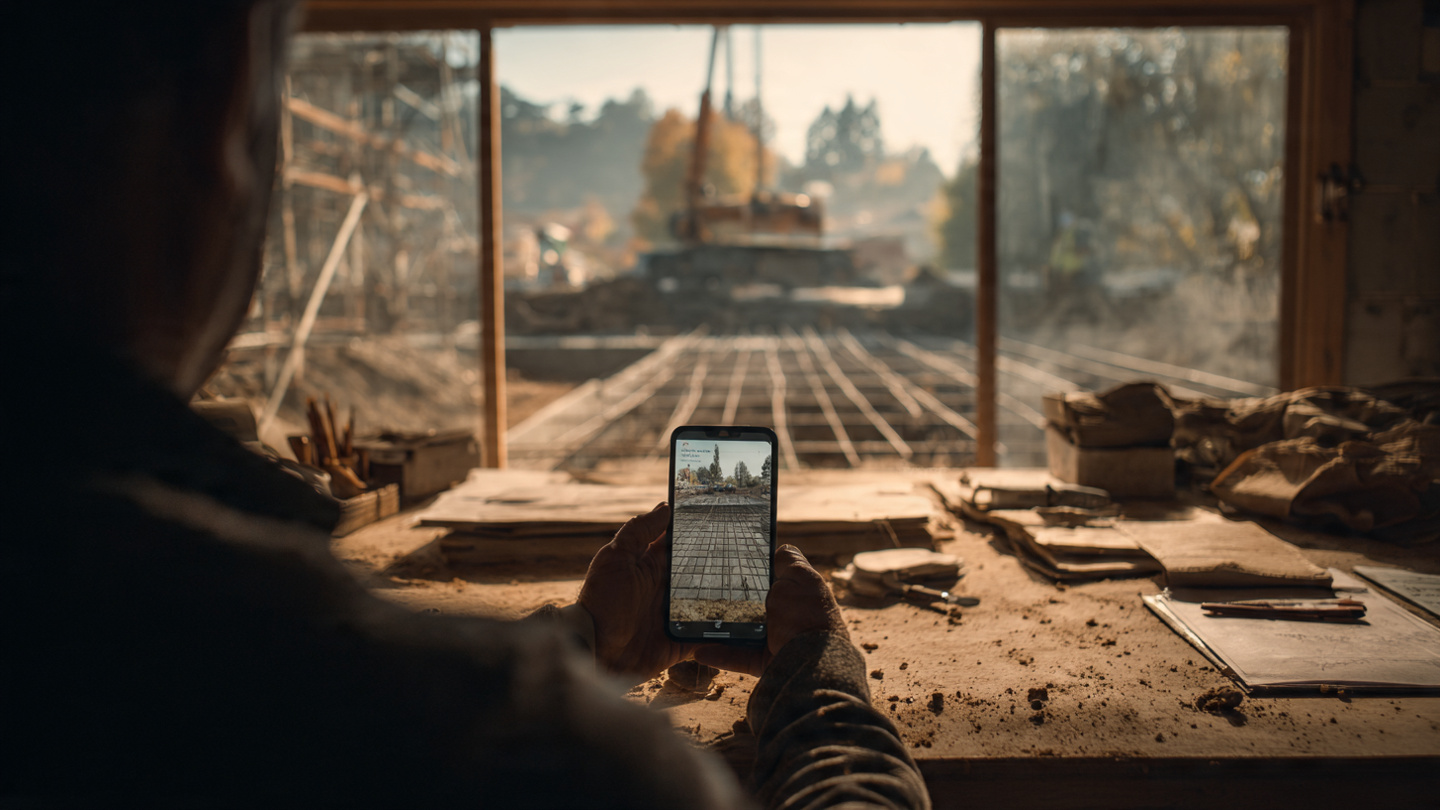
A contractor in Brooklyn holds his phone over a freshly stripped foundation wall. He pans left, pans right. Forty seconds of shaky footage. On the other end of the call, a building inspector for the New York City Department of Buildings watches from a desk in Lower Manhattan, checks a box on a form, and approves the inspection.
Nobody measured the rebar spacing. Nobody checked that the concrete cover met the IRC R403.1 minimum of three inches. Nobody verified the anchor bolt placement. The foundation passed.
This is not hypothetical. In March 2021, the NYC DOB launched a remote video inspection pilot in Staten Island and Brooklyn. The program's own requirements acknowledge the gap: it demands "adequate lighting," "a separate light source such as a flashlight for darker areas," and "an authorized attendee with a tape measure for measuring certain dimensions." Read that last one again. The person holding the tape measure is the contractor whose work is being inspected.
147,600 Inspectors. Sixteen Million Inspections.
The Bureau of Labor Statistics counted 147,600 construction and building inspectors in the United States in 2024. The projected change through 2034: negative 1,200. The profession is shrinking.
Run the numbers against demand. Census Bureau data shows roughly 1.4 million housing starts per year. Each single-family home requires a minimum of six inspections: foundation, framing, rough plumbing, rough electrical, rough mechanical, and final. That's 8.4 million residential inspections. Add commercial construction, renovations, code complaint investigations, and re-inspections, and a conservative estimate puts the national total above 16 million inspections annually.
Divide 16 million by 147,600 inspectors. Each inspector must complete 108 inspections per year, or roughly 2.2 per workday, just to keep pace. Factor in drive time between sites, documentation, plan review, and the administrative overhead that consumes at least a third of every workday, and the math barely works today.
Now subtract 30% of the workforce.
An International Code Council survey found that 85% of code officials are over 45 years old. More than 80% expect to retire within 15 years. Over 30% plan to do so within five. More than half work in departments of nine or fewer employees. When two people retire from a seven-person department, the remaining five don't simply work harder. Inspections get delayed. Then they get shortened. Then they move to a phone screen.
What a Video Call Cannot See
LA County published a list of inspection types it considers eligible for virtual review. The list includes smoke detectors, water heater swaps, window replacements, and re-roofs. Reasonable enough. But it also includes pad footings, a structural foundation element. Pad footings support point loads from posts and columns. Getting them wrong doesn't cause a code violation notice. It causes a floor that sags, a beam that shifts, a wall that cracks.
Six critical inspection items that cannot be reliably verified through a phone or tablet camera:
Rebar spacing and concrete cover. IRC R403.1 requires a minimum 3 inches of concrete cover over reinforcement in foundations. Checking this requires a tape measure pressed against the form, measuring from the rebar to the nearest soil face. A camera shows rebar exists. It cannot measure the gap.
Shear wall nail patterns. IRC R602.10 specifies nailing schedules for braced wall panels: 3 inches on center at edges, 6 inches at intermediate supports. Verifying spacing requires counting nails across a physical panel, often in dim light behind other framing. One nail every 6 inches looks identical to one nail every 8 inches on a phone screen.
Fire blocking in concealed spaces. IRC R302.11 mandates fire blocking at every floor level, at ceiling-to-floor connections, and at the tops and bottoms of stair stringers. Fire blocking sits behind other framing members. Even an in-person inspector has to look carefully. A camera operator who doesn't know where to point won't capture it at all.
Vapor barrier continuity. Proper lapping, taping, and sealing of housewrap and interior vapor retarders requires close inspection. A torn section of Tyvek behind a downspout bracket doesn't show up on a wide-angle phone shot taken from eight feet away.
Insulation installation grade. Grade I insulation means no gaps, voids, or compression against the air barrier. Checking for compression behind electrical boxes and around plumbing penetrations requires pressing on the insulation and visually inspecting from multiple angles. A phone camera captures the surface. Not the contact.
Anchor bolt placement and embedment. Anchor bolts in a foundation must be set to specific depths and spacing per the plans. Once concrete is poured, only the exposed threads are visible. A virtual inspector can confirm bolts are present. They cannot confirm the bolts are 7 inches deep instead of 4.
Who Is Liable When Something Fails
Suppose a foundation is approved via video inspection. Two years later, cracks appear. The homeowner hires a structural engineer who discovers the rebar spacing was 18 inches on center instead of the 12 specified in the plans. The homeowner sues.
The builder is the first target. But builders operate through LLCs that dissolve, go bankrupt, or simply stop returning calls. Warranty claims against the builder assume the builder still exists to honor them.
The city is the second target. And here the legal doctrine of governmental immunity protects the jurisdiction. In most states, a municipality cannot be held liable for negligent building inspection. The University of North Carolina School of Government analyzed this directly: even when a housing inspector fails to identify dangerous conditions, "the answer is probably no" to liability, "thanks to the legal doctrines of governmental immunity and public official immunity."
The inspector personally? Also shielded. Public official immunity covers discretionary acts performed in the course of official duties. Deciding how to conduct an inspection, and whether to approve it, is a discretionary function.
The homeowner is left with a cracked foundation, a dissolved LLC, and a city that says: "We followed our procedures." The fact that those procedures involved a 40-second video call on a Tuesday afternoon is not a legal basis for recovery in most jurisdictions.
Florida is a partial exception. Threshold building inspectors in Florida face specific statutory liability for structural inspections on larger buildings. But this applies to commercial threshold inspections, not standard residential work. And it's one state out of 50.
AI Won't Fix This
The Department of Energy's Pacific Northwest National Laboratory published a 2024 report on AI for energy code compliance verification. Tools like CivCheck and PermitFlow automate plan review, catching code violations in submitted drawings before permits are issued. These tools are real, improving, and genuinely useful for the paper side of construction permitting.
They do nothing for the physical side.
AI plan review tools analyze drawings, not job sites. They can flag that a submitted plan shows 16-inch rebar spacing where the code requires 12. They cannot verify whether the contractor actually placed rebar at 12 inches in the trench. The automation asymmetry is growing: the paper side of permitting gets faster and cheaper while the physical verification side gets slower and less reliable.
Computer vision technology could theoretically analyze inspection photos for rebar spacing, nail patterns, and other measurable features. Object detection algorithms exist. Calibrated image measurement from known reference points is a solved problem in manufacturing. But no validated, code-approved system exists for residential construction inspection. The technology is available. The regulatory framework, the liability allocation, and the standardization needed to make it work in the field do not exist.
The Strongest Case for Virtual Inspections
Dismissing virtual inspections entirely would be dishonest. For a water heater swap, a smoke detector installation, or an HVAC changeout, a video call is adequate. The work is visible, the scope is narrow, and the failure mode is not structural collapse. The ICC's 2020 guidance explicitly encourages jurisdictions to determine which inspection types are suitable for remote review. Some jurisdictions are doing this thoughtfully.
Virtual inspections also reduce scheduling delays. In markets where a framing inspection takes two weeks to schedule because the department has three inspectors covering an entire county, a same-day video inspection keeps the project moving. Delay costs money. A two-week hold on framing while waiting for an inspector adds $4,000 to $8,000 in carrying costs on a typical construction loan (at 8% interest on a $600,000 draw).
The problem is scope creep. Virtual inspections started as a COVID emergency measure for low-risk items. They expanded because staffing shortages demanded it. Now structural inspections are being approved remotely in jurisdictions that haven't formally evaluated which inspections can safely move to a screen and which cannot.
What You Can Do
If you are building a home, request written confirmation from your building department that all structural inspections will be conducted in person. Foundation, framing, and shear wall inspections are the three where virtual review creates the most risk. Some jurisdictions will accommodate the request. Others will tell you they don't have the staff. That answer is itself useful information.
If you are buying a newly built home, pull the permit file from the building department. Inspection records typically show the date, inspector name, and result. They may not show whether the inspection was conducted in person or remotely. Ask the building department directly. If they cannot confirm in-person inspection for structural items, hire an independent structural engineer for a pre-closing inspection. Budget $500 to $1,200. Compared to the cost of a foundation repair ($10,000 to $50,000), it is cheap insurance.
If you are a builder, document your own work obsessively. Timestamped photos of rebar placement, nail patterns, fire blocking, and anchor bolts before concrete pours and before drywall protect you when the city's inspection record is a checkbox on a form. Your photos may be the only evidence that the work was done correctly. Or the evidence that convicts you if it wasn't.
If you are a building official reading this: publish your virtual inspection policy. Identify which inspection types are eligible for remote review and which require physical presence. The ICC's framework exists. Use it. The homeowner who discovers three years later that their foundation was approved over FaceTime deserves to have known that before they wrote the check.
What We Don't Know
No study has compared defect rates between virtual and in-person residential inspections. The data doesn't exist because no jurisdiction tracks it. The ICC workforce survey dates from 2021. Current retirement numbers may be higher. No centralized database records which jurisdictions use virtual inspections for which inspection types, making national analysis impossible.
Governmental immunity doctrine varies meaningfully by state. Some states have waived immunity for specific government functions. A few have created narrow exceptions for building inspection negligence. This article describes the majority rule, not the universal one. If you're facing a specific defect claim, consult a construction attorney licensed in your state.
Our inspector workload calculation uses Census Bureau housing starts as a proxy for inspection demand. Actual inspection volume depends on renovation activity, commercial construction, and jurisdictional requirements that vary widely. The 16 million figure is an order-of-magnitude estimate, not a census.