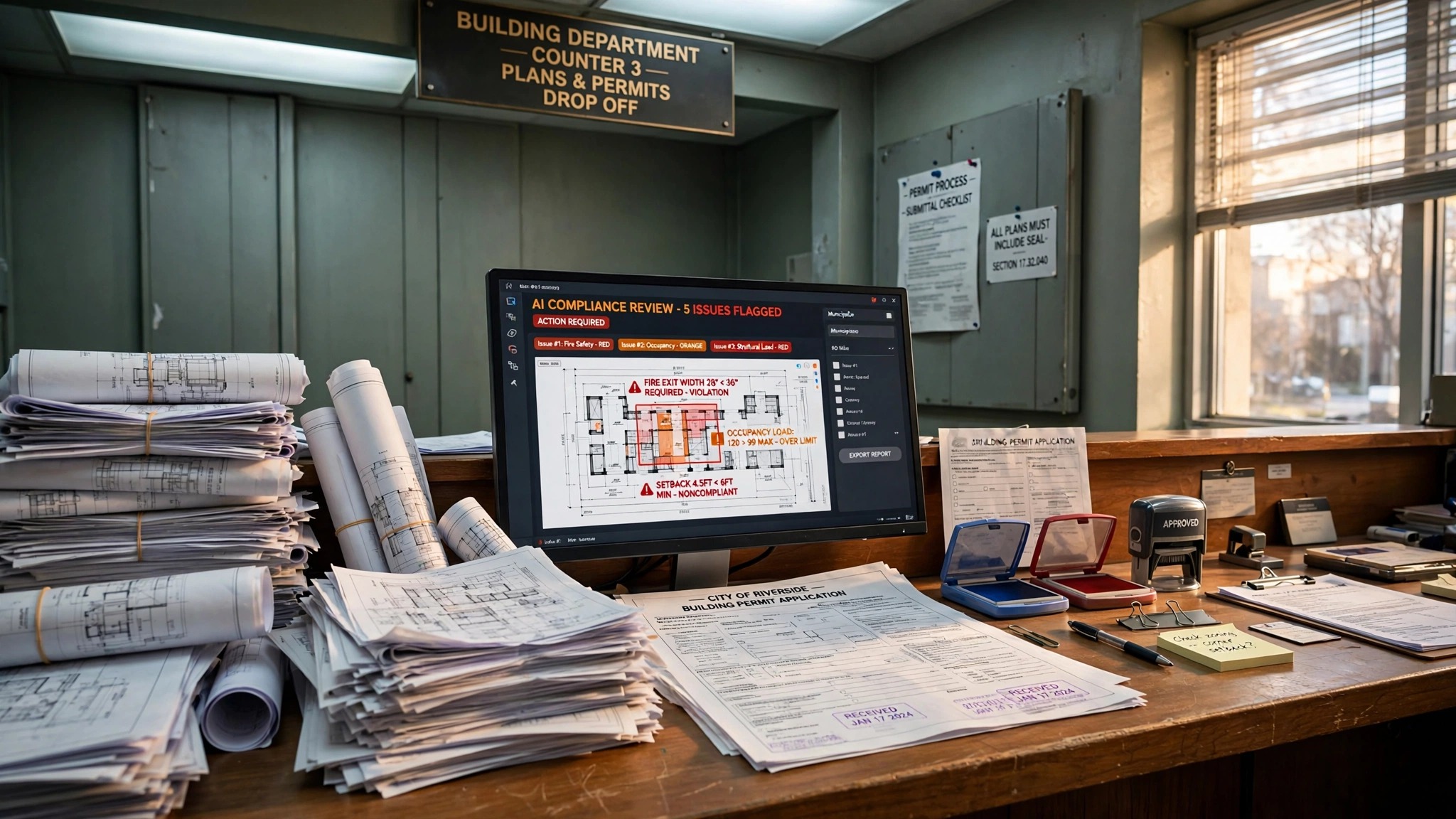
A homebuilder in Virginia lost three weeks on a permit this spring, not because the plans were wrong, not because the foundation design failed a structural review, but because the county employee handling the application resigned and nobody picked up the file. The plans sat in a folder on a desk that no longer belonged to anyone, accumulating dust and carrying costs at roughly $103 per day, until someone thought to check whether the reviewer who’d been assigned to the project still worked there. He did not.
That story, from a March 2026 account in the Independent Institute, is the kind of anecdote that makes AI permit review sound like an obvious fix. And six American cities have now decided it is.
The Machines Arrive at the Counter
In March, Denver signed a five-year, $4.6 million contract with CivCheck, an AI plan review platform owned by Clariti. CivCheck was hired to solve a problem that is specific and quantifiable: Denver approved only 30 percent of building permit applications on the first submission. Seventy percent bounced back for missing documents, incomplete fields, code violations that should have been caught before the applicant hit submit, and each rejection cycle added weeks to a timeline that was already burning carrying costs. CivCheck’s AI reads the plans, flags the gaps, and lets applicants fix errors before a human reviewer ever opens the file. Denver expects to push first-try approval rates to 80 percent.
Denver is not alone. Honolulu launched CivCheck in December 2025 for residential permits, with commercial projects scheduled to follow by mid-2026 in a city where state government projects averaged 632 days from application to issuance in 2023. Seattle’s mayor signed an executive order directing all development applications through an AI review pilot. Austin deployed Archistar’s eCheck tool, which uses computer vision and machine learning to map every element of a design against a city’s exact zoning regulations in minutes, for zoning compliance on single-family homes, while Louisville and Bellevue began piloting Govstream.ai for intake screening. And Edmonton, Alberta, achieved what may be the most dramatic result: same-day residential permits for single-family and semi-detached homes in eligible areas, down from a typical twenty-day wait.
A Y Combinator startup called Verdant launched in July 2026 after its founders interviewed more than 200 local government staff and heard the same answer everywhere: permitting is where the pain is sharpest and software has done the least to help.
The Math That Nobody Runs
NAHB published its 2026 Government Regulation in the Price of a New Home study in June. $131,734 is the number that made headlines, the total regulatory cost embedded in a median-priced $499,500 new home, up from $93,870 in 2021. Twenty-six point four percent of the sale price goes to compliance before the buyer ever turns a key.
But break down those costs and a different story emerges, one that separates the cost of waiting from the cost of the rules themselves. Building code changes enacted over the past decade account for $40,288 per home. That single line item dwarfs everything else. Permit fees, inspection fees, and hook-up fees add $20,154. Architectural design standards imposed during construction add $16,117. Pure delay cost from regulatory compliance across both the development and construction phases totals $4,112.
Read that again. Four thousand, one hundred twelve dollars.
AI permit review tools are engineered to compress the delay component, the sliver of the regulatory burden that exists because applications bounce between applicants and reviewers in cycles that consume weeks without producing construction. If CivCheck eliminated every minute of unnecessary waiting in Denver’s permitting pipeline, if Archistar reduced Austin’s zoning review to instantaneous, if every city in America achieved Edmonton’s same-day turnaround for residential permits, the theoretical national savings at 1.5 million housing starts would be $6.2 billion, a figure that sounds enormous until you realize it is 3.1 percent of the $199.4 billion in total regulatory costs those same homes carry.
Meanwhile, 96.9 percent sits in the codes themselves, in the fees municipalities charge to review them, in the design standards that accompany them, and in the land that must be dedicated or left unbuilt because of them. No AI tool currently deployed in any American city touches any of those costs. CivCheck catches that your setback is two inches short of what the code requires. It does not ask whether the setback requirement makes sense, and no municipal government in the country has hired an AI to do that asking.
The First Mover Went Bankrupt
There is a cautionary subplot. AutoReview.AI, developed by researchers at the University of Florida, was believed to be the first U.S. system to use AI to automate full building code compliance checks. Its founders encoded the entire Florida Building Code, all 800-plus pages, into a platform that could parse uploaded architectural drawings and produce standardized compliance reports. Altamonte Springs, a suburb of Orlando, ran a pilot that compressed its review timeline so dramatically that Frank Martz, the city manager, told HousingWire that what used to take a week took three to four minutes.
The pilot ended, the company ceased operations, and the code survived untouched.
The Counterargument Deserves Its Weight
NAHB’s $4,112 “pure delay cost” almost certainly understates the real impact of permitting bottlenecks. Carrying costs are only the interest on the construction loan. They do not capture trades crews scheduled and then idled because a permit review ran three weeks past its estimate, crews whose day rates accumulate whether they are framing walls or sitting in a parking lot waiting for a phone call that says the correction letter has been resolved. They do not capture material price escalation during wait periods, which in a volatile lumber market can swing thousands of dollars in a month. They do not capture the opportunity cost of capital locked into land that cannot be improved until a reviewer clears a folder. Denver’s 70 percent first-submission rejection rate meant many applications cycled three or four times, each round consuming weeks and compounding costs in ways that a single “pure delay” number does not express.
Faster permitting also enables more housing starts, a supply effect that matters considerably more than the per-unit savings because the national housing deficit currently sits at 4.7 million homes according to Zillow. If permit compression allowed a builder to start two additional homes per year, the aggregate impact on local housing inventory outweighs any carrying cost arithmetic. That argument holds water, and every pitch to a city council that leads with “faster reviews” instead of “more housing starts” is selling the wrong number.
What This Does Not Prove
CivCheck’s claimed 97 percent accuracy and 80 percent reduction in approval time come from the company and its acquirer, Clariti, not from an independent audit. Edmonton’s same-day permits apply only to certain housing types in certain areas, not to every residential application in the city. No controlled before-and-after study of any AI permit review tool has been published in a peer-reviewed journal, and the deployments span too short a period for longitudinal analysis. AutoReview.AI’s failure may have been a business model problem rather than a technology problem, but we could not determine the cause from public records. NAHB’s methodology for isolating “pure cost of delay” from broader regulatory costs is not fully transparent, and the figure may undercount cascading effects.
Only “a few dozen” U.S. cities have meaningfully deployed AI in permitting workflows, per the Independent Institute. That is a few dozen out of roughly 19,500 incorporated cities and towns, a deployment rate so low that it barely registers as a rounding error on the national permitting landscape. And the $6.2 billion savings figure uses 1.5 million total housing starts, including multi-family, while NAHB’s per-home cost data covers single-family construction; applied to single-family starts alone, the absolute number drops by roughly a third, though the 3.1 percent ratio is unchanged.
Where This Leaves the Person Writing the Check
If you are building a home in Denver, your permit application is now screened by an AI before a human reviewer touches it. That is, by any reasonable measure, an improvement. Catching a missing fire egress detail before the application enters the formal queue saves you a round-trip that would have cost two to four weeks and whatever your construction loan charges per day, and it saves a city reviewer the time spent writing a correction letter that the AI could have generated at intake.
What it does not save you is the $40,288 in code-driven costs baked into your home before anyone reviews anything, the $20,154 in fees the city charges to perform the review, or the $16,117 in design standards your architect had to meet to make the submission viable in the first place. AI permit review is an efficiency gain at the counter of a building department whose real costs are structural. It is a faster way to process the paperwork that a 97.4-percent-of-builders-agree-is-too-expensive regulatory framework generates.
AutoReview.AI read all 800 pages of the Florida Building Code. It understood every setback, every egress width, every energy compliance pathway in the state’s construction regulations. The technology worked. The company did not survive. The code is still 800 pages long.