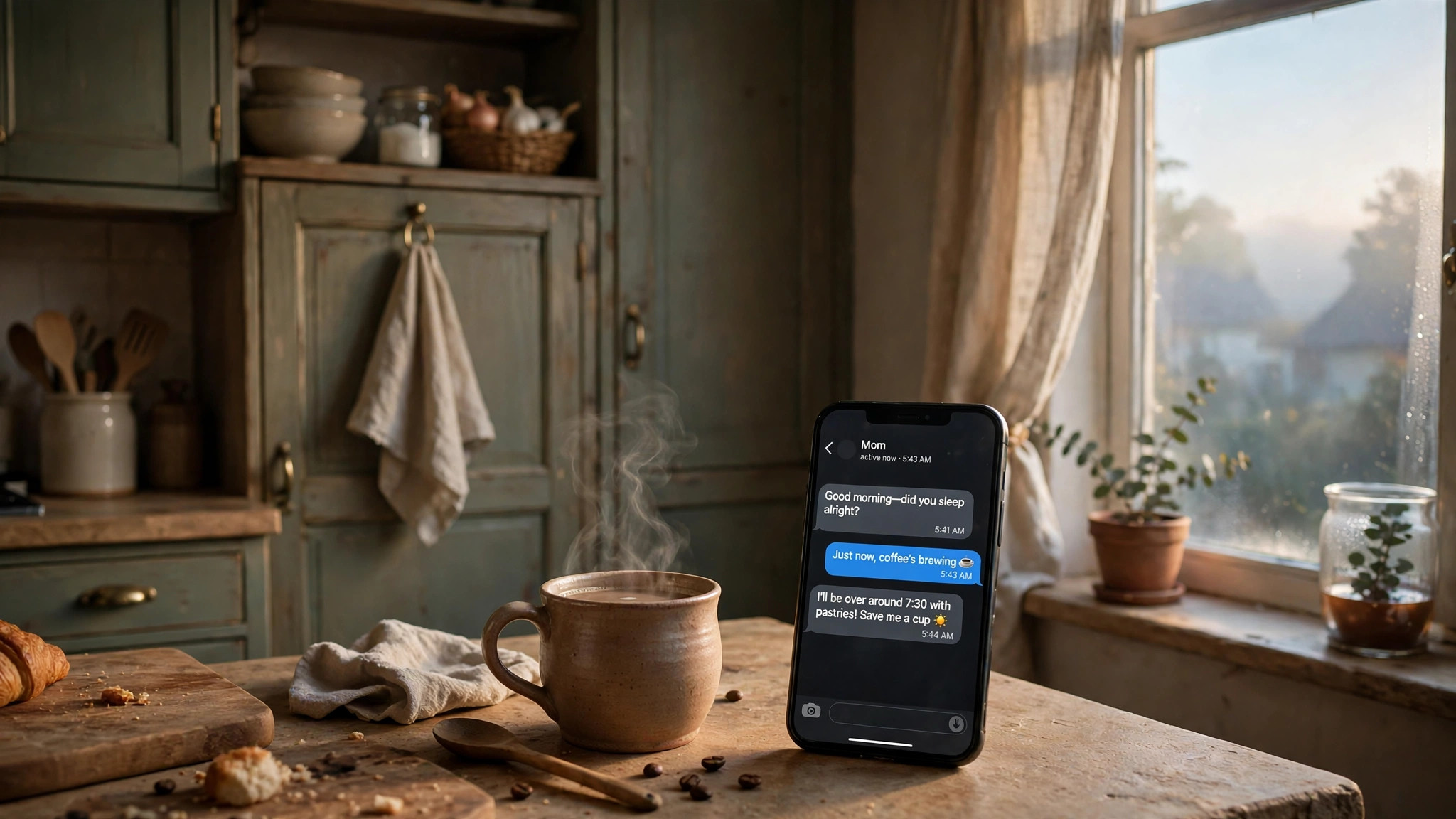
Stand in your kitchen at 7:12 a.m., one hand in the fridge, and ask the room a question. "Muse, did the dentist appointment move?" If the answer comes back through a chat app you already open twenty times a day, that is the product working. If the answer comes back through a pocket gadget that has not shipped, a video avatar with no release date, or an email address that does not exist yet, that is a keynote.
Two months after launch, Muse has eight doors. Four of them open onto something real; four are painted on. Nobody has written down which is which, with the receipts, so this is that ledger, and I am writing it because the people who most need an agent in their corner, parents mid-morning-chaos, caregivers juggling shifts, anyone whose hands are full, are exactly the people who cannot afford to build a routine around a door that is not there.
Four doors that open
The app and the website: iOS, Android, and muse.ai carry the full agent: background work, side chats, artifacts, the Goals tab, voice mode. Meta says Muse runs on its own cloud computer, a private VM with its own browser, and keeps working after you close the app. (completeaitraining.com) This is where heavy work lives. The independent guides are blunt about the channel strategy: WhatsApp is for thinking and deciding, the app is for production, because long threads and precise formatting are miserable in a chat window. (museaicodes.com)
WhatsApp: You message Muse like a person, and it is the product's sharpest distribution idea, an agent where billions of people already coordinate errands, and the place the ordinary-use case lives: quick asks, reminders, the recipe reel you saved on Instagram that becomes a grocery list. But note the fine print from the coverage: it launched in the United States, some reports add Canada, and Meta's later Japan and Singapore launch posts name the iOS and Android apps and muse.ai but do not mention WhatsApp at all. (zapvoxia.com; toolcolumn.com) It was also never presented as a reader of your existing chats. It is a contact, not a spy.
Voice mode: Talk instead of typing. Underneath sits Muse Voice Transcribe, a real-time audio model that evaluates streaming audio every 80 milliseconds and follows conversations across more than 20 speakers and 25 validated languages, including mid-sentence switching. (museaicodes.com) For a parent cooking dinner or a caregiver whose hands are busy, this is the surface that matters most, and it is the one with the least to prove: it is live, it works in the app, and it keeps working in the background while you talk.
The Mac app with computer use: This is the headline addition from Connect 2026, and the only announced capability Meta described as available now: with your permission, Muse operates applications on your Mac, clicking and typing, and works through a queued list of tasks after you walk away. (ai-generative.org) It puts Muse in direct company with Anthropic's computer use and OpenAI's Operator, except it is free for now, and Meta shipped it in the app you already downloaded rather than a separate product.
Four doors that do not
The email address: Muse will get its own address, you will add it to threads or forward mail for it to act on, and the agent will work in the background without the app open. Meta announced it at Connect, gave no date, and has said nothing about the permission model, which matters more than the feature: can anyone email your agent? (museaicodes.com) Until that question is answered in public, an agent with an inbox is a liability with an inbox.
The Realtime Avatar: A video-chat avatar that turns the real-time voice into an expressive face you can talk to. Meta showed the technology, gave it a name, and announced no release date, no market list, no technical boundaries. Treat it as a preview, not a product. (museaicodes.com)
The glasses: Say its name and Muse acts on what you are looking at, a product on a shelf, a flyer on the fridge. Meta said "the coming months." "Coming months" is a direction, not a promise, and dates slip. (ai-generative.org)
Muse Charm: A small pocket voice device, details promised later in 2026. That is the entire public record. (museaicodes.com)
The money, in one paragraph
Free gets you the whole agent. That is the part Meta keeps repeating, and the Help Center backs it: the free tier has a weekly usage limit that refreshes, and the paid tiers raise the allowance, not the features. Power is $20 a month for 500 million Muse tokens a week; Maximum is $100 a month for 3 billion. The same weekly allowance covers every surface, phone apps, muse.ai, WhatsApp, and the Mac app. (aimodelwaddle.com; museaialternative.com; shipwithmuse.live) Mark Zuckerberg said at launch the free tier runs up to 100 million tokens a week, which is a launch statement on Threads, not a Help Center figure, so check your own number under Usage in the app. You must be 18 or older to subscribe, Meta calls the whole subscription program "limited testing," and Meta plans to take a small fee from transactions without publishing the amount. Everything here is verified as of late October 2026. Confirm on the official pages before you pay.
Where the doors exist
Meta's own posts announce Muse in the US and Canada from September, Japan from October 23 (Japan time, the first region outside North America), and Singapore from October 27. There is no published country list, and the Japan and Singapore posts name only the phone apps and muse.ai. (toolcolumn.com) The Japanese help page lists plan prices in US dollars only. If you live elsewhere, the Connect keynote was not for you yet, and none of the announced features change that.
The strongest case against this whole exercise
Here it is, at full strength: none of this matters. An agent's value lives in what it can do, not where you summon it from. Seven half-built doors are worse than one good one, and every new surface is a new attack surface, another place your agent can be misled, leaked, or talked into something. The ledger above is honest about availability, but honesty cuts both ways. If all eight doors opened onto the same room, the number that matters is still one.
Fair. But rooms matter to the people who live in them. A caregiver who can only talk while cooking needs the voice door to be real, not the email door that does not exist. The point of the ledger is not to celebrate eight doors. It is to stop you from leaning on one that is painted on.
What to actually do
- Start free, and check your Usage panel: The free tier is the whole agent; the limit is the only difference. Your in-app Usage number is the truth, not a launch post.
- Match the door to the moment: WhatsApp for quick asks on the go, voice when your hands are full, the app or muse.ai for anything long or precise. One guide's rule of thumb holds up: decide in chat, produce in the app. (museaicodes.com)
- Verify voice before it acts: Voice mode transcribes fast, but a misheard "send it" is still a sent email. Keep approval gates on for anything consequential; that is the entire safety model.
- Mac users: one low-stakes errand first: Computer use is genuinely new and genuinely powerful. Try it on organizing downloads before you hand it your inbox, and keep a hand on the permission prompt.
- Budget for zero announced surfaces: No email address, no avatar, no glasses date, no Charm. If a routine needs one of them, it is not a routine yet.
- Check your country before you plan: Japan and Singapore just joined; WhatsApp availability outside North America is unclear. Prices are in dollars everywhere.
- Do the token math before you pay: Power buys five times the free weekly allowance at $20. If you do not know your weekly usage, Maximum's $100 is a guess, not a plan.
Limitations
I have not personally tested every surface; availability claims come from Meta's announcements as reported by independent guides, and "live now" is Meta's word, not a bench test. That free-tier token figure comes from Zuckerberg's launch statement, not the Help Center, and may differ by account. Sources disagree on whether WhatsApp availability extends beyond the US; Meta's Japan and Singapore posts do not name it. Announced features have no ship dates, and Meta delayed Muse itself from April 2026 over safety issues found in testing, with vice president Vishal Shah quoted saying it is impossible to say there will never be a mistake. (beconfidency.agency) Pricing is in what Meta calls limited testing and may change. Treat every date and dollar here as a snapshot from late October 2026, and confirm on the official pages before making decisions.