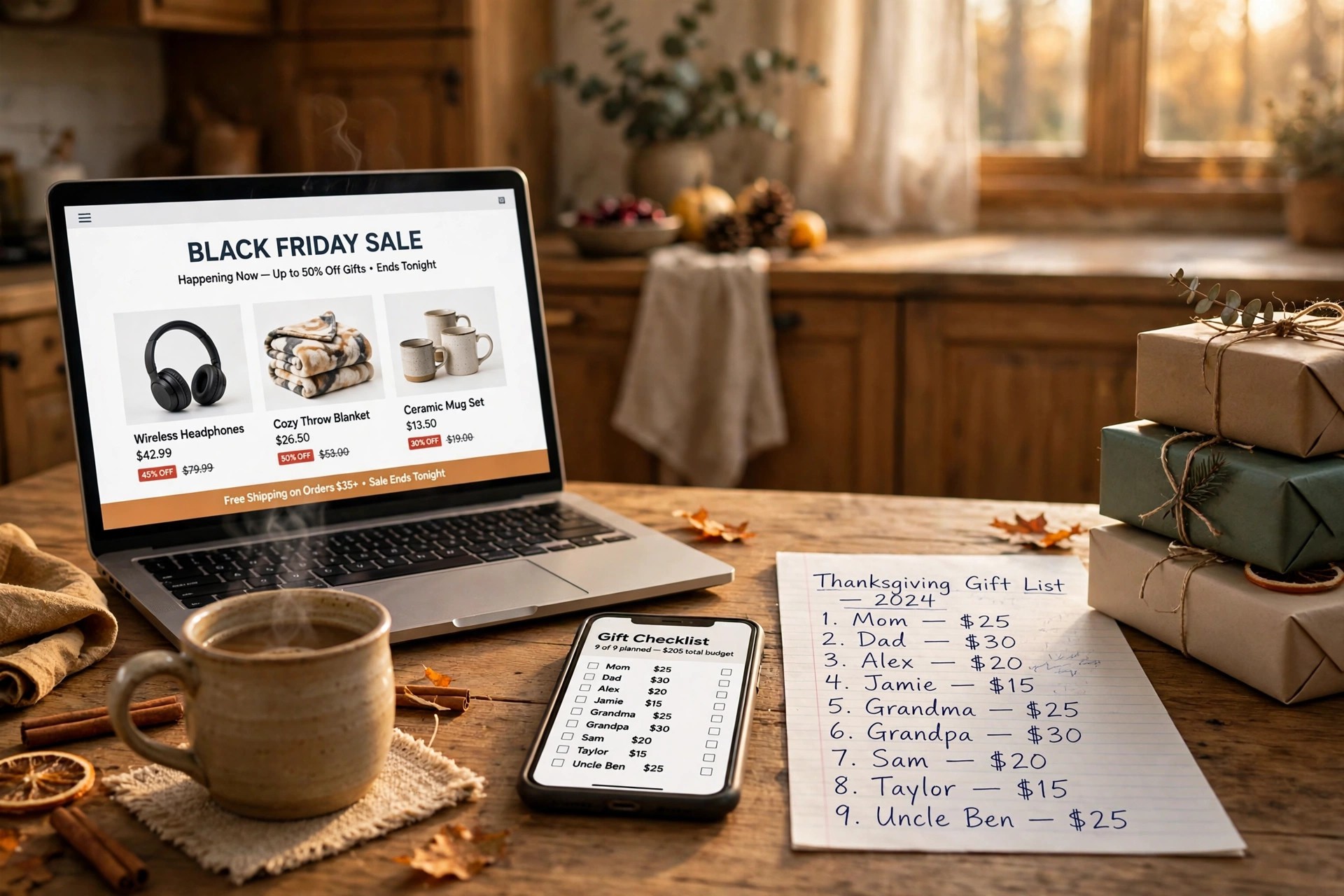
Thanksgiving dinner is still warm and somebody at the table is already doing holiday math out loud. Nine people to buy for, a budget that sounded reasonable in October, two nieces who want the same art set, a mother-in-law who returns everything, and a gift list scattered across a fridge note, a spreadsheet nobody has opened in weeks, and a chat thread where you explained the whole thing to Muse four times because every conversation started from zero.
Now Muse can do more than remember the list: it can buy from it.
On November 6, Meta gave Muse Spaces, persistent mini-apps you describe in plain language, and its lead example was a holiday gift tracker. On November 24, Walmart announced that Muse can shop its Black Friday deals directly, find items, build a basket, and complete the purchase through a new Walmart Agent Gateway. Eighteen days. That is how long it took your agent to go from organizing your list to charging your card.
That speed is the story. Not the feature list, which Meta and Walmart have both published in cheerful detail, but the gap between the two announcements, because the control that is supposed to keep the shopping honest gets configured at the worst possible moment: the first time you add something to a cart.
Three doors, three different risks
Meta and Walmart present this as one smooth experience, Muse does the holidays. It is not one thing; it is three doors, and they carry three very different kinds of risk.
Door one is the tracker. A gift tracker Space never buys anything, never places an order, never shares the list outside itself. Worst case is a wrong number in a spreadsheet, and you catch it when you look at the budget bar. This is the door most families should walk through first, and for many households it is the only door worth opening.
Door two is the shopper. Through the Walmart Agent Gateway, Muse passes your shopping list to Walmart, Walmart finds matching products, and you check out inside the conversation with a card saved in your Walmart account, at the same prices as Walmart.com. Walmart says its return policy still applies if something is not quite right. Between a misunderstood request and a charged card stand two things: a spending limit and a purchase approval, both set in an Agent Profile you create the first time an item lands in the cart.
Door three is the caller. Since November 12, paid US subscribers can ask Muse to phone businesses on their behalf, navigating menus and hold times to reach a human. That is the door with no receipt. A tracker leaves a spreadsheet. A shopper leaves a purchase history. A phone call leaves whatever the person on the other end heard, which means you find out what Muse committed you to after it hangs up.
Treating these as one feature is how a family ends up surprised, so price them separately.
What the controls actually are
Walmart's announcement is specific about the mechanics, and the specifics are reassuring as far as they go. You set an Agent Profile inside your Walmart account, including a spending limit you choose, and you approve purchases. You can review purchase history to see which purchases your agent made. Walmart says the gateway helps agents find products without sharing your broader purchase history with others.
What the announcement does not say matters just as much. It does not say whether the spending limit applies per purchase, per day, or for the whole season. It does not say what happens mid-basket when a limit is hit, or how a price that changes between basket and checkout during a flash sale gets handled. And while Walmart's return policy covers sending the wrong item back, it does not cover the cost of the mistake: the Black Friday price that is gone by the time the replacement is ordered, the shipping, the afternoon spent fixing it.
None of that is a reason to refuse the gateway outright. It is a reason to set the limit before the first purchase, not during it, and to set it low. A $150 seasonal cap on a first run teaches you how the agent behaves for the price of one mistake, not nine.
Do the budget math before Friday
Take a real, tested example. The editors at Muse Skills published a gift tracker Space built around nine people and a $600 total budget. By December 10 in their example, $412 was spent, three gifts were still at the idea stage, and two bought gifts were waiting to be wrapped. One person was flagged at $95 spent against a $75 limit.
Run those numbers forward: with $412 spent, $188 remains for three un-bought gifts, or about $62.67 each, against an original per-person average of $66.67. That flagged overspend, $20 over one person's cap, is 27 percent over that person's limit, and on its own it consumed about 10 percent of the remaining headroom for the whole list. Two more overspends like it and the list is underwater before the last gift is bought.
Small overspends compound. That is the entire argument for per-person limits inside the tracker, and it is the same argument for the spending limit on the gateway, except the gateway version of an overspend arrives already charged.
None of this requires trusting Meta's numbers; it requires trusting your own arithmetic, which is the point: the tracker makes the arithmetic visible, and visible arithmetic is the cheapest holiday insurance there is.
The case against letting it shop at all
Now the strongest objection, stated at full strength, because it is probably right for most households.
Most people enjoy choosing gifts. Hunting a deal is half the fun of Black Friday for millions of shoppers, and handing the list to an agent saves perhaps forty minutes across a whole season while introducing a new failure mode, a wrong item, a missed deal, a duplicate gift, that costs more time to fix than the agent saved. A tracker is genuinely useful because it solves a real problem, remembering. A shopper is a demo that happens to charge your card, solving a problem most people do not have, because they were never going to pay someone else to pick the presents.
That objection does not kill the story; it sharpens it. If you use the gateway anyway, use it for the boring part, the batteries, the wrapping paper, the duplicate of the thing you already bought last year, the items where a wrong choice costs $12 instead of $120, and keep the gifts that matter in your own hands while letting the agent carry the bags instead of choosing the presents.
What to do before Friday
First, build the tracker before you connect the shopper: describe the gift list to Muse as a Space, or use the budget prompt published by AI Setups That Work, which tells Muse explicitly not to buy anything, add anything to a cart, or contact anyone. Set per-person limits and a total, and ask Muse to check in weekly with what is spent and what is left.
Second, set Muse's permissions to Always ask while you shop, so nothing moves without your approval, because Meta's own help pages describe Always ask as the setting that makes Muse ask before any action.
Third, if you try the Walmart gateway, set the Agent Profile spending limit before the first item goes in the cart, keep it low for the first run, approve every purchase individually, and check the purchase history after the first order, not after the fifth.
Fourth, remember the rest of November arrived in the same pile: Muse gained voice calls with the agent on November 5, Spaces and Wonder-trained models on November 6, Uber Courier and Expedia booking on November 10, outbound business calling on November 12, and Walmart shopping on November 24. Ten moves in nineteen days, and nobody has tested how they interact: a Space that tracks a gift, a gateway that buys it, and a phone call that returns it, all in the same afternoon.
And when the season is over, clean up by asking Muse to forget the gift list, or delete the spreadsheet from the Library. A list that knew what everyone in your family wanted, what you spent, and where you shop is not something to leave lying around in an agent's memory until next December.
Thanksgiving is the right day to decide this, because the decision is small and the season is long. Let Muse remember the list. Let it carry the bags, and decide for yourself, before Friday, whether it gets to spend the money.
What this article did not prove
This analysis rests on vendor announcements from November 2026, and no independent testing of the Walmart Agent Gateway at Black Friday volume exists yet. The hands-on sources cited here are setup guides and a tested Space specification, not purchase receipts, so the failure modes described above are reasoned from the announced controls, not observed in a live order. Walmart has not published whether the spending limit is per purchase, per day, or per season, what happens mid-basket when a limit is hit, or who bears the cost when a Black Friday price disappears during a return and rebuy. Spaces cannot yet be shared between family members, so each person keeps a separate list, which is exactly how duplicate gifts happen. Outbound calling is limited to paid US subscribers, so free-tier users cannot have Muse call a store about an order it just placed. The budget math uses the Muse Skills example of nine people and $600; your list will differ, and the compounding effect of small overspends scales with the number of people on it.
Sources: Meta Newsroom, "Design the Muse App, Just for You" (November 6, 2026); Walmart Corporate News, "Walmart's Black Friday Deals Continue. Meta's Muse Can Now Shop Them, Too" (November 24, 2026); TechCrunch, "Meta introduces Spaces" (November 6, 2026); TechWyse, "Meta Muse AI Can Now Call Businesses for Users" (November 2026); AI Setups That Work, "Holiday gift budget with Meta Muse" (November 6, 2026); Muse Skills, "Holiday Gift Tracker" (November 12, 2026); AgentStackList, Muse news tracker (November 12, 2026).