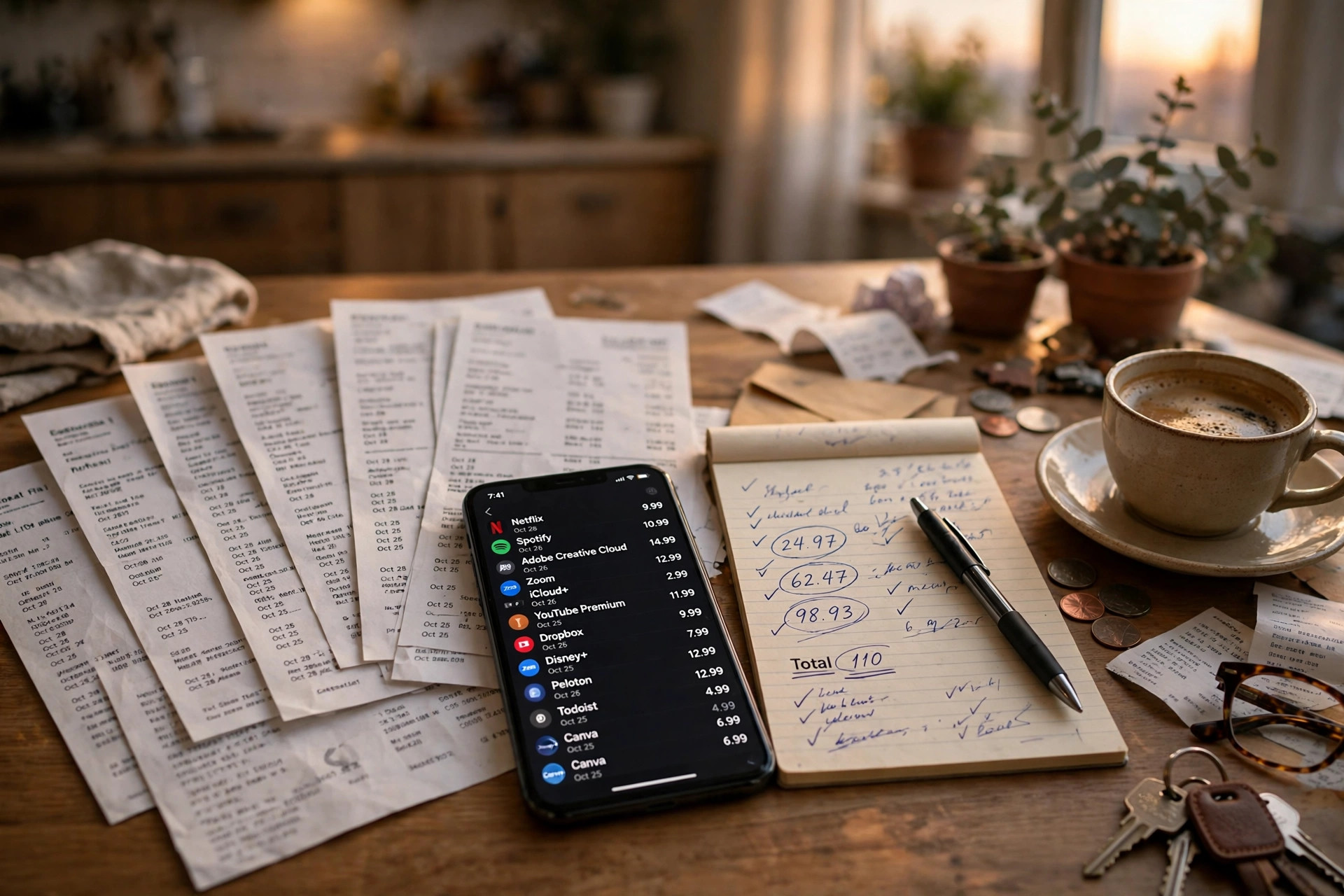
Every operation I have ever run had a monthly close, a day when somebody sat down with the ledger and found out what the month actually cost, and every operation I have ever run also had a manager who skipped the close for six months and then acted surprised at the number.
Your household has a monthly close too, except nobody does it, and the charges do not wait for permission to keep coming. Subscriptions are the one line item in a family budget that grows without a meeting, without a signature, and without anybody noticing, because each charge is small enough to ignore and automatic enough to forget.
Somebody finally measured the gap between what people think they pay and what they actually pay, and the number should embarrass everyone in the room, starting with me.
Ask twice, get two different answers
In 2022, C+R Research surveyed 1,000 American consumers and asked them a simple question first, then a harder one. Asked off the top of their heads, people estimated they spent $86 a month on subscriptions. Then the researchers walked the same people through every category, streaming, music, gaming, food, fitness, software, one by one, and asked them to add it up. Same people, same month, same wallets. Itemized total: $219 a month.
That is a $133-a-month gap between the guess and the count, roughly $1,600 a year, and it came from the respondents themselves, which is the point. Nobody checked a bank statement. Nobody audited anything. People were simply asked to count instead of guess, and counting produced a number two and a half times larger than the guess.
Two details from that survey deserve more attention than they usually get. First, 42 percent of respondents admitted they were still paying for a service they had stopped using, and 74 percent agreed that recurring charges are easy to forget. Second, 72 percent had every subscription on autopay, which removes the one moment, the act of paying, that would have reminded them the service existed at all.
Newer numbers point the same direction, though they run lower, and the reason they run lower is worth understanding before anyone quotes them. A CNET and YouGov survey of 2,522 adults, fielded in late April and early May of 2026, found the average adult reports spending $111 a month on subscriptions, up 23 percent from $90 a month in the 2025 survey, and wasting $21 a month, $252 a year, on subscriptions they never use. Self-reports land lower than itemized counts because a self-report is still a guess, just a more recent one. West Monroe found the same pattern in 2021 with 2,500 consumers: $273 a month once people were walked through 21 categories, and 66 percent underestimated their spend by more than $200.
Pick whichever number you trust. Even the lowest of them, the $21 a month of admitted waste, is $252 a year leaking out of a household that never held a meeting about it.
The law that was supposed to fix this got vacated
For a while it looked like the government would do the monthly close for you. In October 2024 the Federal Trade Commission adopted a revised Negative Option Rule, the one everyone called click-to-cancel, by a 3-2 vote. It would have required clear disclosure of auto-renewal terms, express consent, and a cancellation mechanism as easy as the signup, which in practice meant a button instead of a phone call.
On July 8, 2025, the U.S. Court of Appeals for the Eighth Circuit vacated the rule in its entirety, in a case called Custom Communications, Inc. v. Federal Trade Commission. Read the decision carefully, because what it says matters. The court did not rule that easy cancellation is a bad idea. It ruled that the FTC skipped a procedural step, a preliminary regulatory analysis required by Section 22 of the FTC Act once an administrative law judge found the rule's economic impact exceeded $100 million a year, and that the failure could not be cured after the fact.
Procedure killed the rule, not substance, but dead is dead. The FTC restarted rulemaking in January 2026 with a draft Advance Notice of Proposed Rulemaking, sought public comment in March, and as of this writing no replacement rule has followed. Enforcement under the older Restore Online Shoppers' Confidence Act continues, but that statute never promised you a cancel button.
One jurisdiction did act. California's AB 2863, which took effect July 1, 2025, requires businesses to get express affirmative consent to auto-renewal terms, to send an annual reminder notice, and to let consumers cancel in the same medium they used to sign up, with a prominently located click-to-cancel option and no steps that obstruct or delay termination. Trial periods over 31 days get a notice 3 to 21 days before they convert. Annual terms get a notice 15 to 45 days before renewal. Fee changes get a notice 7 to 30 days before they take effect. Attorney General Rob Bonta issued a consumer alert when the amendments took effect, which is the government doing what it can, in one state, while the federal rule sits in pieces.
If you live in California, you have rights worth citing the next time a merchant hides the cancel button. If you live anywhere else, you have a monthly close to run yourself, and nobody is coming to run it for you.
The audit Muse can run every month
This is where the agent earns its keep, and the job is specific enough to write down as a procedure instead of a wish. A subscription audit needs two feeds, and Muse has both of them, if you connect them. One is the bank feed, through the Plaid connector, which sees every recurring charge as it posts. The other is the inbox, through the Gmail connector, which holds the receipts, the renewal notices, and the trial-expiry warnings that the bank feed never explains.
Either feed alone tells you half the story. A bank feed shows a $14.99 charge from a merchant name you do not recognize, and you cannot tell whether it is the meditation app or the cloud storage. An inbox search shows a receipt for a service you cancelled in March, and you cannot tell whether the charge stopped. Put them together and each charge gets two witnesses, and a charge with a bank record and no matching receipt, and no sign of use in 90 days, is the prime suspect in every audit I have ever run.
Here is the scheduled task, written the way you would actually give it to Muse. Set it for the first of the month, and let it run while you are doing something else.
On the first of every month, audit my subscriptions. Pull all recurring charges from my bank and card transactions for the last 30 days through Plaid, then search Gmail for receipts and renewal notices for each merchant. For every subscription, report: merchant, monthly cost, date of last charge, date of last receipt, and whether I have used the service in the last 90 days based on my email and calendar. Sort the results into three buckets. Keep: used in the last 30 days. Question: not used in 30 days but used in 90. Cancel: no use in 90 days, or a charge with no matching receipt. Give me the total monthly cost of the Cancel bucket first, then the list. Do not cancel anything yourself.
Three details in that brief are doing real work, so do not trim them. "Do not cancel anything yourself" keeps the agent in the auditor's chair, where it belongs, because cancellation is the step with the most ways to go wrong. The three buckets force a decision on every line instead of producing a report you file and forget. And the total of the Cancel bucket goes first, because a list without a dollar figure at the top is a document, not a decision.
Scheduled tasks run on Muse's own computer in Meta's cloud, so the audit runs whether your phone is in your pocket or on the charger, and the results arrive as a message. Each run uses part of your weekly allowance, which is the cost of the job, and each task has its own approval, reviewable in Settings under Permissions, so you can see exactly what the audit is allowed to touch and revoke it in one place.
What the audit is worth
Nobody can tell you what your audit will find, but the published numbers let you price the three outcomes honestly, with the assumptions stated instead of hidden.
| Scenario | Monthly recovery | Annual recovery | What it assumes |
|---|---|---|---|
| Floor: admitted waste only | $21 | $252 | CNET 2026: what adults say they waste on subscriptions they never use |
| Middle: half the memory gap | $66.50 | $798 | Muse's audit catches half of the C+R $133 gap between guess and itemized total |
| Ceiling: the full memory gap | $133 | $1,596 | The household is average, and the audit finds everything the itemized count found |
Run the arithmetic on the floor first, because it is the only scenario that does not ask you to believe anything. If the audit finds nothing but the $21 a month people admit to wasting, that is $252 a year, which covers one year of the $20-a-month agent subscription that ran the audit, with $12 to spare. The floor scenario barely breaks even against the cost of the agent itself, which is the honest way to read it. The middle and ceiling scenarios are where the audit earns its keep, and both depend on your household looking something like the average one in the C+R study.
There is also a number that does not appear in the table and should. Deloitte's Digital Media Trends survey for 2026 found the average subscribing household spends $69 a month on streaming video across four services, which means streaming alone is most of the way to the $86 people guess for everything. Your guess was never going to survive contact with the ledger. It was low before you counted the first service.
What Muse can see, and what it cannot
An honest audit names its blind spots before the client finds them, so here is the ledger for this one.
| Muse can see | Muse cannot see |
|---|---|
| Recurring card and bank charges, through Plaid | App Store and Google Play billing, which arrives as one platform charge, not one per service |
| Receipts and renewal notices in Gmail | Subscriptions on a partner's or family member's card |
| Trial-expiry warnings, if they arrive by email | Annual charges that predate the Gmail connection |
| Usage signals in email and calendar | Services paid by gift card, cash, or a work account |
| Price changes announced by email | Whether you actually opened the app, which email cannot prove |
Read that right column twice before you trust the audit completely, because the App Store row is the one that bites. Apple and Google bill many subscriptions as a single platform charge, which means the bank feed shows one number for five services, and the audit has to go into the platform's own subscription page to itemize it. Tell Muse to check your Apple subscriptions page and your Google Play subscriptions page as part of the monthly run, and say so in the brief, or the audit will undercount by exactly the services you forgot about, which are the ones that matter.
The case against handing Muse your bank feed
Here is the strongest case against everything above, stated at full strength, because an audit that hides its own cost is a sales pitch, not an operation.
The audit asks you to hand your bank feed to the same agent you are asking to judge your spending, which is the access paradox at the center of the whole personal-agent idea. The more useful the agent, the more of your financial life it can see, and a misread charge is a cancelled service you actually use, like the password manager or the cloud backup you touch once a year and need desperately on the day your laptop dies. A single wrong cancellation costs more than a year of audit savings, and it costs it in the currency you cannot get back, which is a locked account at 11 p.m.
Cancellation is also the part Muse is worst at, and the law is the reason. Many merchants still require a phone call, a retention maze, or a chat with a human being whose job is to keep you, and California's same-medium rule only helps if you live in California. The federal rule that would have made cancellation one click everywhere was vacated on a procedural technicality, so the agent finds the money and then hands you the phone. If the audit saves $252 a year but costs you an afternoon of retention calls and one wrongly cancelled backup service, you are behind, and no table in this article changes that arithmetic.
That case is fair, and it is the reason the brief above says "do not cancel anything yourself" in plain language. The agent's job is the monthly close, not the execution. You are the foreman. The agent brings the ledger, and you sign the cancellations, one at a time, with your eyes open, which is how every operation that lasts is run.
What to do tonight
Connect two things and write one sentence. Connect the Plaid connector for your bank and card transactions, and connect Gmail, then give Muse the monthly audit brief above, set for the first of the month, and check that it appears under the assistant icon in Upcoming. Open Settings, Permissions, and confirm the audit task can read transactions and email and nothing else. That is the whole setup, and it takes less time than cancelling one subscription by phone.
When the first audit lands, read the Cancel bucket total first, then work the list from the largest charge down, because a $49-a-month service you forgot is worth more than four $4.99 ones, and operations people always work the big numbers first. Cancel one service a day for a week instead of all of them in an hour, so a mistake is one service, not five. If you live in California and a merchant obstructs the cancellation, cite AB 2863 and the same-medium rule, and keep the email where they told you to call instead. If you live elsewhere, cite the Restore Online Shoppers' Confidence Act and ask for the cancellation in writing, which creates a record the phone call never will.
Then, next month, let the audit run again, and compare the two totals. A monthly close only works if you do it every month, and the second audit is the one that tells you whether the first one mattered, because the number that counts is not what you cancelled. It is what stopped coming back.
What we did not verify
No hands-on Muse subscription audit was run for this article. No real bank feed was connected and no real household's subscriptions were audited, so the recovery figures are arithmetic on published survey numbers, not measured results, and your household will differ. C+R Research is from 2022 and self-reported, and the CNET 2026 survey is self-reported as well. No published statement-level audit of a large sample exists, so the true average waste is unknown, and the $133 gap is a memory gap, not a bank-verified figure.
California's AB 2863 protections apply only to California consumers. Readers elsewhere rely on the Restore Online Shoppers' Confidence Act and the FTC's restarted rulemaking, which has produced no rule as of November 2026. Muse's Plaid connector scope, and whether a scheduled task can read transactions without a fresh approval on each run, were not independently verified beyond connector documentation. Confirm both during setup, and treat the first audit as a test, not a verdict.
Sources
C+R Research, "Subscription Service Statistics and Costs," survey fielded April 22-May 2, 2022, n=1,000 U.S. consumers ($86 guess vs $219 itemized; 42% still paying for unused services; 74% say charges are easy to forget; 72% on autopay). Money Under 40, "The Subscription Audit: Find the Money Hiding in Your Bank Statement," November 10, 2026 (CNET/YouGov 2026: $111/month average, up 23% from $90; $21/month wasted, $252/year; n=2,522). Sidley, "U.S. FTC Click-to-Cancel Rule Struck Down," July 2025 (Eighth Circuit vacatur, July 8, 2025, Custom Communications, Inc. v. FTC). Gibson Dunn, "FTC Restarts Negative Option Rulemaking After Eighth Circuit Vacatur," February 27, 2026, updated March 11, 2026 (ANPRM, comments due April 13, 2026; ROSCA enforcement continues). California Legislature, AB 2863 bill text, Stats. 2024, Ch. 515 (effective July 1, 2025). California Attorney General, consumer alert on the Automatic Renewal Law, 2025. Always On GTM, "How to Set Up Recurring Tasks in Muse," 2026 (scheduled tasks run on Muse's cloud computer; approvals in Settings, Permissions; Upcoming tab). Subby, "Average Subscription Cost per Month, Survey by Survey," 2026 (West Monroe 2021: $273/month, n=2,500; Deloitte 2026: $69/month streaming per household).