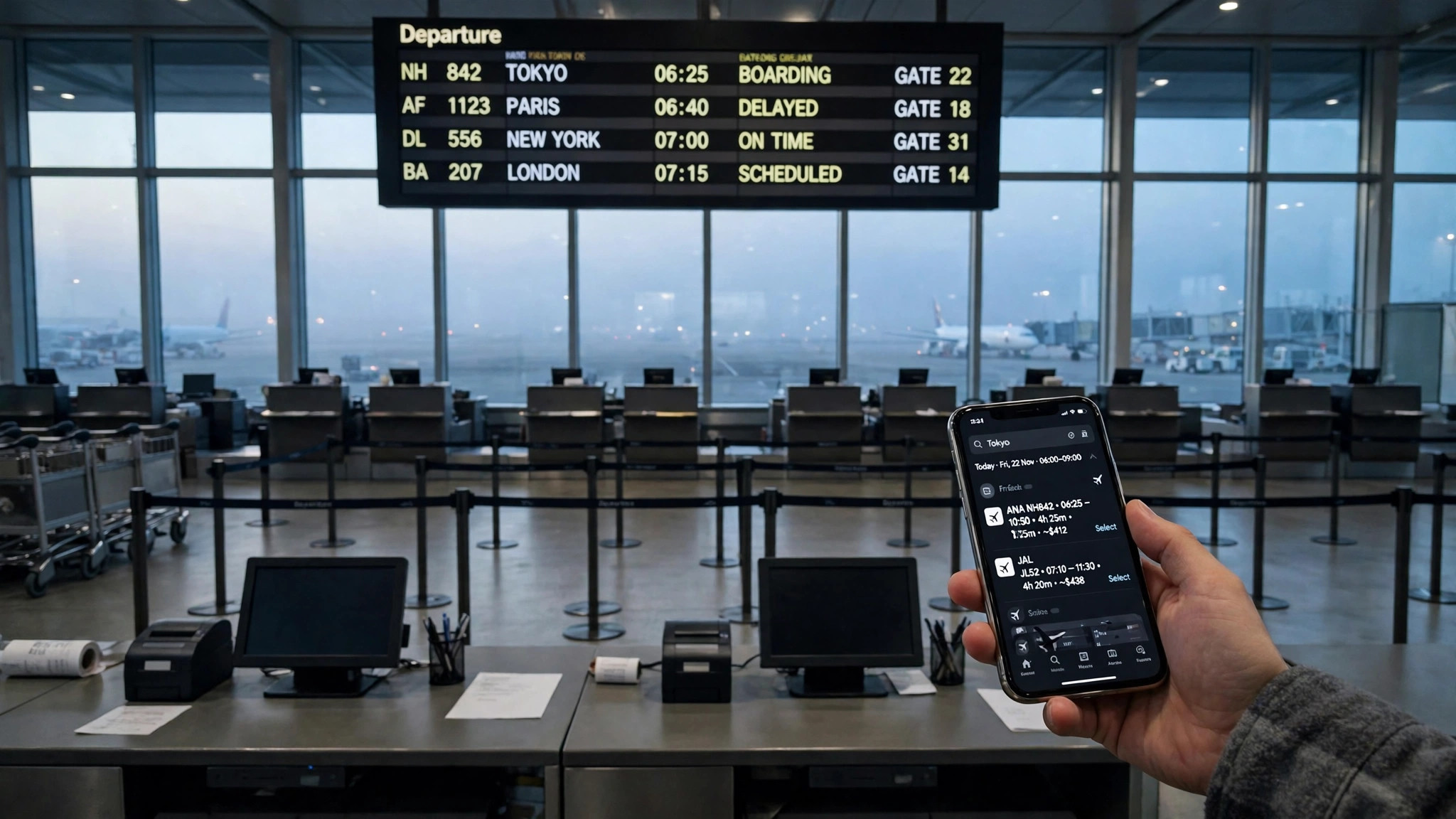
United Airlines chief executive Scott Kirby said the quiet part out loud the day before his airline banned your AI agent from buying its tickets. "To be honest, I don't want to create another middleman," he told a Chicago audience on November 10, 2026, and the next morning United rewrote its Contract of Carriage to make sure no middleman would be created, at least not on its metal. Read the press release and you will hear about data security, unintended purchases, and federal aviation rules. Read the contract and you will hear something else: a company that has decided the customer relationship is its own, and that your agent, however helpful, is a stranger at the gate.
Muse is Meta's personal AI agent, launched September 8, 2026, and booking travel is one of the jobs people actually hand it, because travel is the perfect agent task, a mess of calendars, fares, seat maps, and confirmation numbers that no sane person enjoys managing by hand. On Wednesday, November 11, United became the first United States carrier to draw a line through that job. Its revised Contract of Carriage, headed "revised November 11, 2026," adds a definition of "AI Agent" to Rule 1, adds a new prohibited practice at Rule 6.J.6, and amends Rule 5.H so that reservations made, modified, or serviced by an AI agent are among the improper reservations United "will cancel without notice." Coverage in CBS News and CNBC named the agents people actually use for this work, Meta's Muse and OpenAI's Dots, and United's own help pages confirm the scope: agents may still show you United's flights and fares, but they may not complete the purchase, change a booking, or check you in.
Most coverage stopped there, at the headline that bookings are banned. Anyone who has spent twenty years watching automation promises meet real operations knows the headline is never the whole story, because the interesting part of a contract is never the ban, it is the definition, and United's definition is written deliberately wide. An "AI Agent," under the new Rule 1, is "any software or service, including but not limited to an AI assistant, AI agent or AI-enabled browser that takes autonomous or semi-autonomous action, whether or not Passenger or another individual supervises or approves its actions, to discover, search for, book, purchase, ticket, service or manage any product or service offered by or through United, including flights, seats, upgrades, ancillary products and partner products." Read that clause again, slowly, because the eight words doing all the work are "whether or not Passenger or another individual supervises or approves its actions." Your approval does not cure it. Your supervision does not cure it. United's Digital Trust Center page says it plainly, in language a tired traveler can understand at midnight: giving an assistant access "doesn't mean United will permit an AI assistant to transact with United." Authorization that counts belongs to the airline, not to you, and every prior story about agents acting without their owners missed this, because United's rule bans the agent acting with you.
What your agent can and cannot do on United, task by task
Nobody had published the task-by-task map, so here it is, derived from the Rule 1 definition, the new Rule 6.J.6, and United's Trust Center answers, and each cell carries the contract language behind it rather than a guess.
| Task you might ask Muse to do | Status on United | Why |
|---|---|---|
| Search fares and show flight options | Allowed, with a catch | Agents may display flights and fares, but United's Trust Center treats any agent that searches on united.com or in the United app without permission as unauthorized, so the safe version is research that never touches United's own site. |
| Hold a fare while you decide | Banned | A hold is servicing a ticket, and Rule 6.J.6 bans AI agents from making, modifying, or servicing a ticket. |
| Book the ticket | Banned | Rule 6.J.6, in so many words, and Rule 5.H lets United cancel the reservation without notice. |
| Change a booking or pick a seat | Banned | Same rule, same words: "make, modify or service a Ticket, and/or to purchase any service or product." |
| Check you in | Banned | United flags automated check-in as a possible breach of FAA and Department of Transportation rules, because online check-in requires a passenger to personally acknowledge that their bags carry no prohibited items. |
| Spend MileagePlus miles | Banned | Buying with miles is still a purchase of a service or product, and Rule 6.K remedies run from invalidating tickets to deleting miles, revoking Elite status, and ending MileagePlus membership. |
Two notes on that table, because a table that pretends to be certain is worse than no table at all. First, the search row is genuinely gray: planning with AI is fine, pointing an AI browser at united.com is not, and the line between them is wherever United's detection draws it, which nobody outside the airline has seen. Second, bookings an agent completed before November 11 will not be canceled, according to United, though the airline recommends reviewing recent trips to confirm they were ticketed correctly, which is the kind of sentence that should make anyone who let an agent book a holiday flight go check right now.
United is not the first door to close
Put November 11 on a timeline and the pattern stops looking like one airline's quirk. Amazon blocked Muse from buying on Amazon.com on September 20, 2026, twelve days after Muse launched. eBay updated its user agreement to prohibit automated access without permission. Booking.com bars AI assistants without prior permission. Target allows only an approved list of agents. Yelp accepts only agents with paid data-licensing agreements. JPMorgan Chase and Charles Schwab reportedly block agent access to accounts. Cloudflare changed its defaults on September 15, 2026, and began blocking mixed crawlers, which swept agents into blocks on pages carrying advertising, whether or not anyone at the site made a deliberate decision about agents at all. Add it up and the web your agent was promised, every door open to software acting on your behalf, is closing one contract at a time, and United is simply the first airline to say so in a document passengers are bound by.
Not every door is closing. Walmart announced an official partnership with Muse at Meta Connect in September 2026, and Meta says it is developing open standards with Walmart, Stripe, Sierra, and others for safe interactions between agents and business systems. On the very same day United moved, the European Commission adopted a Digital Fairness Act proposal that would let Brussels fine companies up to 6 percent of worldwide turnover and require AI shopping agents to disclose when a suggestion has been paid for. One side of the Atlantic is banning agents from the checkout, the other is writing rules for how agents must behave at the checkout, and both moves point the same way, toward a world where an agent transacts only where a company has explicitly agreed to let it.
The big three split three ways
Travelers who fly more than one airline should know the map is not uniform, because the three largest United States carriers have now taken three different positions, and the differences matter more than the headlines. United bans agent booking outright. Delta lets authenticated AI assistants complete bookings, with extra safeguards for sensitive transactions such as trips for unaccompanied minors. American says some agents can buy tickets through certain partners. One ban, one conditional yes, one partial yes, and none of them is a settled policy, because all three are feeling their way through a technology that is two months old in its current form. If you fly United and Delta in the same month, your agent is a booking tool on one and a contract violation on the other, and the only way to know which is to read the fine print of the carrier you happen to be standing in front of, which is a miserable way to run a travel operation and exactly the kind of friction that kills a workflow.
The case for the ban, at full strength
Fairness demands the strongest version of United's case, stated without a strawman, and it is stronger than the middleman quote makes it look. Handing a MileagePlus login to an outside agent does expose sensitive information, including payment details and travel history, and an agent acting on its own really could make a purchase you did not intend, change a reservation you meant to keep, or burn miles you never meant to spend. Automated check-in really does sit uneasily beside federal rules that require a human being to acknowledge what is in their bag. Agent bookings are rare today by United's own account, so the ban costs almost nobody anything right now, and a carrier that waits until agent bookings are common has waited too long to set the terms. Kirby's middleman line is honest, but honesty about a motive does not disprove the security case, and a ban can be both self-interested and prudent at the same time, which is the usual condition of corporate policy. Anyone who has watched an agent confidently do the wrong thing at 2 a.m. while its owner slept will recognize the risk United is describing, because we have all seen the failure mode, just not on an airplane yet.
Even so, the ban has a hole in it, and it is worth naming before anyone treats the contract as a wall. United's rule is contractual, not technical, and multiple reports note it is far from clear how the airline would reliably detect an AI booking that arrives through an intermediary, a travel agency, or an aggregator, which is exactly the channel the ban claims to reach. A rule nobody can enforce is a statement of intent, and statements of intent change when the business case changes. United's own Trust Center answers "Not yet" when asked whether it works with any third-party AI agents, with a promise to update the page if that changes, and that "yet" is doing a lot of work. It leaves the door open to approved integrations later, on United's terms, with United's authorization, which brings us back to Kirby's sentence. United does not object to agents. United objects to agents it did not choose.
What I could not verify
Honesty requires the gaps stated plainly. I read the Rule 1 definition directly in the revised Contract of Carriage, and I verified the Trust Center answers through multiple independent reports, but the Rule 6.J.6 and Rule 5.H language comes from secondary reporting of the contract text, and the Wall Street Journal's original report sits behind a paywall I did not read in full. Nobody outside United has demonstrated how the airline detects agent bookings, so enforcement remains unproven. Delta's and American's positions come from trade-press reporting, not from contract language I read myself. The European Commission's Digital Fairness Act is a proposal, not law, and its fines and disclosure rules may change substantially before adoption. Treat this article as a reading of a contract that is two days old, not as a settled account of how the industry will work.
The workflow that still works
None of this means Muse is useless for United travel. It means the job changes shape, and the new shape is actually a better workflow than the old one, because the part of travel that wastes your time was never the checkout click. Use Muse to research the trip: compare routes, watch fares, weigh a 6 a.m. departure against a 9 a.m. one with a connection, and flag the tradeoffs in plain language. Ask it to watch the fare and tell you when it moves, because monitoring is the tedious part and monitoring is still allowed. Then book the ticket yourself, in the United app, in about ninety seconds, because that click is the one thing the contract reserves for you. Hand the confirmation back to Muse afterward, and let it track the flight, watch for schedule changes, re-check the seat map, remind you to check in yourself, and manage everything around the purchase. Your agent loses one click and keeps the whole trip, and the airline gets its direct relationship, and the person who actually flies the plane, you, does the one part of the job that requires a human being to say, yes, this is my bag, and yes, I am on this flight.
Twenty years of running operations teaches you to watch what changes hands when a new tool arrives, and here the thing changing hands is not the booking, it is the customer. United has decided that the traveler belongs to United, and your agent may advise you, but it may not represent you. That is a defensible position, and it is also a position that will be tested the first time a competitor lets an agent book a flight in one sentence and United's app asks for eleven taps. Until then, keep your agent on the research side of the line, book the ticket yourself, and check the confirmation your agent made before November 11, because the contract changed on a Wednesday, and the holidays are coming, and nobody wants to find out at the gate that their reservation was a test case.