July 7, 2026 • By Catherine Chen
OSHA Started Writing a Heat Rule in 2021. Five Years Later, Construction Workers Are Still Dying Without One.
María Isabel Vásquez Jiménez was seventeen. She collapsed in a vineyard near Stockton, California, on May 14, 2008, after working nine hours in temperatures above 95°F without shade or adequate water breaks. Her body temperature reached 108.4°F, and she died two days later.
California named its heat illness prevention standard after her. Section 3395 of Title 8 of the California Code of Regulations, the María Isabel Vásquez Jiménez heat illness standard, requires employers to provide water, shade at 80°F, and mandatory cool-down breaks with buddy-system observation at 95°F for construction workers, farmworkers, and landscapers. The rule's technology requirements are, by modern standards, almost comically simple. A jug of water, a pop-up canopy, a thermometer, and a supervisor who watches for symptoms — total compliance cost per worker, effectively zero.
Eighteen years after a teenager died in a vineyard, the federal government is still trying to decide whether the rest of the country deserves the same protection.
Five Years of Rulemaking, Zero Pages of Law
On October 27, 2021, OSHA published an Advance Notice of Proposed Rulemaking for Heat Injury and Illness Prevention in Outdoor and Indoor Work Settings. It was the first step in what the agency described as a process to "consider a heat-specific workplace standard" that would "more clearly set forth employer obligations." Three years later, in August 2024, the Biden administration published the proposed rule itself, a detailed standard that would require employers to develop heat illness prevention plans, provide water and rest breaks, and implement specific protocols when the heat index crosses 80°F (initial trigger) and 90°F (high-heat trigger).
Then came the hearing: from June 16 to July 2, 2025, OSHA held an informal public hearing in which industry groups argued, with apparent sincerity, that the proposed rest break requirements were unreasonable. Stephen Kinn, testifying on behalf of the Associated General Contractors of America, explained that "an 85-, 90-degree heat index down here is a vacation compared to their 104 heat index that they're getting in the middle of summer." The American Petroleum Institute submitted a memo arguing that mandatory rest breaks would "stifle creativity, innovation." The SBA's Office of Advocacy pushed for a "performance-oriented approach," regulatory language that translates, roughly, to "let employers decide what's adequate."
Post-hearing comments closed on October 30, 2025. No action has followed. The Trump administration has not finalized, killed, or withdrawn the rule. It sits in regulatory purgatory, neither alive nor dead, accumulating dust while the rulemaking docket grows thicker and the body count stays steady. In April 2026, OSHA quietly removed heat inspection targets from its enforcement directive, according to Civil Eats reporting. OSHA says compliance officers "will continue to conduct outreach," which is the enforcement equivalent of thoughts and prayers.
What Five Years of Inaction Costs in Bodies
BLS data shows 999 workers killed by environmental heat exposure from 1992 to 2021. That's 33 per year, averaged over three decades, which sounds manageable until you learn what those numbers don't include. BLS tallied 33,890 heat injuries and illnesses involving days away from work over just the 2011–2020 period, roughly 3,389 per year. Actual figures are almost certainly higher: the National Council for Occupational Safety and Health pegs it at 28,000 annually in its 2026 Dirty Dozen report, which named D.R. Horton, the nation's largest homebuilder, among twelve companies that "put workers' lives at risk through unsafe practices."
A 2025 study published in Environmental Health by researchers at Harvard's T.H. Chan School of Public Health analyzed every 2023 injury case reported to OSHA's Injury Tracking Application. By matching each injury to high-resolution weather data for that specific day, they estimated that 1.18 percent of all workplace injuries, roughly 27,953 per year when applied to BLS national totals, are directly attributable to heat exposure above a heat index of 70°F.
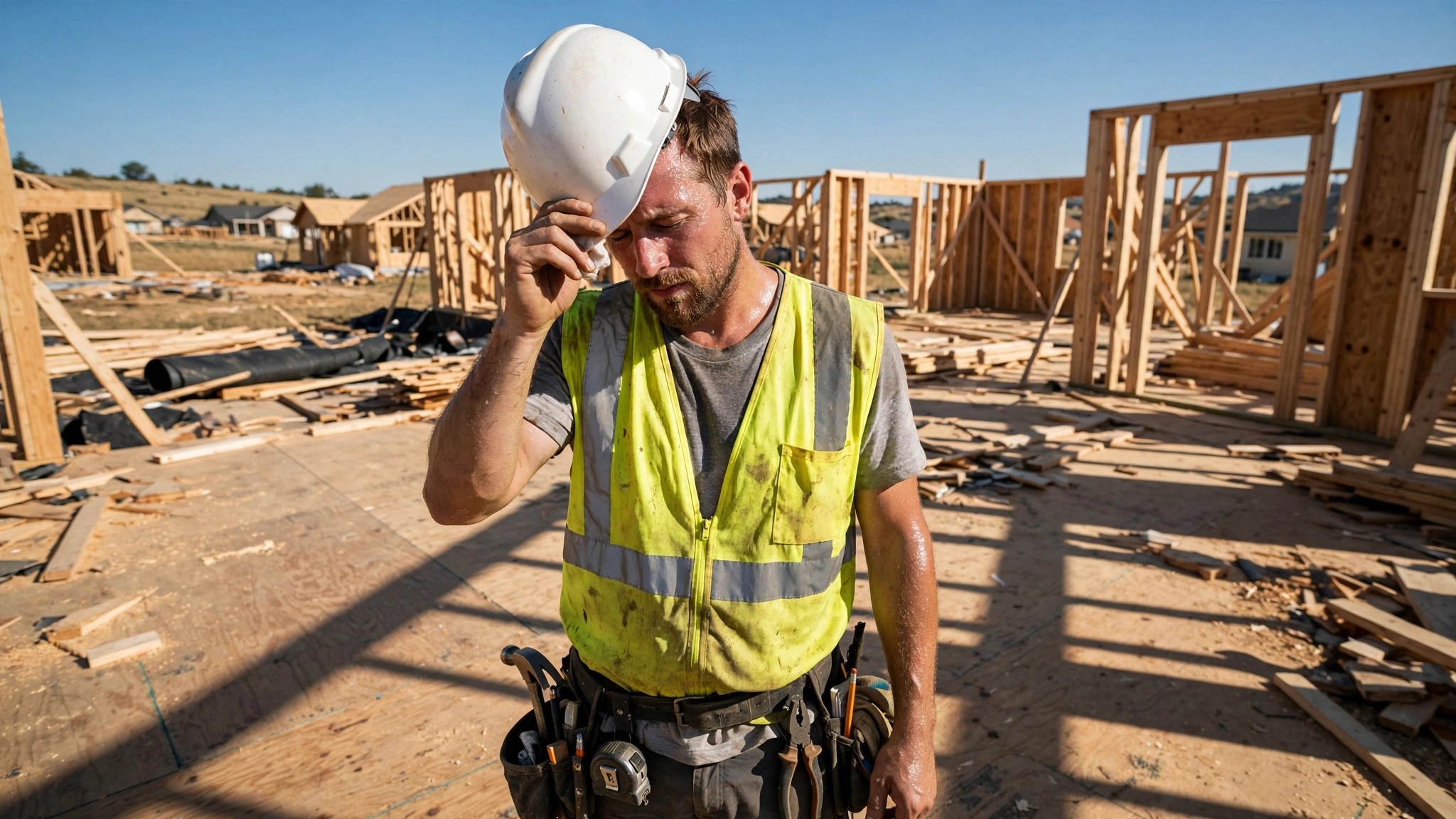
Construction workers absorb a grossly disproportionate share. CDC's National Institute for Occupational Safety and Health found that construction accounts for more than a third of all occupational heat deaths, with 285 construction workers killed by heat between 1992 and 2016. Seventy-five percent of those deaths occurred in June, July, and August.
You are reading this in July.
Five States Built the Standard. Forty-Five Didn't.
California adopted Section 3395 in 2006 and strengthened it in 2015. Washington State has had outdoor heat exposure rules since 2008, expanded in 2023. Oregon adopted heat illness prevention rules in 2022 after a heat dome killed more than 100 Oregonians in the summer of 2021, a catastrophe that made the regulatory cost-benefit analysis uncomfortably literal. Colorado and Minnesota enacted standards in 2024, bringing the total to five.
Every other state relies on OSHA's general duty clause, a catch-all provision from the Occupational Safety and Health Act of 1970 that requires employers to maintain workplaces "free from recognized hazards that are causing or likely to cause death or serious harm." No temperature thresholds, no required protocols, no specified rest intervals. An unnamed spokesperson from the Indiana Department of Labor summarized the situation to IndyStar with admirable concision: "Currently, there is no heat standard at the state or federal level."
Harvard's data measured whether this regulatory gap actually matters. It does.
On a 105°F day, the odds of a workplace injury increase by 16 percent in states without heat rules (odds ratio 1.16, 95% CI 1.11–1.21). In states with heat rules, the increase is 8 percent (OR 1.08, 95% CI 0.88–1.32). At 110°F, the gap widens: 22 percent (no rules) versus 9 percent (rules). California, Colorado, Oregon, and Washington, which account for the "rules" cohort in the study, still show elevated injury risk on extreme heat days because heat is genuinely dangerous. But they cut that risk nearly in half compared to states that rely on the general duty clause alone.
Half. With shade, water, rest breaks, and a buddy system. No algorithms required.
The Market Built the Standard OSHA Won't
While OSHA deliberates, the private sector is constructing a parallel safety infrastructure priced at $25 to $40 per worker per month.
Kenzen sells an arm-worn physiological sensor that monitors heart rate, activity, skin temperature, and ambient temperature to predict core body temperature. When the system detects a worker approaching heat stress, it vibrates on their arm, sends a phone alert, and notifies a supervisor dashboard, a system developed with $161,600 in DHS funding. Pipeline contractor Garney Construction has deployed it on a dozen jobsites. WakeCap, which raised a $28 million Series A in May 2025, offers a solar-powered helmet sensor that provides real-time location tracking, fall detection, and heat stress alerts for under $1 per worker per day. Soter Analytics, $12 million in funding, tracks spinal motion and ergonomic risk alongside heat exposure. Smart construction PPE is a $5.39 billion market in 2026, growing at 16.2 percent annually, according to The Business Research Company.
These tools work. Physiological heat monitoring rests on solid science; core body temperature prediction from wearable sensors has been validated in multiple field studies, including a 2025 feasibility study in the American Journal of Industrial Medicine that found multi-sensor wearable systems are "feasible for continuous heat strain monitoring and can support accurate prediction of heat-related risk." The engineering is solid.
The economics are not.
The Two-Tier System Nobody Talks About
A Kenzen subscription at $30 per worker per month costs $360 per worker per year. For a commercial general contractor running a 200-person crew on a $50 million data center project, that's $72,000 annually, which vanishes into a budget line labeled "safety technology" and is barely distinguishable from the cost of hard hats.
For a residential framing crew of eight workers building custom homes in Georgia, $360 per worker per year is $2,880 that comes directly out of the owner's margin on a business where net margins average 3 to 5 percent. NAHB reports that 85 percent of its member companies have fewer than 20 employees. These are the builders who set the trusses on your $400,000 house. They don't have safety technology budgets, and most lack dedicated safety officers.
What they have, in 45 states, is a vague obligation to keep the jobsite "free from recognized hazards" and a prayer that nobody collapses before the roof is dried in.
This is how a regulatory vacuum creates a two-tier safety system. Large commercial builders deploy sensor networks, predictive analytics, and dashboard-driven intervention because they can afford the technology and because their insurance carriers and project owners increasingly require it. Suffolk Construction, DPR, Garney, and their peers are building a privatized heat safety standard that exceeds anything OSHA has proposed. Small residential builders, who account for the majority of housing construction starts in the United States, have neither the technology nor the regulatory floor.
California's Section 3395 costs an employer approximately nothing in technology: a cooler of water, a shade structure, a written plan, and training. The proposed federal rule, if it ever sees a Federal Register with a final-rule header, would require the same. These are not burdensome interventions; they are the absolute minimum an employer can do for a worker whose labor involves standing on plywood sheathing in direct sun for eight hours in July.
What the General Duty Clause Actually Gets You
When a construction worker dies of heat on a jobsite in a state without a heat standard, OSHA investigates under the general duty clause. If the agency finds a violation, it issues a citation, and the fines tell the story.
In 2017, a Texas oil field worker complained of cramps and nausea while trying to clear two obstructed well holes. According to the OSHA citation, the employee was "encouraged to continue to work." He later died after experiencing convulsions, without receiving medical attention. OSHA issued fines totaling $21,367 to the employer, Patco Wireline Services, for three serious violations. All of them were later dropped in a settlement.
Twenty-one thousand dollars for a death, dropped in settlement.
Contrast this with California, where Cal/OSHA enforces Section 3395 with specific, measurable requirements. An employer who fails to provide shade at 80°F or cool-down rest at 95°F faces a citation for a specific regulatory violation, not a vague general-duty finding that defense attorneys can argue into oblivion. The standard's existence transforms the enforcement calculus: it is far harder to contest a citation for failing to provide shade at 82°F when the regulation says shade is required at 80°F than it is to argue about what constitutes a "recognized hazard" in the abstract.
What a Builder in the Other Forty-Five States Should Do Right Now
Don't wait for OSHA: a final rule may never materialize, and even if a future administration revives it, the rulemaking process has at least another year of legal procedure ahead of it. In the meantime:
Adopt California's Section 3395 triggers as your voluntary standard. At 80°F heat index, provide accessible shade. At 95°F, implement high-heat procedures: a designated observer, mandatory cool-down breaks of at least ten minutes every two hours, and pre-shift briefings on heat illness symptoms. These measures are free and proven — they cut heat injury risk nearly in half, according to the best available evidence.
If you want to go further, a basic heat monitoring system, even a WBGT meter at $150 and a simple work-rest schedule pinned to the job trailer wall, gives you actionable data without the subscription cost of a wearable platform. NIOSH's free Heat Safety Tool is a smartphone app that calculates real-time heat index from local weather data and recommends work-rest cycles. It is not a physiological monitor or a legal compliance system, but it is better than the current federal standard, which is nothing.
Document everything. If a heat-related injury occurs on your site, the single most important factor in how the resulting OSHA investigation, workers' compensation claim, or civil lawsuit resolves is whether you can demonstrate that you had a written heat illness prevention plan, that your workers were trained on it, and that you followed it. A builder with a documented prevention program and a $0 shade canopy is in a dramatically stronger legal position than a builder with a $360-per-worker sensor platform and no written plan.
Limitations
This analysis compares the regulatory terrain and available technology. I did not evaluate the clinical accuracy of any specific wearable heat monitoring product, and I did not independently verify vendor claims about false-positive rates, battery life under field conditions, or durability on active construction sites. The Harvard study's comparison between states with and without heat rules is ecological rather than causal: states that adopted heat rules may differ from non-adopting states in ways beyond the regulation itself, including climate, workforce demographics, and enforcement culture. OSHA's heat death statistics are acknowledged by the agency to be "vast underestimates" due to misclassification and underreporting, and the true toll remains unknown.
As of this writing, the proposed federal rule remains in limbo: neither finalized, withdrawn, nor officially stalled. That means the regulatory outlook could change rapidly in either direction. Nothing in this article constitutes legal advice about compliance with state or federal occupational safety requirements.
The Strongest Counterargument
Industry groups argue, not without some basis, that a one-size-fits-all federal heat standard fails to account for regional acclimatization. A roofer in Phoenix who has worked outdoors every summer for fifteen years has a different physiological response to 95°F than a newly hired laborer in Vermont encountering that temperature for the first time. The proposed rule's 80°F and 90°F triggers, critics say, would impose mandatory rest breaks on experienced workers in southern climates who neither need nor want them, reducing productivity and, in some cases, extending the workday into hotter afternoon hours because less work gets done in the morning break windows.
California's standard addresses this by requiring acclimatization procedures for new and returning workers but applying the shade and rest triggers to everyone. The evidence supports this approach: the CDC found that heat stress exceeded recognized exposure limits in all fourteen fatalities it investigated from 2011 to 2016, including experienced workers. Acclimatization reduces risk but does not eliminate it. And the workers most likely to downplay symptoms and refuse breaks are the experienced ones, because they believe they are immune, right up until the moment their core temperature crosses the threshold that separates discomfort from organ failure.
A heat standard named after a seventeen-year-old who died in a vineyard exists in one state. Five years of federal rulemaking have produced a docket, a hearing transcript, and a comment period. The rule itself does not exist. The workers it would protect do.