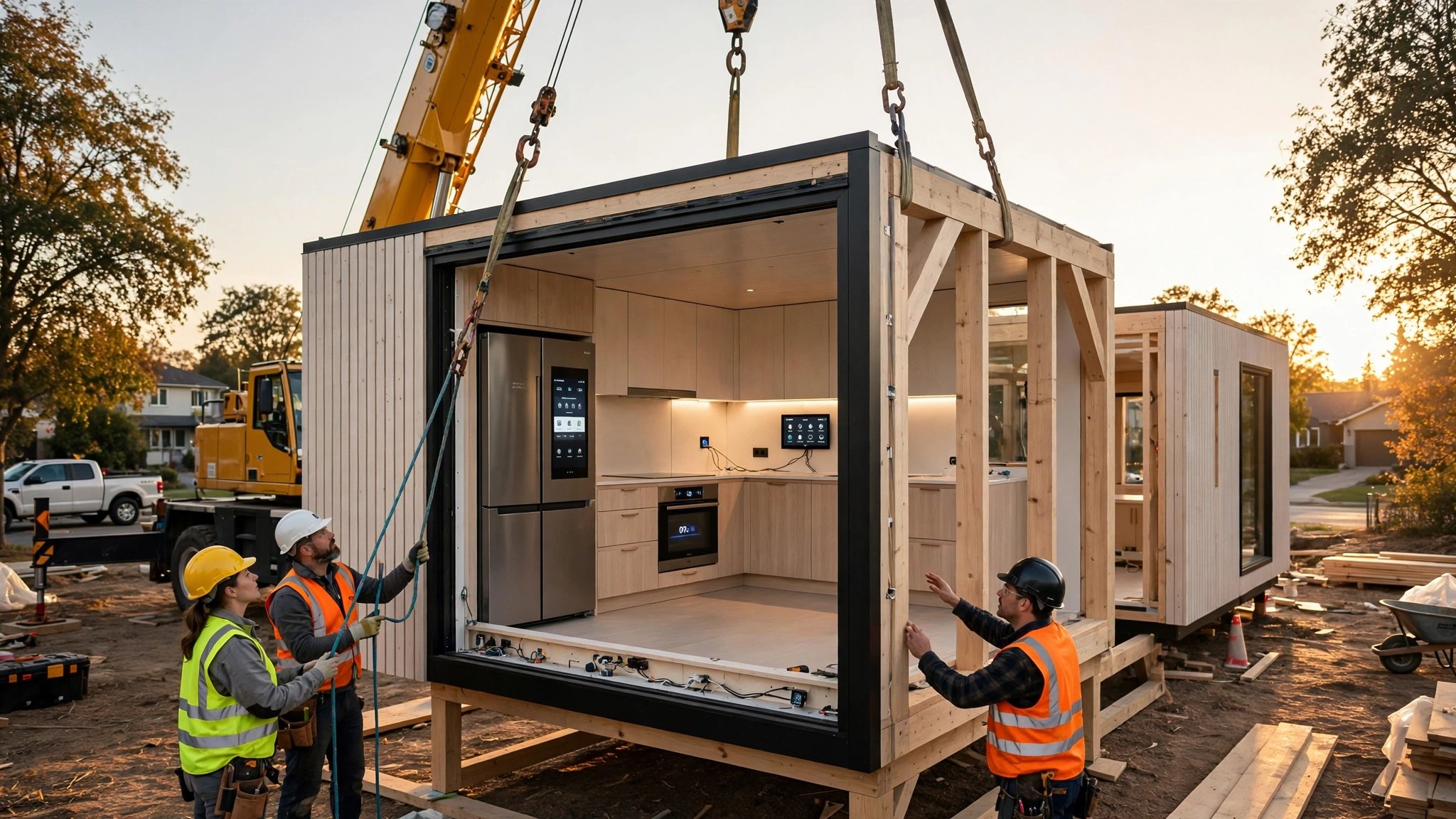
In a showroom outside Seoul, a 330-square-meter house sits on a concrete pad in Hwaseong, Gyeonggi Province, and it looks, from the street, like a Scandinavian weekend retreat: timber walls, a pitched roof, the kind of proportions that suggest somebody cared about proportion. Walk inside and the architecture disappears — every surface belongs to Samsung. A refrigerator was placed before the cabinetry was drawn around it, air conditioning vents were routed before walls were framed, and twenty-three networked devices, from smart door locks to ceiling-mounted cameras, were installed and registered to SmartThings while the house was still a stack of panels in a Gonggan Jejakso factory, before it had an address or a foundation or a family to live in it.
This is Samsung's AI Modular Home, launched in June 2026 for direct sale to individual consumers, not a concept sketch or an IFA demo. You can order one in sizes from 33 to 132 square meters, roughly 355 to 1,421 square feet, and a factory that produces 1,700 modular units a year using AI-based architectural design and robotic assembly will build eighty percent of it before a truck arrives at your lot.
Samsung is not alone in this bet: LG Electronics launched its Smart Cottage line a year earlier and in October added the MONO Core 27, a 27-square-meter open-plan unit at 100 million won, roughly $72,000, that arrives with an LG air conditioner, LG refrigerator, LG washing machine, LG induction cooktop, and four IoT devices all pre-wired and connected through ThinQ before the buyer has chosen a curtain color. Half what the previous model cost. LG has since opened its catalog to individual consumers after initially selling only to corporate training centers and campground operators.
Architecture in Reverse
For as long as residential construction has existed, the sequence has been clear: an architect designs the space, a builder constructs the envelope, and a homeowner fills it with furniture and appliances chosen after move-in from whatever brand they prefer. Samsung and LG propose something altogether different, a process where the appliance ecosystem comes first and the architecture arranges itself around the product catalog, the way a phone case is designed around the phone rather than the hand that holds it.
Consider Samsung's showroom. A SmartThings 3D Map View panel greets visitors at the entrance, not a foyer table or a window framing the garden but a screen, and the kitchen was arranged so that the Bespoke AI refrigerator occupies the primary sight line from the living area, and the bedroom features an air conditioner calibrated by Samsung's AI to the room's exact cubic volume, a level of machine-to-room integration that traditional builders achieve only by accident, if they achieve it at all. When you ask where the design intent resides, the answer is the network diagram. Rooms serve it; bedrooms happen to exist nearby.
LG's approach is subtler but arrives at the same inversion. Its Therma V Monobloc air-to-water heat pump is not an aftermarket upgrade but the cottage's circulatory system, designed into the thermal envelope at the factory stage, and the washing machine lives in a room proportioned to its exact footprint, meaning that if LG redesigns the WashTower Compact next year, the room dimensions in next year's cottage will shift to match. Buildings following product cycles, not the reverse.
A Different Direction of Travel
This matters because we have already watched the opposite experiment fail spectacularly, expensively, and instructively. Katerra raised more than $2 billion to transform residential construction by building its own factories, its own supply chains, even its own cross-laminated timber plant capable of producing ten percent of the world's CLT supply, and it employed 7,500 people across a dozen countries, planned fourteen distribution centers, and filed for Chapter 11 in 2021 without ever mastering the production of a single building type at a cost that worked. Veev, a Bay Area modular unicorn backed by roughly $1 billion in venture capital, managed 170 units in fifteen years before shuttering its U.S. operations entirely. Both were construction companies trying to become manufacturers, and both failed because manufacturing discipline, the relentless, unsexy work of running a factory floor at less than one percent defect rate through supply chain shocks and labor disputes and quality excursions that threaten to cascade into recalls, was the capability they did not have and could not buy.
Samsung and LG are traveling in the opposite direction, and the distinction is not academic. Samsung runs semiconductor fabs where a single contamination event can destroy millions of dollars in wafers; its defect tolerance is measured in parts per billion. Its €1.5 billion acquisition of FläktGroup, a German HVAC systems manufacturer, signals that Samsung is not content to supply appliances into someone else's building but wants to control the climate system too, extending vertical integration from the chip to the compressor to the wall that houses it. LG has climbed to the world's fifth-largest HVAC manufacturer by revenue. These are companies that already know how to run factories. Walls and roofs are the addition, not the core.
Crucially, neither company is building from scratch. Samsung partnered with Gonggan Jejakso, a Korean timber modular specialist already producing at scale, and LG assembled its cottage line through existing prefab supply chains rather than constructing greenfield facilities. What Volumetric Building Companies CEO Vaughan Buckley observed after acquiring Katerra's California factory applies directly here: "We can do it because we are doing it." Samsung and LG are not trying to learn construction from first principles; they are bolting construction onto manufacturing, and the ambition is bounded in a way that Katerra's boil-the-ocean posture never managed.
What the Numbers Actually Say
Decomposing LG's pricing reveals what an appliance-first home really costs. At approximately $72,000 all-in for the MONO Core 27, the price bundles structure, HVAC, and a full appliance suite into a single figure. Estimating the retail value of included LG appliances, an air conditioner at roughly $3,000, a refrigerator at $2,500, a washing machine at $1,500, an induction cooktop at $1,200, a smart boiler at $800, and IoT peripherals at $600, yields an appliance layer worth approximately $9,600, which means roughly $62,400 remains for the structure itself: about $215 per square foot.
For context, US Census Bureau Survey of Construction data puts the median per-square-foot construction cost for a new single-family home, excluding land, between $150 and $200, and LG's structure-only figure lands slightly above that band but includes factory-finished HVAC, insulation, and a thermally sealed envelope that most stick-built homes must install piecemeal at the job site. An imperfect comparison, certainly, given that Korean labor costs, material pricing, and building codes differ substantially from U.S. conditions, but it suggests that the modular premium is not the structure. Appliances represent roughly thirteen percent of total unit cost. Buying them separately at retail would likely cost more than what LG charges to factory-integrate them, a margin advantage that only a manufacturer selling into its own building can capture.
Broader market conditions support the timing. Mordor Intelligence values the U.S. prefabricated buildings market at $41.45 billion in 2025, growing at 6.67 percent annually toward $61 billion by 2031, with residential applications holding a 42.45 percent share. Samsung VP Park Chan-woo noted at IFA 2025 that seven percent of German homes and up to forty percent of Nordic homes are already modular. Not fringe numbers, but market penetration at a level that makes a Samsung or LG product launch rational rather than speculative.
What Gets Lost When Factories Design Houses
An architect designs for the occupant: how light will enter a room at three in the afternoon, where a child will spread homework across a table, how a couple will move through the kitchen when both are cooking and neither wants to collide at the island. A manufacturer designs for the assembly line: how many SKUs the module requires, what tolerances the robot can hold, which configuration minimizes shipping damage during a 200-kilometer truck haul from the Hwaseong factory to a lot in Gangnam. Both are legitimate design logics, yet they are not the same logic, and pretending otherwise produces homes that function without resonating, spaces where every measurement is correct and no measurement is generous.
Samsung's Hwaseong showroom reveals the tension. By any conventional architectural standard, the living room is pleasant enough, with clean sightlines, natural timber, and competent proportions, yet the spatial hierarchy is wrong in a way that takes a moment to identify, like a portrait where the eyes are a millimeter too close together. A SmartThings panel commands the entry the way a hearth once did. An AI-calibrated air conditioner occupies a master bedroom wall with the visual authority of a headboard. These are not incidental placements but what a floor plan looks like when it serves a network diagram rather than an inhabitant. Anyone who has lived in a home where the television was the first object placed and every other piece of furniture orbits it will recognize the feeling immediately.
Here is the strongest counterargument, and it deserves full volume: this criticism is romantic, and most new American homes are not designed by architects at all but drawn by production builders working from plan libraries, and the result is a kitchen island facing a great room arranged for a television that has not yet been purchased, which is not meaningfully different from Samsung pre-installing the screen and building the room around it. If the baseline is a tract house in Frisco, Texas, Samsung's approach may actually be more coherent, because at least the devices and the architecture were designed together, which is more than you can say for most subdivision homes where the smart thermostat was an afterthought screwed into a wall that was never wired for it. Coherent mediocrity still beats incoherent mediocrity. Whether it counts as architecture is a different question, and one that most buyers never ask.
What This Means If You Are Building or Buying
Neither Samsung nor LG has announced U.S. sales. Samsung's global commercialization plans, discussed at IFA 2025, reference European partnerships with construction companies and energy firms while targeting the Korean domestic market first. But the direction is unmistakable, and both companies maintain extensive American distribution networks for their existing product lines, and the U.S. prefabricated market is already the largest in the world. If Korean pilots succeed, the question for American homebuyers shifts from "which appliances do I want?" to "which ecosystem do I want to live inside?"
For builders and developers evaluating modular partnerships, the Samsung/LG entry changes the risk calculus in both directions simultaneously. A modular partner backed by a $230 billion consumer electronics conglomerate carries different counterparty risk than a venture-backed startup burning through its Series C, and the manufacturing discipline is real, as is the HVAC vertical integration that neither Katerra nor Veev ever achieved. But the design constraint is equally real. A Samsung modular home is a Samsung home, built on their platform, subject to their product cycles, their device compatibility decisions, and their SmartThings roadmap. If SmartThings deprecates a protocol, your walls are the ones that notice.
This analysis relies on Korean market pricing and cannot be directly extrapolated to U.S. construction costs, labor markets, or building codes, all of which would significantly affect unit economics. Appliance valuations use approximate U.S. retail prices for comparable LG products and do not account for Samsung's internal transfer pricing. No third-party post-occupancy evaluation exists for either product, no customer satisfaction data is publicly available, and Space Factory (Gonggan Jejakso)'s production volume of 1,700 modular units per year represents Korean domestic capacity only. U.S. manufacturing infrastructure for these products does not yet exist. Katerra and Veev comparisons are instructive but structurally different: both were standalone companies whose failures reflected capital structure and governance failures alongside operational ones, and applying their lessons to Samsung or LG requires acknowledging that the companies' risk profiles, balance sheets, and manufacturing histories are fundamentally different animals.